
Rasn Yast
The Avestan Hymn to ‘Justice’
By (author) Leon Goldman

Hardback (Published)
(September 2015)
ISBN: 9783954901081
6.69 x 9.45 inches
Price: $104.00
On back order
This book contains a critical edition of the Avestan language composition known as the Rašn Yašt, or ‘Hymn to Justice’. The text is accompanied by an English translation, philological commentary and glossary. In addition, the main themes of the Rašn Yašt are taken up for detailed discussion, covering the Zoroastrian deity Rašnu, ancient Iranian cosmography, and the use of ordeal rituals in pre-Islamic Iran. <br/>
For the first time, this work treats in a comprehensive manner the Rasn Yast, or ‘Hymn to Justice’. The Rasn Yast stands in praise of the Zoroastrian deity Rasnu ‘Justice’ and belongs to the group of religious texts known as the Avesta – a collection of compositions in the ancient Iranian language of Avestan. Although the Rasn Yast, like all of the Avesta, is generally assumed to have been committed to writing either during or shortly after the Sasanian era (224-651 CE.), its verses were probably composed during the early first millennium BCE. The present monograph contains an English translation of the Rasn Yast supported by a critical edition of the Avestan text. The latter is based on the testimony of thirteen manuscripts, of which nine were newly collated. Variant readings from the manuscripts are recorded in a detailed and easy to read apparatus. Matters of a philological or text critical nature are taken up for discussion in an accompanying commentary and all forms appearing in the Rasn Yast are parsed in the text’s glossary. In addition, this book includes three introductory chapters that aim to elucidate the key themes of the Rasn Yast. The first chapter concerns the titular divinity Rasnu and explores his role as a judicial figure, both in this world and the hereafter. The second chapter explicates the cosmographic scheme which is uniquely preserved in the Hymn to Justice and argues this map of the universe encodes numerical and spatial patterns. The third chapter draws upon Avestan and Middle Persian sources to give an in depth account of the use of ordeal rituals in ancient Iran – a practice with which Rasnu is intimately associated and which is repeatedly mentioned in the Rasn Yast. This work is intended for specialist and more general audiences alike, and is principally aimed at those with interests in Indo-Iranian philology, Zoroastrianism, ancient Iran and comparative religion.
- By (author) Leon Goldman
"Goldman's Rasn Yast is without doubt the new standard edition to consult for anyone working with material from Y12. Thanks to the extended introductory remarks in section 1, the book may also function as a point of entry to the Yast genre in general. Indeed the fact that most of the philological arguments are spelled out at lenght makes the book accessible for non-specialists as well." Benedikt Peschl (Ludwig-Maximilians-Universitat Munchen), Indo-Iranian Journal 60 (2017) 285-301
—
„Goldman’s Rasn Yast is without doubt the new standard edition to consult for anyone working with material from Y12. Thanks to the extended introductory remarks in section 1, the book may also function as a point of entry to the Yast genre in general. Indeed the fact that most of the philological arguments are spelled out at lenght makes the book accessible for non-specialists as well.“<br/><br/>Von: Benedikt Peschl (Ludwig-Maximilians-Universität München)<br/>In: Indo-Iranian Journal 60 (2017) 285-301.
—
Other Titles in this Series
 Zarathushtra entre l’Inde et l’Iran
Études indo-iraniennes et indo-européenes offertes à Jean Kellens à l’occasion de son 65e anniversaire


 Literarische Stoffe und ihre Gestaltung in mitteliranischer Zeit
Kolloquium anlässlich des 70. Geburtstages von Werner Sundermann

 Proceedings of the Third European Conference of Iranian Studies
Held in Cambridge, 11th to 15th September 1995. Old and Middle Iranian Studies


 Vafsi Folk Tales
Twenty Four Folk Tales in the Gurchani Dialect of Vafsi as Narrated by Ghazanfar Mahmudi and Mashdi Mahdi and Collected by Lawrence P. Elwell-Sutton


 Proceedings of the Third European Conference of Iranian Studies
Held in Cambridge, 11th to 15th September 1999. Mediaeval and Modern Persian


 Tabous, interdits et obligations de langage en Afghanistan
Éléments du vocabulaire de la vie privée en terre d’Islam


Similar Books


 Cities through Time
Glimpses into Urbanity and Community in Mediaeval to Modern West Asia and Egypt
Volume 1
 Cuneiform Artefacts from Archaeological Contexts: New Research on Ancient Iraq
Proceedings of a Conference Held at the Bavarian Academy of Sciences and Humanities, July 4–5, 2024
Volume 2
 Des mots aux actes
Traduction épistémique et littéraire. Nouvelles tendances en histoire et didactique
Volume 15


 Global Gulf
Geo-Economic, Geo-Political, and Geo-Technological Transformation in Saudi Arabia, the United Arab Emirates, and Qatar


 Ismail Hakki Bursevi’s translation of and commentary on Fusus al-Hikam By Muhyiddin Ibn ‘Arabi
Volumes 1-4


 Monastic Manuscripts from the Eastern Mediterranean (Sinai, Jerusalem, Antioch)
Production, Use, and Contexts


 Punning in Odd or Elegant Constructions in Jeremiah
The Convergence of Linguistics, Rhetoric, and Textuality in the Hebrew Text of Jeremiah
 Qatar’s Societal Security
Towards the Inclusive National Concept of ‘Baladna’ Identity, Migration and External Threats Since 2017


 The Biblical Tale of Judah and Tamar in Fourteenth-Century Iran
A Judeo-Persian Versified Account by Shāhīn with Scholarly Edition, Annotated Translation and Persian Transliteration
Volume 94, 951
 The Discourse of Rites
Shaping and Reshaping the (Counter-)Priestly Rituals Conducted Outside the Tabernacle



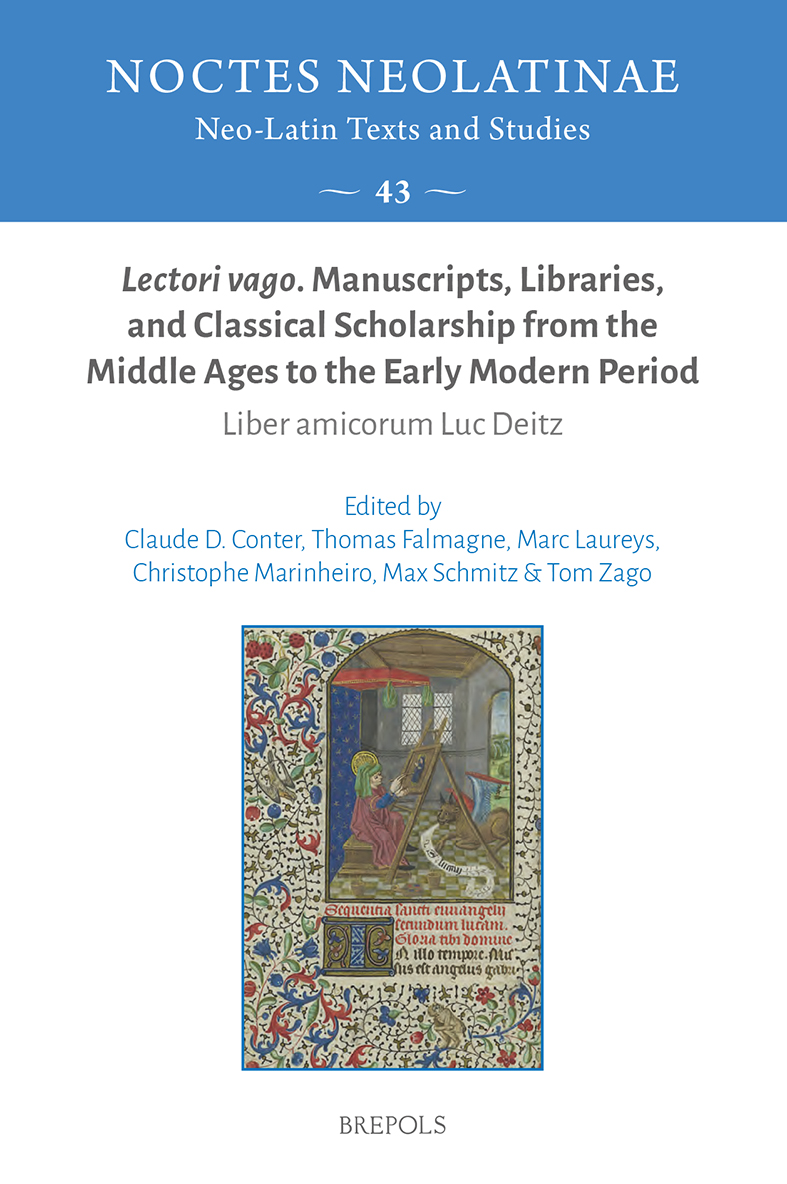 Lectori vago. Manuscripts, Libraries, and Classical Scholarship from the Middle Ages to the Early Modern Period
Liber amicorum Luc Deitz
Volume 43


 »Ein elend-schönes Land«
Gattung und Gedächtnis in Lea Goldbergs hebräischer Literatur. Aus dem Hebräischen von Rainer Wenzel

