
Interreligious Learning
Edited by D. Pollefeyt

The growth of secularisation, pluralism and globalisation have placed the West’s traditional monoreligious education under pressure. Christianity no longer possesses a privileged position in Western Europe. Since the 1970’s, a number of scholars have been trying to formulate an answer to this question of multireligiosity by developing a multireligious concept of religious education. As both a critique on, and alternative for, the multireligious model, scholars in the 1990s developed the interreligious model of religious education. This aproach distinguishes itself from monoreligious pedagogy through acknowledging plurality among the pupils as both a part of departure and as a possible end result of religious education. Moreover, it openly approaches the plurality of religions and worldviews as a learning opportunity. Religious education thus becomes a place of encounter and dialogue between different religious convictions. Interreligious learning further distinguishes itself from the multireligious model by overcoming a purely objective representation of the multitude of religions. In the interreligious model, students are not only informed, but are introduced to the cognitive and value commitments underlying the different religions, giving them the opportunity to enrich and develop their own personal religious identity. The teacher takes an explicit and particular religious (Christian) standpoint, but also tries to bring in other committed religious and philosophical voices. The interreligious model aims to teach students that holding a proper religious identity while having an openness to the religious other is not necessarily self-contradictory. What is more, that authentic religiosity is able to welcome the other in his/her vulnerability and strength as a witness to God. In this volume, scholars from various disciplines (theology, pedagogy, psychology and ethics) and from different religious backgrounds (Jews, Christians and Muslims) face up to a total of ten challenges related to interreligious learning. Challenges that may act as obstacles to the acceptance of this possible new paradigm for religious education.
- Edited by D. Pollefeyt
Other Titles in this Series

 Florilegium Lovaniense
Studies in Septuagint and Textual Criticism in Honour of FlorentinoGarcía Martínez
Volume 224
 Analyse narrative et Bible
Deuxième colloque international du RRENAB, Louvain-la-Neuve, avril2004
Volume 191


 Half-Truths
The Irish College, Rome, and a Select History of the Catholic Church, 1771-1826
Volume 322


 Des communautés nouvelles dans le catholicisme contemporain
Innovations, réinventions, ruptures et régulations
Volume 345
 Writing, Rewriting, and Overwriting in the Books of Deuteronomy and the Former Prophets
Essays in Honor of Cynthia Edenburg
Volume 304

 The Belgian Contribution to the Second Vatican Council
International Research Conference at Mechelen, Leuven andLouvain-la-Neuve (September 12-16, 2005)
Volume 216

 Éléments d’une théologie fondamentale de la création artistique
Les écrits théologiques sur l'art chez Karl Rahner (1954-1983)
Volume 307


 Polycarpiana
Studies on Martyrdom and Persecution in Early Christianity. Collected Essays
Volume 205
 Fading Frontiers?
A Historical-Theological Investigation into the Notion of the 'Elementa Ecclesiae'
Volume 321

 Virtuelle Vergangenheit
Die Textrekonstruktion einer verlorenen mittelniederländischenEvangelienharmonie. Die Handschrift Utrecht Universitätsbibliothek 1009
Volume 210
 The Holy Spirit, The Church, and Christian Unity
Proceedings of the Consultation Held at the Monastery of Bose, Italy(14-20 October 2002)
Volume 181

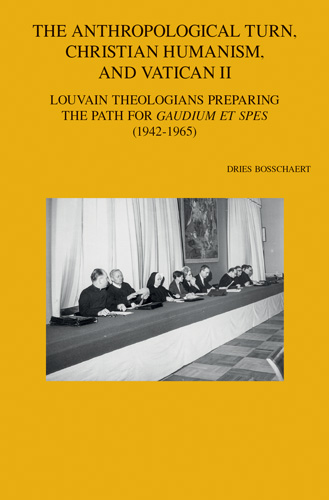 The Anthropological Turn, Christian Humanism, and Vatican II
Louvain Theologians Preparing the Path for 'Gaudium et spes'(1942-1965)
Volume 303
Similar Books
 ‘For You I Study, For You I Work, For You I Live, For You I Am Ready To Even Give My Life’
Essays in Honour of Francis (Frank) J Moloney, SDB

 A Connecting Polemic in the Medieval Mediterranean
The Correspondence of Leo III and ʿUmar II
Volume 6





 Ars Prophetica
Theology in the Poetry of Twentieth-Century Hebrew Poets Avraham Halfi, Shin Shalom, Amir Gilboa, and T. Carmi
 As Messianism Turns to Heresy
The Regenstein Chair Lectures On Lurianic Kabbalah and Shabbatai Tzevi at Hebrew Union College - Cincinnati



 Beyond Sovereign Courts
Agents and Practices in Early Modern Spanish and Habsburg Diplomacy
Volume 3


 Creating the Woman in Antiquity
Proceedings of the 16th Melammu Workshop, Innsbruck, 2–3 June 2022
Volume 13
 Cultic Kisses
Fruitful Encounters Between Deities and Humans. Festschrift for Angelika Berlejung on the Occasion of Her 65th Birthday

 De/colonizing Theologies
Glocal Histories, Contemporary Challenges, Theoretical Reflections
Volume 4
 Drunk the Potion, No Whit Charmed
The Doctrine of Pure and Perfect Souls from Iamblichus to Damascius




 Extracanonical Traditions and the Holy Land
Texts, Rituals, and Material Culture in Late Antique Palestine

 Fear, Fear of God, God-Fearers
Philological and Historical Perspectives on the World of Ancient Judaism and Christianity


