
The Political Ethics of Jean-François Lyotard and Jacques Derrida
By (author) G. De Schrijver

A genuine political ethics seems to require a universal perspective, and yet we are told that the postmodern age eschews universal perspectives. In this book, Georges De Schrijver argues that the leading proponents of postmodernity have not, as is commonly assumed, abandoned the search for universals. Rather they have sought to reshape the concept in ways that account for postmodernity’s critique. Examining the thought of both Jean-Francois Lyotard, who prophesies the end of the grand stories, and Jacques Derrida, the leading proponent of deconstruction, De Schrijver comes to the conclusion that each, in his turn, is still in search of the universal. Taking his lead from Kant’s unpresentable Idea, Lyotard holds out hope for a universal expressed through respect for heterogeneity, whereas Derrida arrives at this impossible dream through a critical study of Husserl’s phenomenology. The common bond for Lyotard and Derrida is their quest of the unpresentable. For Lyotard, this comes through a sublime sadness urging him to side with the silenced party in legal disputes. For Derrida, the same quest is expressed through a yearning for the impossible things to come: a justice that goes beyond legality, a reshaping of the international juridical order, and a hospitality that is truly unconditional in its reach. Underlying the thought of both men is a profound appreciation for their Jewish ethical inheritance, an appreciation they learn from Emmanuel Levinas. In passing judgment on the new world order, both authors go decidedly beyond Kant – and thus beyond modernity – in reaching for a truly transcultural perspective in this era of globalization.
- By (author) G. De Schrijver
Other Titles in this Series

 Un livre de feu dans un siècle de fer
Les lectures de l'Apocalypse dans la littérature française de la Renaissance
Volume 220

 La structure ontologique-communionnelle de la personne
Aux sources théologiques et philosophiques du père Dumitru Staniloae
Volume 315


 Penser la tradition avec Walter Kasper
Pertinence d'une catholicité historiquement et culturellementouverte
Volume 259


 Kindness, Courage, and Integrity in Biblical Texts and in the Politics of Biblical Interpretation
Festschrift Reimund Bieringer
Volume 333
 Theological Renewal and the Resurgence of Integrism
The René Draguet Case (1942) in Its Context
Volume 266

 New Studies in the Synoptic Problem. Oxford Conference, April 2008
Essays in Honour of Christopher M. Tuckett
Volume 239


 Le Récit: Thèmes bibliques et variations
Lectures et réécritures littéraires et artistiques. VIIIe Colloqueinternational du RRENAB: Metz, 26-29 Mai 2016
Volume 293
 The Normativity of History
Theological Truth and Tradition in the Tension between Church History and Systematic Theology
Volume 282

 L’Europe de l’exégèse au XVIe siècle
Interprétations de la parabole des ouvriers à la vigne (Matthieu20,1-16)
Volume 174


Similar Books


 Des mots aux actes
Traduction épistémique et littéraire. Nouvelles tendances en histoire et didactique
Volume 15


 Drunk the Potion, No Whit Charmed
The Doctrine of Pure and Perfect Souls from Iamblichus to Damascius


 Libertinage et philosophie à l’époque classique (XVIe-XVIIIe siècle)
Athéisme, Modernité et Sécularisation / Atheism, Modernity and Secularization
Volume 23


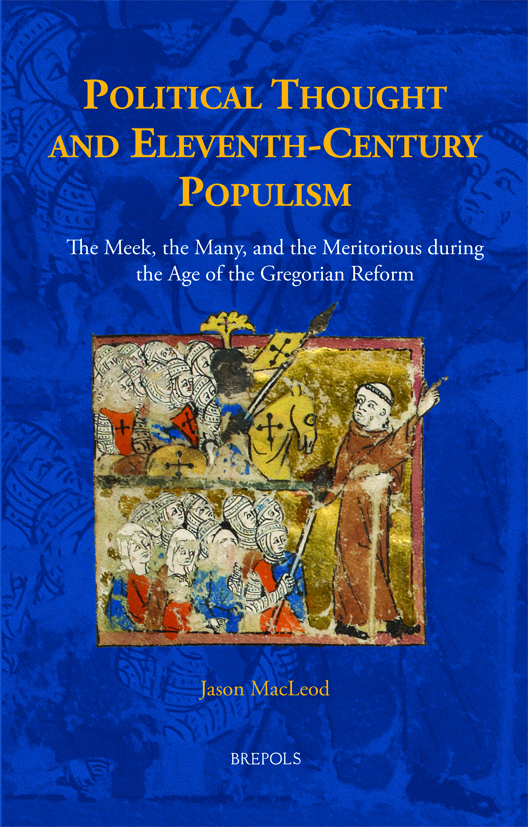 Political Thought and Eleventh-Century Populism
The Meek, the Many, and the Meritorious during the Age of the Gregorian Reform
Volume 38
 Punning in Odd or Elegant Constructions in Jeremiah
The Convergence of Linguistics, Rhetoric, and Textuality in the Hebrew Text of Jeremiah


 The Latin Hermes in Translation
Asclepius, Glosses on Trismegistus, Book of Six Principles of Things, Book of 24 Philosophers
Volume 50


![Book cover: Transitive Media [Philosophy]](https://isd.stisonbooks.com/images/books/native/9781804132333.jpg?asset_id=66970)


 Lectori vago. Manuscripts, Libraries, and Classical Scholarship from the Middle Ages to the Early Modern Period
Liber amicorum Luc Deitz
Volume 43
