
Temporal Dimensions of the Apocalypse
Ancient Christian Reception and Contemporary Hermeneutical Reflections
By (author) Bohdan Kuryliak

Paperback (Published)
(October 2026)
ISBN: 9783162002785
6.1 x 9.13 inches
Price: $164.00
On back order
Bohdan Kuryliak examines the book of Revelation through four approaches: preterism, idealism, historicism, and futurism. Drawing on careful exegesis and ancient Christian reception history, he argues that historicism’s ability to combine past, present, and future offers an integrative framework for understanding the Apocalypse’s prophetic imagery.
Bohdan Kuryliak examines the book of Revelation through four interpretive approaches: preterism, idealism, historicism, and futurism. Drawing on a synthesis of close biblical exegesis and early Christian reception history (second to seventh centuries), he analyzes key temporal markers and disputed passages, ranging from the vision of the seals to the millennium. The author challenges the tendency to confine the text’s symbolic richness to a single framework, showing that early Christian interpreters often blended these perspectives by combining past, present, and future dimensions. By grounding this synthesis in the text itself, he proposes historicism as an integrative model that incorporates the temporal insights of the other three approaches. The author thus offers a renewed hermeneutical pathway for navigating Revelation’s complex temporal landscape.
1. Introduction
2. Interpretive Issues in the Book of Revelation: The Temporal Dimensions
2.1. Temporal Markers of the Apocalypse
2.2. Seven Seals (Revelation 6:1-8:1)
2.3. Seven Trumpets (Revelation 8:7-11:19)
2.4. Dragon and the Beasts (Revelation 12-13)
2.5. Babylon the Whore (Revelation 17)
2.6. Millennial Kingdom (Revelation 20)
2.7. Conclusions
3. Temporal Dimensions in the Reception of the Book of Revelation (ca. 2nd-7th Centuries)
3.1. Early Revelation's Reception (ca. 2nd-3rd Centuries)
3.2. Later Revelation's Reception (ca. 4th-7th Centuries)
3.3. Conclusions
4. The Panorama of Hermeneutical Approaches
4.1. Temporal Markers of the Apocalypse
4.2. Preterist Approach
4.3. Idealist Approach
4.4. Historicist Approach
4.5. Futurist Approach
4.6. Conclusions
5. Conclusions
Born 1991; 2025 PhD (University of Zurich); Postdoctoral Researcher (University of Zurich); Associate Professor of New Testament (Ukrainian Institute of Arts and Sciences).
- By (author) Bohdan Kuryliak
Other Titles in this Series
 Jesaja 53 als theologische Mitte der Apostelgeschichte
Studien zu ihrer Christologie und Ekklesiologie im Anschluss an Apg 8,26-40
Volume 398

 Luke-Acts and Jewish Historiography
A Study on the Theology, Literature, and Ideology of Luke-Acts
Volume 366


 Jesus’ Transfiguration and the Believers’ Transformation
A Study of the Transfiguration and Its Development in Early Christian Writings
Volume 265
 Jesus, the Tribulation, and the End of the Exile
Restoration Eschatology and the Origin of the Atonement
Volume 204


 Communal Participation in the Spirit
The Corinthian Correspondence in Light of Early Jewish Mysticism in the Dead Sea Scrolls
Volume 575

 Portraits of Paul’s Performance in the Book of Acts
Luke's Apologetic Strategy in the Depiction of Paul as Messenger of God
Volume 556
 The Doubt of the Apostles and the Resurrection Faith of the Early Church
The Post-Resurrection Appearance Stories of the Gospels in Ancient Reception and Modern Debate
Volume 495
 Semantik und Ethik des Wortfeldes ‘Ergon’ im Johannesevangelium
Kontexte und Normen neutestamentlicher Ethik / Contexts and Norms of New Testament Ethics, Band VIII
Volume 431
 Der Hohepunkt des Hebraerbriefs
Hebraer 12,18-29 und seine Bedeutung fur die Struktur und die Theologie des Hebraerbriefs
Volume 463

 Peter – Apocalyptic Seer
The Influence of the Apocalypse Genre on Matthew's Portrayal of Peter
Volume 348

 Spirits and the Proclamation of Christ
1 Peter 3:18-22 in Light of Sin and Punishment Traditions in Early Jewish and Christian Literature
Volume 305


 Jesus as the Eschatological Davidic Shepherd
Studies in the Old Testament, Second Temple Judaism, and in the Gospel of Matthew
Volume 216
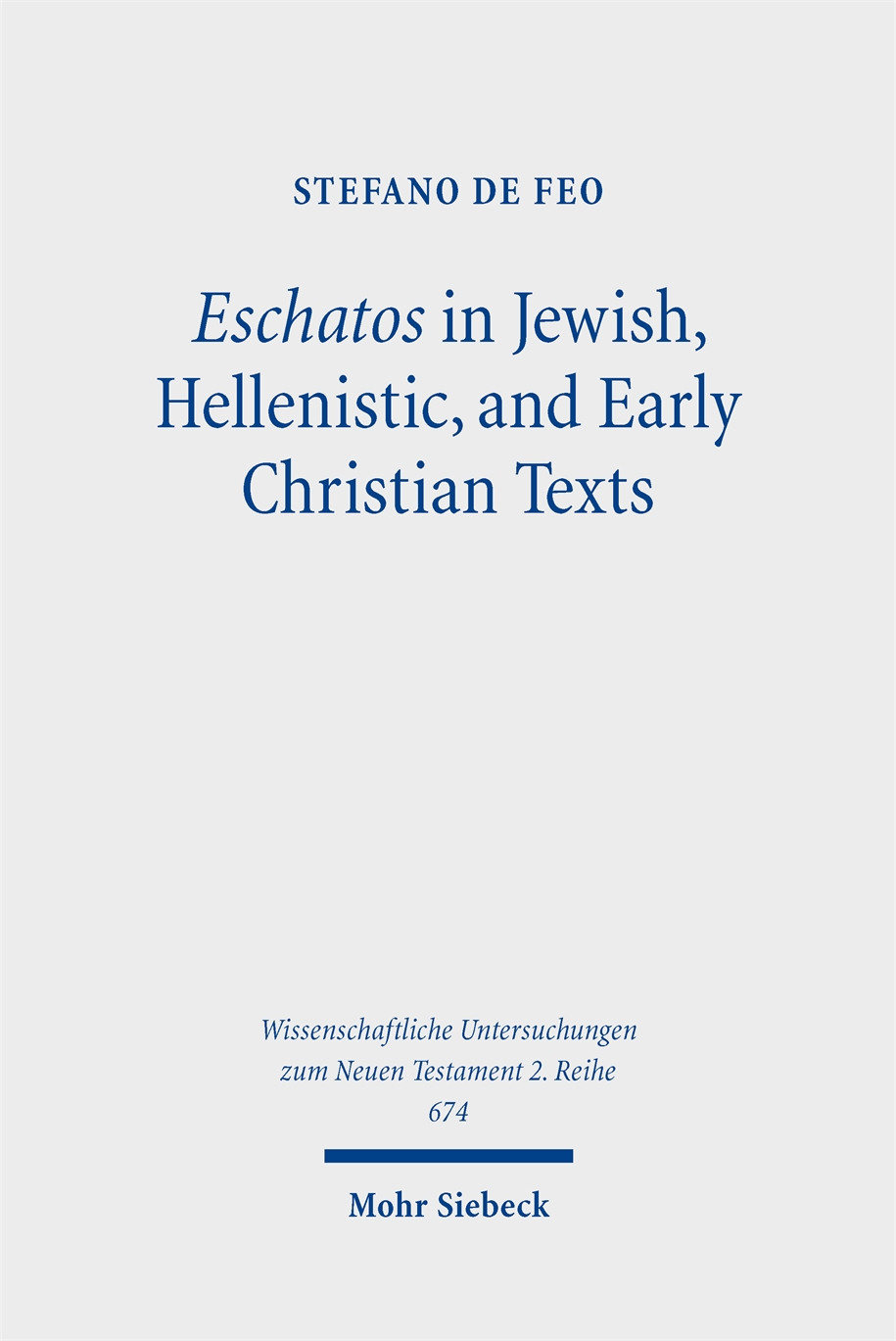 Eschatos in Jewish, Hellenistic, and Early Christian Texts
A Diachronic Analysis (3rd cent. BCE – 1st cent. CE)
 Der verborgene Vater im Matthausevangelium
Ein Beitrag zum Gottesbild und zur Gebetstheologie von Mt 6,1-6.16-18
Volume 617
 Intercession of Jesus in Hebrews
The Background and Nature of Jesus' Heavenly Intercession in the Epistle to the Hebrews
Volume 585


 Participation, Justification, and Conversion
Eastern Orthodox Interpretation of Paul and the Debate between Old and New Perspectives on Paul
Volume 442
 The Divine Voice in Paul’s Letters
The Use of Scripture as Theopoiesis and Paul’s Characterization of God
Similar Books


 Apocrypha, Magic, Liturgy
The Multiple Identities of Coptic Prayers in Late Antique and Early Islamic Egypt
 Athanasius of Alexandria, Epistula ad episcopos Aegypti et Libyae
Old Slavonic Version and English Translation
Volume 261



 Contesting Labeled Identities
The Sociology of Gentilics in Biblical and Northwest Semitic Literature

 Cyril of Alexandria’s Christological Exegesis
Explorations of Partitive Exegesis in the Dialogues on the Trinity
Volume 70


 Epiphanies of the Divine in the Septuagint and the New Testament
Fifth International Symposium of the Corpus Judaeo-Hellenisticum Novi Testamenti (CJHNT), 14-17 May 2015, Nottingham


 Extracanonical Traditions and the Holy Land
Texts, Rituals, and Material Culture in Late Antique Palestine
 From Joseph to Jesus
The Joseph Narrative as a Compositional Template from Old Greek Esther to the Gospel of Luke
Volume 125




 Nicholas of Lyra’s Commentaries on the Gospels of Matthew and Luke
Franciscan Exegesis in a Time of Crisis
 Paradise Lost in Transmission
The Return to Eden in the Apocalypse of Peter within Its Ethiopic and Early Christian Contexts




 Punning in Odd or Elegant Constructions in Jeremiah
The Convergence of Linguistics, Rhetoric, and Textuality in the Hebrew Text of Jeremiah
