
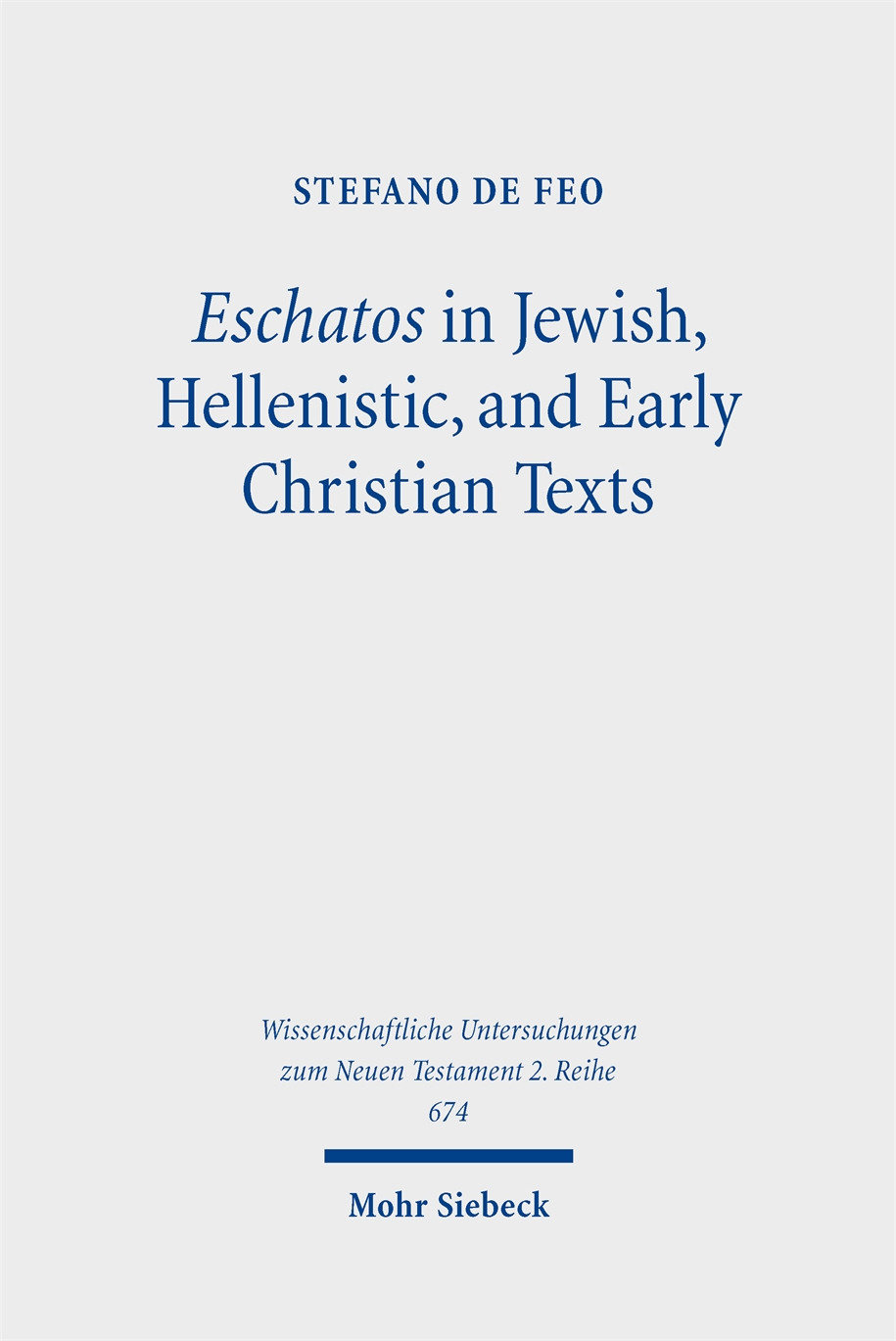
Eschatos in Jewish, Hellenistic, and Early Christian Texts
A Diachronic Analysis (3rd cent. BCE – 1st cent. CE)
By (author) Stefano De Feo
Paperback (Forthcoming)
(November 2026)
ISBN: 9783161644481
6.1 x 9.13 inches
Price: $164.00
Stefano De Feo explores how ancient Jewish, Christian, and Graeco-Roman traditions used the lexeme ἔσχατος. By tracing this key Greek word across diverse sources, the author offers a fresh look at how ideas of ‘the end’ are shaped – or not – by the vocabulary that eventually became eponymous for eschatology.
Stefano De Feo offers the first comprehensive investigation of the Greek lexeme ἔσχατος in Jewish, Christian, and Graeco-Roman sources from the 3rd cent. BCE to the 1st cent. CE. He examines how this term functions within diverse philosophical and religious traditions and asks which uses may be described legitimately as “eschatological.” The author maintains that the scholarly confusion regarding the use of the category of eschatology can be reduced significantly through a broad analysis of the lexeme ἔσχατος, the very lexeme from which the modern term “eschatology” is derived. Methodologically, the author adopts a historical-critical approach integrated with insights from modern semantics. Each occurrence of the lexeme is interpreted within its literary, argumentative, and historical context, thereby avoiding the “word-concept fallacy,” the retrojection of later theological categories, and the assumption that the presence of a word necessarily signals a concept. The analysis is both diachronic and comparative: it follows the development of the lexeme across the Greek translation of the Hebrew Scriptures, Jewish apocalyptic literature, Stoic philosophical writings, Hellenistic and Roman Jewish authors, the writings of the early Christian communities, and selected pagan authors (such as, for example, Dio Chrysostom and Plutarch). By tracing the uses of ἔσχατος across several centuries and traditions, De Feo demonstrates that the “time of the end” is not reducible to a chronological endpoint but constitutes a theological and philosophical category. He thereby provides a new foundation for the interpretation of eschatological language.
INTRODUCTION
1. THE RATIONALE OF THE STUDY
2. STATE OF CURRENT RESEARCH
3. METHODOLOGICAL CAVEATS
4. RELEVANCE OF THE ANALYSIS
5. OUTLINE OF THE STUDY
PART 1. THE USE OF THE LEXEME ἜΣΧΑΤΟΣ IN THE HELLENISTIC PERIOD
1. TRANSLATION AS CREATION OF MEANINGS? THE USE OF THE LEXEME ἜΣΧΑΤΟΣ IN THE SEPTUAGINT
1.1. Between Jewish and Christian Traditions
1.2. From the Hebrew Vorlage to the LXX
1.3. The Equivalents of the Lexeme Ἔσχατος in the Hebrew Bible
1.4. The Use of the Lexeme Ἔσχατος with No Equivalent in the Hebrew Bible
1.5. A Diachronic Overview of the Occurrences of the Lexeme Ἔσχατος in the Septuagint
1.6. The Septuagint Connection Between the Lexeme Ἔσχατος and the Noun Ἡμέρα
1.7. Final Observations
2. THE USE OF THE LEXEME ἜΣΧΑΤΟΣ IN THE APOCALYPTIC TRADITIONS
2.1. The Book of Enoch or 1 Enoch
2.2. The Book of Jubilees
2.3. The Testaments of the Twelve Patriarchs
2.4. The Testament of Job
2.5. The Sibylline Oracles
2.6. Final Observations
3. THE USE OF THE LEXEME ἜΣΧΑΤΟΣ IN THE HELLENISTIC PHILOSOPHICAL TRADITIONS
3.1. Between 'Teleology' and 'Eschatology': The Stoics
3.2. The Peculiar Meanings of the Lexeme Ἔσχατος in the Stoic Tradition
3.3. Final Observations
PART 2. THE USE OF THE LEXEME ἜΣΧΑΤΟΣ IN THE EARLY ROMAN IMPERIAL PERIOD
4. NO TIME FOR ESCHATOLOGY: THE USE OF ἜΣΧΑΤΟΣ IN PHILO AND JOSEPHUS
4.1. Philo of Alexandria
4.2. Josephus
4.3. Final Observations
5. THE USE OF ἜΣΧΑΤΟΣ IN THE NEW TESTAMENT
5.1. Forging Eschatological Language: The Lexeme Ἔσχατος in Paul's Letters
5.2. The Lexeme Ἔσχατος in Connection with Temporal Terms Within the New Testament
5.3. The Space of Eschatology
6. THE USE OF THE LEXEME ἜΣΧΑΤΟΣ IN EARLY CHRISTIAN TEXTS PRIOR TO THE APOLOGISTS
6.1. Didache (or The Doctrine of the Twelve Apostles)
6.2. The Ascension of Isaiah
6.3. The Epistle of Barnabas
6.4. The First and Second Letter of Clement
6.5. The Epistles of Ignatius of Antioch
6.6. The Shepherd of Hermas
6.7. Final Observations
7. THE USE OF ἜΣΧΑΤΟΣ IN THE PAGAN-RELIGIOUS TRADITIONS (1ST CENT. CE)
7.1. Dio Chrysostom
7.2. Plutarch
7.3. The Roman Stoics
7.4. Final Observations
CONCLUDING REMARKS
Born 1993; 2024 PhD; post-doctoral researcher in the SNSF project “Resonances through History. Conceptualizing the Divine in the Context of a Biographically Grounded Contemplation and Presentation of History in the Early Roman Imperial Era” (University of Bern).
- By (author) Stefano De Feo
Other Titles in this Series
 Der Tag der Plagen
Studien zur Verbindung der Rezeption von Ex 7-11 in den Posaunen- und Schalenvisionen der Johannesoffenbarung und der Tag des Herrn-Tradition
Volume 387
 Matthew and the Mishnah
Redefining Identity and Ethos in the Shadow of the Second Temple's Destruction
Volume 418

 Herod Antipas in Galilee
The Literary and Archaeological Sources on the Reign of Herod Antipas and its Socio-Economic Impact on Galilee
Volume 215


 Christusglaube
Studien zum Syntagma pistis Christou und zum paulinischen Verstandnis von Glaube und Rechtfertigung
Volume 227

 The Characterisation of Jesus the Davidic Shepherd in Mark’s Gospel
A Narrative Analysis through the Lens of Metalepsis
Volume 626


 “Make Disciples of All Nations”
The Appeal and Authority of Christian Faith in Hellenistic-Roman Times
 Moral Transformation in Greco-Roman Philosophy of Mind
Mapping the Moral Milieu of the Apostle Paul and his Diaspora Jewish Contemporaries
Volume 515
 Paul’s Teaching on the Pneumatika in 1 Corinthians 12-14
Prophecy as the Paradigm of ta Charismata ta Meizona for the Future-Oriented Ekklesia
Volume 455
 Vielfalt der Emotionen in neutestamentlicher und frühchristlicher Literatur
Exegetische Studien zu Darstellung, Funktion und Deutung
 The Hermeneutics of Divine Testing
Cosmic Trials and Biblical Interpretation in the Epistle of James and Other Jewish Literature
Volume 396


 The Use of the Old Testament in Hebrews
A Case Study in Early Jewish Bible Interpretation
Volume 260


 Communal Participation in the Spirit
The Corinthian Correspondence in Light of Early Jewish Mysticism in the Dead Sea Scrolls
Volume 575

 Portraits of Paul’s Performance in the Book of Acts
Luke's Apologetic Strategy in the Depiction of Paul as Messenger of God
Volume 556
 The Doubt of the Apostles and the Resurrection Faith of the Early Church
The Post-Resurrection Appearance Stories of the Gospels in Ancient Reception and Modern Debate
Volume 495
 Semantik und Ethik des Wortfeldes ‘Ergon’ im Johannesevangelium
Kontexte und Normen neutestamentlicher Ethik / Contexts and Norms of New Testament Ethics, Band VIII
Volume 431
Similar Books




 Cyril of Alexandria’s Christological Exegesis
Explorations of Partitive Exegesis in the Dialogues on the Trinity
Volume 70


 Extracanonical Traditions and the Holy Land
Texts, Rituals, and Material Culture in Late Antique Palestine
 From Joseph to Jesus
The Joseph Narrative as a Compositional Template from Old Greek Esther to the Gospel of Luke
Volume 125


 Nicholas of Lyra’s Commentaries on the Gospels of Matthew and Luke
Franciscan Exegesis in a Time of Crisis

 Punning in Odd or Elegant Constructions in Jeremiah
The Convergence of Linguistics, Rhetoric, and Textuality in the Hebrew Text of Jeremiah


 Reformed Covenantal Eudaimonism
Wilhelmus à Brakel (1635–1711) on Highest Good, Virtue, and Law
Volume 87


 The Biblical Tale of Judah and Tamar in Fourteenth-Century Iran
A Judeo-Persian Versified Account by Shāhīn with Scholarly Edition, Annotated Translation and Persian Transliteration
Volume 94, 951
 The Body
Lived, Cultured, Adorned: Essays on Dress and the Body in the Bible and Ancient Near East in Honor of Nili S. Fox






 The Therapeutae as the Best Paradigm for the Contemplative Life
A Contextual Reading of Philo of Alexandria's De Vita Contemplativa
