
Just a Matter of Perspective?
Focalization in Early Christian Narratives
By (author) Christoph Heilig

Hardback (Published)
(September 2026)
ISBN: 9783162008855
6.1 x 9.13 inches
Price: $164.00
On back order
Through whose eyes do we witness the events of the New Testament? Christoph Heilig shows how perspective unlocks the Gospels, Acts, Paul’s letters, and Revelation. He develops a method that embraces creative imagination and gives exegesis a future in the age of artificial intelligence.
Stories are foundational to early Christian literature. Yet one of the most basic narratological categories, narrative perspective, has received no detailed treatment in New Testament scholarship. Christoph Heilig argues that this concept, called focalization following Gérard Genette, is indispensable for adequately analyzing early Christian narratives. Narratives, after all, are defined not only by what they tell but also by how: a narrator can tell different stories depending on through whose eyes they let us witness the unfolding events. Drawing on recent cognitive linguistics, the author adapts the category for the exegesis of first-century Koine Greek texts. Across the New Testament, focalization sheds light on fundamental questions: it explains how Paul persuades his audiences in miniature narratives, places Synoptic redaction criticism on a new footing, provides nuanced tools for assessing the role of eyewitnesses in Mark and John, resolves debates about the we-passages in the Acts of the Apostles, and clarifies the narrative structure of Revelation. Whenever we read these stories, we inevitably make assumptions about perspective. Exegesis therefore requires a methodology both historically sensitive and creative. This includes the reception history of these perspectives, from the apocrypha onward, showing which viewpoints shape later reimaginations and which become marginalized. Theologically, then, the narratives cannot be reduced to their plots; their inherent multiperspectivity must be preserved in retellings for our time. In the age of artificial intelligence, when scholarly work is increasingly outsourced to machines, the lasting value of human interpretation lies precisely in this personal act of seeing, shared with others.
This work was awarded the Dewetteanum 2024, the prize for the best scholarly work submitted to the Faculty of Theology at the University of Basel.
1 Narratology: Who Sees?
1.1 Genette's Proposal
1.2 Subsequent Discussions
1.3 A Constraint Approach to Focalization
1.4 Markers of Internal Focalization
1.5 The Oversight of Focalization in New Testament Exegesis
1.6 From Narratology to Exegesis
1.7 Concluding Thoughts
2 Cognitive Linguistics: The Viewpointed Nature of Language
2.1 The Rise of Cognitive Linguistics
2.2 Core Assumptions of Cognitive Linguistics
2.3 Construal
2.4 Specificity
2.5 Focusing
2.6 Prominence
2.7 Perspective
2.8 Concluding Thoughts
3 Paul's Letters: Shifting Perspectives
3.1 External Focalization
3.2 The Perspective of the "Narrating I"
3.3 The Perspective of the "Narrated I"
3.4 Other Focalizers
3.5 Concluding Thoughts
4 Synoptics: Redaction Criticism Re-Visioned
4.1 Patterns of Focalization in the Synoptics
4.2 Imperfect Focalization in Mark
4.3 A Female Perspective
4.4 Concluding Thoughts
5 Eyewitnesses: Peter and the Beloved Disciple as Focalizers in Mark and John?
5.1 Bauckham's Thesis on Mark: Peter as Eyewitness and Focalizer?
5.2 The Beloved Disciple as Focalizer?
5.3 Concluding Thoughts
6 Acts: Tracing Luke's Presence
6.1 The We-Passages in Scholarship
6.2 Markers of Internal Focalization in Concert with First-Person Pronouns and Verb Forms
6.3 Luke Enters the Stage
6.4 Luke's Presence in Philippi
6.5 Leaving the Focalizer Behind
6.6 Getting the Band Back Together
6.7 Short Outlook on the Rest of Acts
6.8 Concluding Thoughts
7 Revelation: A Heavenly Perspective
7.1 A Prima Facie Case for the Experiencing I as Focalizer
7.2 John's View of Jesus (Rev 1:10-17)
7.3 Jesus as an Embedded Narrator and Focalizer (Rev 2-3)
7.4 John's Heavenly Perspective (Rev 4-5)
7.5 Some Indications for Future Research
7.6 Concluding Thoughts
8 Epilogue: Broadening the Perspective
8.1 The Inevitability of a Viewpointed Construal
8.2 Reception History
8.3 Theology
- By (author) Christoph Heilig
Other Titles in this Series

 Bibelkritik und Auslegung der Heiligen Schrift
Beitrage zur Geschichte der biblischen Exegese und Hermeneutik
Volume 217
 Hebrews as Pseudepigraphon
The History and Significance of the Pauline Attribution of Hebrews
Volume 235


 Allgemeines Priestertum
Zur Metaphorisierung des Priestertitels im Fruhjudentum und Neuen Testament
Volume 331


 Paul and the Mosaic Law
The Third Durham-Tübingen Research Symposium on Earliest Christianity and Judaism (Durham, September, 1994)


 Deliver Us from Evil
Interpreting the Redemption from the Power of Satan in New Testament Theology
Volume 216

 Mark and Matthew I
Comparative Readings: Understanding the Earliest Gospels in their First Century Settings

 Hermeneutik der frühchristlichen Wundererzählungen
Geschichtliche, literarische und rezeptionsorientierte Perspektiven
Volume 339

 Die Septuaginta – Geschichte, Wirkung, Relevanz
6. Internationale Fachtagung veranstaltet von Septuaginta Deutsch (LXX.D), Wuppertal 21.-24. Juli 2016


 The ‘Gospel’ between Emperor and Temple in the Gospel of Mark
A Story of Epoch-Making Proximity to the Divine through Victory and Cult
Volume 505


 Einheit der Kirche im Neuen Testament
Dritte europäische orthodox-westliche Exegetenkonferenz in Sankt Petersburg, 24.-31. August 2005

Similar Books


 Athanasius of Alexandria, Epistula ad episcopos Aegypti et Libyae
Old Slavonic Version and English Translation
Volume 261


 Cyril of Alexandria’s Christological Exegesis
Explorations of Partitive Exegesis in the Dialogues on the Trinity
Volume 70


 Epiphanies of the Divine in the Septuagint and the New Testament
Fifth International Symposium of the Corpus Judaeo-Hellenisticum Novi Testamenti (CJHNT), 14-17 May 2015, Nottingham

 Extracanonical Traditions and the Holy Land
Texts, Rituals, and Material Culture in Late Antique Palestine
 From Joseph to Jesus
The Joseph Narrative as a Compositional Template from Old Greek Esther to the Gospel of Luke
Volume 125


 Paradise Lost in Transmission
The Return to Eden in the Apocalypse of Peter within Its Ethiopic and Early Christian Contexts



 Punning in Odd or Elegant Constructions in Jeremiah
The Convergence of Linguistics, Rhetoric, and Textuality in the Hebrew Text of Jeremiah

 Shame in the Worlds of the Hebrew Bible and Akkadian Texts
A Linguistic Study and Its Implications
Volume 33

 Tabernacle, Table, Ark, and Text
Richard of Saint Victor on the Interpretation of Scripture
Volume 67
 The Anglo-Norman Bible’s Books of Kings, a Critical Edition
(BL Royal 1 C III, fols 234r-274v)
Volume 37
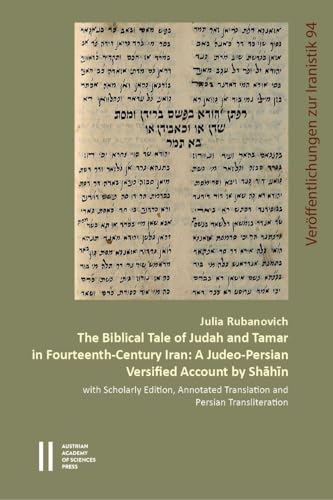 The Biblical Tale of Judah and Tamar in Fourteenth-Century Iran
A Judeo-Persian Versified Account by Shāhīn with Scholarly Edition, Annotated Translation and Persian Transliteration
Volume 94, 951
 The Body
Lived, Cultured, Adorned: Essays on Dress and the Body in the Bible and Ancient Near East in Honor of Nili S. Fox

 The Compositional History of the Book of Kings
An Analysis of the Evaluative Frameworks in 1 Kings 14–2 Kings 25
 The Discourse of Rites
Shaping and Reshaping the (Counter-)Priestly Rituals Conducted Outside the Tabernacle


