
Baptism and Cognition in Romans 6-8
Paul's Ethics beyond 'Indicative' and 'Imperative'
by Samuli Siikavirta

Paperback (Published)
(November 2015)
ISBN: 9783161540141
Price: $118.00
On back order
Baptism, for Paul, is a christological event that he also uses in his ethical argument. The discussion of the relationship between Paul’s theology and ethics has made use of the terms ‘indicative’ and ‘imperative’ since Wernle and Bultmann. As subsequent discussion has shown, these terms are problematic not only because of their rigidity and ambiguity. In this study, Samuli Siikavirta focuses on Romans 6-8, the key text for the interplay between Paul’s theological and ethical material. He brings the discussion back to what he sees as central to this interaction: baptism and its cognition. Both elements are examined in their Jewish and Stoic settings. Death to sin, slavery to God, holiness and the indwelling of the Spirit are all seen as integral parts of the baptismal state that is deeply christological rather than symbolic. Paul’s cognitive language is then viewed in light of his desire to remind his addressees of who and whose they are because of their baptism.
Baptism, for Paul, is a christological event that he also uses in his ethical argument. The discussion of the relationship between Paul’s theology and ethics has made use of the terms ‘indicative’ and ‘imperative’ since Wernle and Bultmann. As subsequent discussion has shown, these terms are problematic not only because of their rigidity and ambiguity. In this study, Samuli Siikavirta focuses on Romans 6-8, the key text for the interplay between Paul’s theological and ethical material. He brings the discussion back to what he sees as central to this interaction: baptism and its cognition. Both elements are examined in their Jewish and Stoic settings. Death to sin, slavery to God, holiness and the indwelling of the Spirit are all seen as integral parts of the baptismal state that is deeply christological rather than symbolical. Paul’s cognitive language is then viewed in light of his desire to remind his addressees of who and whose they are because of their baptism.
- By (author) Samuli Siikavirta
Other Titles in this Series

 Die Areopagrede des Paulus und Reden bei Josephus
Eine vergleichende Studie zu Apg 17 und dem historiographischen Werk des Josephus
Volume 419
 Crucifixion in Antiquity
An Inquiry into the Background and Significance of the New Testament Terminology of Crucifixion
Volume 310

 Kult und Macht
Religion und Herrschaft im syro-palastinensischen Raum. Studien zu ihrer Wechselbeziehung in hellenistisch-romischer Zeit
Volume 319


 The Characterisation of Jesus the Davidic Shepherd in Mark’s Gospel
A Narrative Analysis through the Lens of Metalepsis
Volume 626


 “Make Disciples of All Nations”
The Appeal and Authority of Christian Faith in Hellenistic-Roman Times
 Moral Transformation in Greco-Roman Philosophy of Mind
Mapping the Moral Milieu of the Apostle Paul and his Diaspora Jewish Contemporaries
Volume 515
 Paul’s Teaching on the Pneumatika in 1 Corinthians 12-14
Prophecy as the Paradigm of ta Charismata ta Meizona for the Future-Oriented Ekklesia
Volume 455
 Vielfalt der Emotionen in neutestamentlicher und frühchristlicher Literatur
Exegetische Studien zu Darstellung, Funktion und Deutung
 Sprachethik im Neuen Testament
Eine Analyse des fruhchristlichen Diskurses im Matthausevangelium, im Jakobusbrief und im 1. Petrusbrief
Volume 394

 Literature or Liturgy?
Early Christian Hymns and Prayers in their Literary and Liturgical Context in Antiquity
Volume 363
 The Tongues of Angels
The Concept of Angelic Languages in Classical Jewish and Christian Texts
Volume 287


 Die Theologie der Liebe Gottes in den johanneischen Schriften
Zur Semantik der Liebe und zum Motivkreis des Dualismus
Volume 197


 Communal Participation in the Spirit
The Corinthian Correspondence in Light of Early Jewish Mysticism in the Dead Sea Scrolls
Volume 575

 Portraits of Paul’s Performance in the Book of Acts
Luke's Apologetic Strategy in the Depiction of Paul as Messenger of God
Volume 556
 The Doubt of the Apostles and the Resurrection Faith of the Early Church
The Post-Resurrection Appearance Stories of the Gospels in Ancient Reception and Modern Debate
Volume 495
 Semantik und Ethik des Wortfeldes ‘Ergon’ im Johannesevangelium
Kontexte und Normen neutestamentlicher Ethik / Contexts and Norms of New Testament Ethics, Band VIII
Volume 431
Similar Books


 Athanasius of Alexandria, Epistula ad episcopos Aegypti et Libyae
Old Slavonic Version and English Translation
Volume 261


 Cyril of Alexandria’s Christological Exegesis
Explorations of Partitive Exegesis in the Dialogues on the Trinity
Volume 70


 Epiphanies of the Divine in the Septuagint and the New Testament
Fifth International Symposium of the Corpus Judaeo-Hellenisticum Novi Testamenti (CJHNT), 14-17 May 2015, Nottingham

 Extracanonical Traditions and the Holy Land
Texts, Rituals, and Material Culture in Late Antique Palestine
 From Joseph to Jesus
The Joseph Narrative as a Compositional Template from Old Greek Esther to the Gospel of Luke
Volume 125


 Paradise Lost in Transmission
The Return to Eden in the Apocalypse of Peter within Its Ethiopic and Early Christian Contexts



 Punning in Odd or Elegant Constructions in Jeremiah
The Convergence of Linguistics, Rhetoric, and Textuality in the Hebrew Text of Jeremiah

 Shame in the Worlds of the Hebrew Bible and Akkadian Texts
A Linguistic Study and Its Implications
Volume 33

 Tabernacle, Table, Ark, and Text
Richard of Saint Victor on the Interpretation of Scripture
Volume 67
 The Anglo-Norman Bible’s Books of Kings, a Critical Edition
(BL Royal 1 C III, fols 234r-274v)
Volume 37
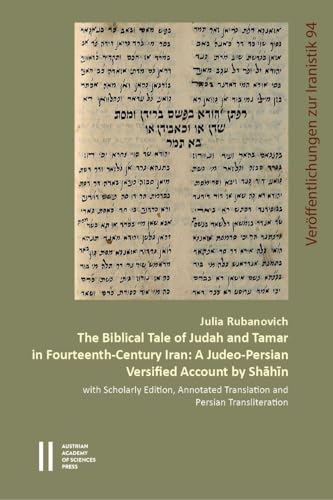 The Biblical Tale of Judah and Tamar in Fourteenth-Century Iran
A Judeo-Persian Versified Account by Shāhīn with Scholarly Edition, Annotated Translation and Persian Transliteration
Volume 94, 951
 The Body
Lived, Cultured, Adorned: Essays on Dress and the Body in the Bible and Ancient Near East in Honor of Nili S. Fox

 The Compositional History of the Book of Kings
An Analysis of the Evaluative Frameworks in 1 Kings 14–2 Kings 25
 The Discourse of Rites
Shaping and Reshaping the (Counter-)Priestly Rituals Conducted Outside the Tabernacle


