
The Psalter. Book Four (Ps 90-106)
By (author) R. Meynet

The composition of the fourth book is in no way inferior to that of the other four books already analysed. Its three major sections, each containing five psalms, are organised in a concentric fashion; they are linked by two short sections which constitute the focal points of the ellipse that the whole book draws. The extreme sections are related. The first section (Ps 90-94) describes “the fate of the children of Adam”, the last one (Ps 102-106) “the fate of the children of Israel”. All are subject to the law of human affliction. They are like the grass that flourishes in the morning and withers and dries up in the evening; and sin accompanies frailty. As the refuge of humanity from generation to generation, the Lord saves people by satisfying those who fear him for many days and by assuring his faithfulness to the children of their children, from age to age. Despite their repeated unfaithfulness, God does not grow weary of forgiving them. The central section (Ps 96-100) stands out from the rest of the book, which it overshadows. All peoples are called to come to Jerusalem to worship the King of the universe and to bless him who has saved the chosen people from among all the families of the earth. Carried by the promise of the one God and by the hope of the one people, this invitation is situated on the unattained, but always desired eschatological horizon. The focal points of the ellipsis (Ps 95 and Ps 101) are the key to reading the book. The first one focuses on a wish addressed to humans: “Today if you would only listen to his voice” (Ps 95:7). The second one poses a question to God: “When will you come to me?” (Ps 101:2). Therefore, the whole fourth book is captured in this tension between God’s desire and human desire, each going to meet the other, in a “today” whose fragility places every human being between the morning when the grass flourishes and the evening when it dries up, between the time of the fathers, which the last section evokes at length, the time of sin and forgiveness, and the time of salvation and of the end, which the central section contemplates.
- By (author) R. Meynet
Other Titles in this Series


 La Paque du Seigneur
Passion et resurrection de Jesus dans les evangiles synoptiques. Troisieme edition revue
Volume 27


Similar Books


 Athanasius of Alexandria, Epistula ad episcopos Aegypti et Libyae
Old Slavonic Version and English Translation
Volume 261


 Cyril of Alexandria’s Christological Exegesis
Explorations of Partitive Exegesis in the Dialogues on the Trinity
Volume 70


 Epiphanies of the Divine in the Septuagint and the New Testament
Fifth International Symposium of the Corpus Judaeo-Hellenisticum Novi Testamenti (CJHNT), 14-17 May 2015, Nottingham

 Extracanonical Traditions and the Holy Land
Texts, Rituals, and Material Culture in Late Antique Palestine
 From Joseph to Jesus
The Joseph Narrative as a Compositional Template from Old Greek Esther to the Gospel of Luke
Volume 125


 Paradise Lost in Transmission
The Return to Eden in the Apocalypse of Peter within Its Ethiopic and Early Christian Contexts



 Punning in Odd or Elegant Constructions in Jeremiah
The Convergence of Linguistics, Rhetoric, and Textuality in the Hebrew Text of Jeremiah

 Shame in the Worlds of the Hebrew Bible and Akkadian Texts
A Linguistic Study and Its Implications
Volume 33

 Tabernacle, Table, Ark, and Text
Richard of Saint Victor on the Interpretation of Scripture
Volume 67
 The Anglo-Norman Bible’s Books of Kings, a Critical Edition
(BL Royal 1 C III, fols 234r-274v)
Volume 37
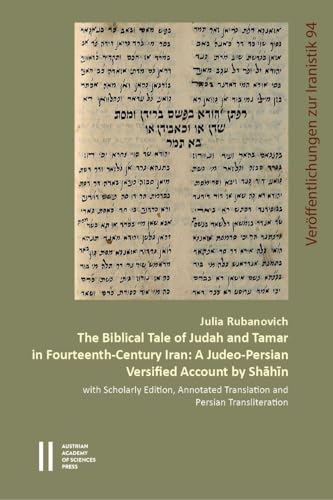 The Biblical Tale of Judah and Tamar in Fourteenth-Century Iran
A Judeo-Persian Versified Account by Shāhīn with Scholarly Edition, Annotated Translation and Persian Transliteration
Volume 94, 951
 The Body
Lived, Cultured, Adorned: Essays on Dress and the Body in the Bible and Ancient Near East in Honor of Nili S. Fox

 The Compositional History of the Book of Kings
An Analysis of the Evaluative Frameworks in 1 Kings 14–2 Kings 25
 The Discourse of Rites
Shaping and Reshaping the (Counter-)Priestly Rituals Conducted Outside the Tabernacle


