
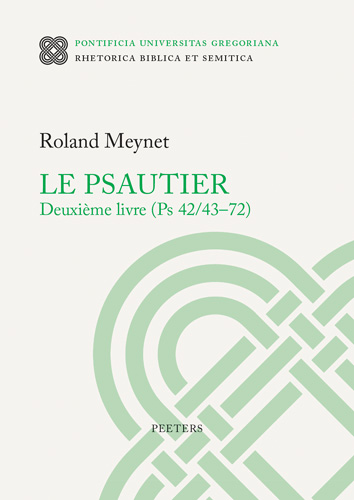
The Psalter. Book Two (Ps 42/43-72)
By (author) R. Meynet
The second book of the Psalter, like the first, third and fifth books, forms a highly elaborate composition. Indeed, not only each of its thirty psalms is well composed, but also each of the “sequences” that bring out two or three psalms; and finally, the five “sections” arranged in a concentric manner around the five psalms “in a low voice” (Ps 56-60). Two complementary movements form and animate the entire second book. On the one hand, evil and violence are everywhere, as are enemies. First of all, they are those from outside, pagan peoples who trample on Israel; but the psalmist later discovers that enemies from within are no less violent, and that violence comes even from his closest friends, those in whom he puts all his trust. Sin, that has always been rooted in the depths of their hearts, marks all human beings. Its most pernicious form is a “lie” which, like the lion and the viper, hides itself to attack more effectively. It is certainly no coincidence that “the serpent” is mentioned right at the centre of the central section, reminding us of the deadly venom of the serpent at the beginning which was injected into the whole of humanity. On the other hand, salvation is meant for all those who trust in God, in his faithfulness and in his truth. Hence the thanksgiving that resounds throughout the book, right to the end. It resounds not only in the mouth of the people of Israel, saved by God, but also on the lips of all the other peoples; the pagan nations, who are bringing gifts to the Temple, lifting up their hands in prayer to the one God, who is King of all the earth. They, who at the beginning of the book were presented as the enemies and oppressors of the chosen people, will join Israel at the end of the book in the same blessing promised to Abraham: “By your offspring shall all the nations of the earth blessed themselves” (Gen 22:18).
- By (author) R. Meynet
Other Titles in this Series




 La Paque du Seigneur
Passion et resurrection de Jesus dans les evangiles synoptiques. Troisieme edition revue
Volume 27


 Treatise on Biblical Rhetoric
Second Complete English Edition. Translation of the Third Revised and Enlarged Edition
Volume 52



Similar Books



 Cyril of Alexandria’s Christological Exegesis
Explorations of Partitive Exegesis in the Dialogues on the Trinity
Volume 70


 Reformed Covenantal Eudaimonism
Wilhelmus à Brakel (1635–1711) on Highest Good, Virtue, and Law
Volume 87

 The Biblical Tale of Judah and Tamar in Fourteenth-Century Iran
A Judeo-Persian Versified Account by Shāhīn with Scholarly Edition, Annotated Translation and Persian Transliteration
Volume 94, 951

 The Therapeutae as the Best Paradigm for the Contemplative Life
A Contextual Reading of Philo of Alexandria's De Vita Contemplativa

 De Moïse à Jésus: une messianité en discussion
Une interprétation de Jean 6 à partir de la section narrative (vv. 1-25a)
Volume 244


 Die Sprache der Psalmen
Skizzierung eines lyrischen Prototyps der hebräischen Psalmen mithilfe von gattungs- und lyriktheoretischen Ansätzen
Volume 440

 Makrothymia im Neuen Testament
Semantik und Ethik einer vergessenen ethischen Norm. Kontexte und Normen neutestamentlicher Ethik / Contexts and Norms of New Testament Ethics. Band XV
 Parola di Dio, di uomo e di Re
L'assoluta verità della Bibbia nella dottrina cattolica di Bacchisio Raimondo Motzo


 Breaking New Ground in John
Imagery, Parables, Characters, Christology, and Ethics in the Fourth Gospel
Volume 531
 But the Wise Shall Understand
Reuse of Prophecies, Chronotope, and Merging of Eschatological Horizons in Daniel 10-12
 Creation Concepts and Creation Care
Perspectives from Early Judaism, Early Christianity, and Beyond. Kontexte und Normen neutestamentlicher Ethik / Contexts and Norms of New Testament Ethics XVII
 De-colonising the Biblical Narrative. Volume 4
The Colonial Worldview of the Book of Joshua
Volume 4


 Personified Mountains in Ancient Canonical Narratives
Spatial and Mythic Studies of Mesopotamian, Greek, and Hebrew Bible Landscapes
Volume 62
