
Studies on the Old Latin of the Book of Esther
By (author) D. Candido

The Book of Esther is a kind of ‘laboratory’ for the study of the Textual Criticism of the Old Testament because of the diversity and complexity of its ancient textual witnesses. This volume complements the Synopsis of the Book of Esther (CBET 102.1), which presents a parallel comparison between the Masoretic Text, the Old Greek, the Alpha Text, the Old Latin, the Vulgate and Josephus’ Jewish Antiquities. Referring to the readings highlighted in the synopsis, the essays in this volume focus on the Old Latin in order to show its distinctive features and its role in the history of the transmission of the Book of Esther.
The Book of Esther is a kind of ‘laboratory’ for the study of the Textual Criticism of the Old Testament because of the diversity and complexity of its ancient textual witnesses. This volume complements the Synopsis of the Book of Esther (CBET 102.1), which presents a parallel comparison between the Masoretic Text, the Old Greek, the Alpha Text, the Old Latin, the Vulgate and Josephus’ Jewish Antiquities. Referring to the readings highlighted in the synopsis, the essays in this volume focus on the Old Latin in order to show its distinctive features and its role in the history of the transmission of the Book of Esther.
- By (author) D. Candido
Other Titles in this Series
 Between Israelite Religion and Old Testament Theology
Essays on Archaeology, History, and Hermeneutics
Volume 80


 From Worshipping, Sacrificing and Mourning to Praising and Praying
Key Concepts of the Greek Bible
Volume 120
 Law, Prophets, and Wisdom
On the Provenance of Translators and their Books in the Septuagint Version
Volume 68


 Heilige oder Hure?
Die Rezeptionsgeschichte von Juda und Tamar (Genesis 38) von der Antike bis zur Reformationszeit
Volume 48

 Oh God of Battles! Steal My Soldier’s Hearts!
A Study of the Hebrew and Greek Text Forms of Jeremiah 10:1-18
Volume 83
 Texts and Contexts of Jeremiah
The Exegesis of Jeremiah 1 and 10 in Light of Text and Reception History
Volume 82
 Transformations in the Septuagint
Towards an Interaction of Septuagint Studies and Translation Studies
Volume 47

 Like Nails Firmly Fixed (Qoh 12:11)
Essays on the Text and Language of the Hebrew and Greek Scriptures Presented to Peter J. Gentry on the Occasion of His Retirement
Volume 115

 Insights into Editing in the Hebrew Bible and the Ancient Near East
What Does Documented Evidence Tell Us about the Transmission of Authoritative Texts?
Volume 84
 The Akedah Servant Complex
The Soteriological Linkage of Genesis 22 and Isaiah 53 in Ancient Jewish and Early Christian Writings
Volume 69
 In Spirit and Truth
An Exegetical Study of John 4:19-26 and a Theological Investigation of the Replacement Theme in the Fourth Gospel
Volume 46

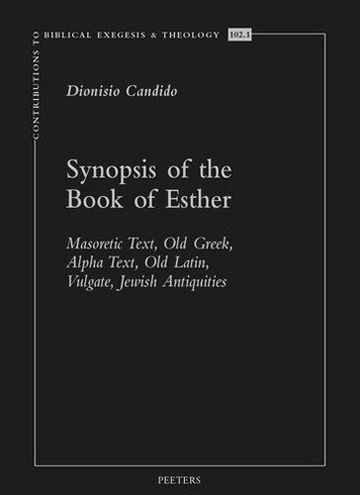 Synopsis of the Book of Esther
Masoretic Text, Old Greek, Alpha Text, Old Latin, Vulgate, Jewish Antiquities
 Prophecy after the Prophets?
The Contribution of the Dead Sea Scrolls to the Understanding of Biblical and Extra-Biblical Prophecy
Volume 52


Similar Books


 Athanasius of Alexandria, Epistula ad episcopos Aegypti et Libyae
Old Slavonic Version and English Translation
Volume 261



 Contesting Labeled Identities
The Sociology of Gentilics in Biblical and Northwest Semitic Literature
 Cyril of Alexandria’s Christological Exegesis
Explorations of Partitive Exegesis in the Dialogues on the Trinity
Volume 70


 Epiphanies of the Divine in the Septuagint and the New Testament
Fifth International Symposium of the Corpus Judaeo-Hellenisticum Novi Testamenti (CJHNT), 14-17 May 2015, Nottingham


 Extracanonical Traditions and the Holy Land
Texts, Rituals, and Material Culture in Late Antique Palestine
 From Joseph to Jesus
The Joseph Narrative as a Compositional Template from Old Greek Esther to the Gospel of Luke
Volume 125





 Nicholas of Lyra’s Commentaries on the Gospels of Matthew and Luke
Franciscan Exegesis in a Time of Crisis
 Paradise Lost in Transmission
The Return to Eden in the Apocalypse of Peter within Its Ethiopic and Early Christian Contexts




 Punning in Odd or Elegant Constructions in Jeremiah
The Convergence of Linguistics, Rhetoric, and Textuality in the Hebrew Text of Jeremiah


 Reformed Covenantal Eudaimonism
Wilhelmus à Brakel (1635–1711) on Highest Good, Virtue, and Law
Volume 87
