
Oh God of Battles! Steal My Soldier’s Hearts!
A Study of the Hebrew and Greek Text Forms of Jeremiah 10:1-18
by J.S. Adcock

This volume represents a comparative analysis of the Greek and Hebrew text forms of Jer 10:1-18. One finds that the Hebrew text’s ancient battle hymn has been transformed by the old Greek translator into an apotropaic incantation against evil spirits. Thus, the two text forms of chapter 10 hinge upon the Aramaic of verse 11 and whether one finds exorcistic magic in its obscure words or enigmatic condemnation of idolatry from the prophet Jeremiah. The Masoretic text proves to evidence a more ancient textual tone and structure.
This volume represents a comparative analysis of the Greek and Hebrew text forms of Jer 10:1-18. One finds that the Hebrew text’s ancient battle hymn has been transformed by the old Greek translator into an apotropaic incantation against evil spirits. Thus, the two text forms of chapter 10 hinge upon the Aramaic of verse 11 and whether one finds exorcistic magic in its obscure words or enigmatic condemnation of idolatry from the prophet Jeremiah. The Masoretic text proves to evidence a more ancient textual tone and structure.
- By (author) JS Adcock
Other Titles in this Series


 Studies on Jewish and Christian Historical Summaries from the Hellenistic and Early Roman Periods
Volume 95
 Three Versions of Esther
Their Relationship to Anti-Semitic and Feminist Critique of the Story
Volume 74


 Wachstumsgesetz oder Kurzungstendenz?
Gedachtnispsychologische Erkenntnisse zu den inhaltlichen Uberhangen in den synoptischen Paralleltraditionen
Volume 104

 A Cosmic Leap of Faith
An Authorial, Structural, and Theological Investigation of the Cosmic Christology in Col 1:15-20
Volume 41
 Anthropology in the New Testament and its Ancient Context
Papers from the EABS-Meeting in Piliscsaba / Budapest
Volume 54
 From Joseph to Jesus
The Joseph Narrative as a Compositional Template from Old Greek Esther to the Gospel of Luke
Volume 125


 My Shepherd, though You Do not Know Me
The Persian Royal Propaganda Model in the Nehemiah Memoir
Volume 78
 Happy the One who Meditates on Wisdom (Sir. 14,20)
Collected Essays on the Book of Ben Sira
Volume 43
 Sabbath in the Making
A Study of the Inner-Biblical Interpretation of the Sabbath Commandment
Volume 97
 The Old Greek of Isaiah: Issues and Perspectives
Papers read at the Conference on the Septuagint of Isaiah, held in Leiden 10-11 April 2008
Volume 55
 “Have You Not Read this Scripture?”
Memory Variation and Context-Based Modification in the Old Testament Quotations in the Gospel of Mark
Volume 116

 Jesus, the Eschatological Temple
An Exegetical Study of Jn 2,13-22 in the Light of the Pre 70 C.E. Eschatological Temple Hopes and the Synoptic Temple Action
Volume 58
 A Divine Round Trip
The Literary and Christological Function of the Descent/Ascent Leitmotif in the Gospel of John
Volume 79

 Qumran and the Bible
Studying the Jewish and Christian Scriptures in Light of the Dead Sea Scrolls
Volume 57
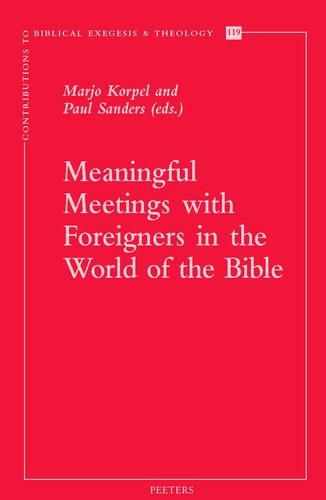 Meaningful Meetings with Foreigners in the World of the Bible
Essays in Honour of Klaas Spronk on the Occasion of His Retirement
Volume 119

Similar Books


 Athanasius of Alexandria, Epistula ad episcopos Aegypti et Libyae
Old Slavonic Version and English Translation
Volume 261



 Contesting Labeled Identities
The Sociology of Gentilics in Biblical and Northwest Semitic Literature
 Cyril of Alexandria’s Christological Exegesis
Explorations of Partitive Exegesis in the Dialogues on the Trinity
Volume 70


 Epiphanies of the Divine in the Septuagint and the New Testament
Fifth International Symposium of the Corpus Judaeo-Hellenisticum Novi Testamenti (CJHNT), 14-17 May 2015, Nottingham


 Extracanonical Traditions and the Holy Land
Texts, Rituals, and Material Culture in Late Antique Palestine
From Joseph to Jesus
The Joseph Narrative as a Compositional Template from Old Greek Esther to the Gospel of Luke
Volume 125





 Nicholas of Lyra’s Commentaries on the Gospels of Matthew and Luke
Franciscan Exegesis in a Time of Crisis
 Paradise Lost in Transmission
The Return to Eden in the Apocalypse of Peter within Its Ethiopic and Early Christian Contexts




 Punning in Odd or Elegant Constructions in Jeremiah
The Convergence of Linguistics, Rhetoric, and Textuality in the Hebrew Text of Jeremiah


 Reformed Covenantal Eudaimonism
Wilhelmus à Brakel (1635–1711) on Highest Good, Virtue, and Law
Volume 87
