
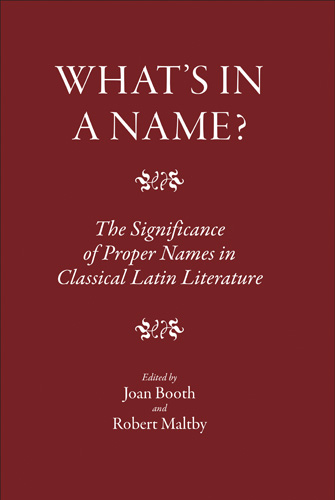
What’s in a Name?
The Significance of Proper Names in Classical Latin Literature
edited by Joan Booth and Robert Maltby
Hardback (Published)
(December 2006)
ISBN: 9781905125098
6.1 x 9.17 inches
Price: $80.00
In stock
Latin poets and prose writers of the classical period and later used – and withheld – names subtly and to important effect. Here, in eleven new essays, an eminent international cast explore themes which include ‘speaking’ names, often involving bilingual Latin/Greek play; the ways in which persons and objects are named in contexts of invective or endearment; the significant suppression or changing of names; the religious and historical significances of names; the uses of names in literary catalogues; names as devices to structure a group of shorter poems.
Introduction - Robert Maltby 1. The qualification of personal names by possessive adjectives in Cicero's letters - Frederique Biville 2. Personal names and invective in Cicero - Javier Uria 3. Tibullus' Nemesis: divine retribution and the poet - Emma Stafford 4. Naming names - or not: some significant choices and suppressions in Latin poetry - Joan Booth 5. The nomenclature of the Tiber in Virgil's Aeneid - Francis Cairns 6. Antonomasia and metonymy in the proem to Virgil's Georgics - Helen Peraki-Kyriakidou 7. From the Metamorphoses to the Fasti: Catalogues of proper names -Stratis Kyriakidis 8. Bilingual word-play on personal names in Martial - Daniel Vallat 9. Onomato-poetics: a linear reading of Martial 7.67-70 - Niklas Holzberg 10. Proper names as a linking device in Martial 5.43-8 - Robert Maltby 11. Naming the characters: the cases of Aristomenes, Socrates and Meroe in Apuleius' Metamorphoses 1.2-19 - Andreas Michalopoulos Indexes
- Edited by Joan Booth
- Edited by Robert Maltby
Other Titles in this Series





Similar Books


 Des mots aux actes
Traduction épistémique et littéraire. Nouvelles tendances en histoire et didactique
Volume 15


 Drunk the Potion, No Whit Charmed
The Doctrine of Pure and Perfect Souls from Iamblichus to Damascius


 Epiphanies of the Divine in the Septuagint and the New Testament
Fifth International Symposium of the Corpus Judaeo-Hellenisticum Novi Testamenti (CJHNT), 14-17 May 2015, Nottingham


 Language and Power in the Roman Empire and Early India
Hierarchy, Ambiguity, and the Art of Reading the Signs in Cosmopolitan Cultures
 Late Antique villae in the Balkans (3rd–7th c. AD): Current Research Questions and Perspectives
HAEMUS Companion to the Late Antique Balkans 1
Volume 4


 Nurturing the Elite
Representations of Drinking, Eating, and Religious Vessels in Palmyrene Funerary Iconography
Volume 13


 Punning in Odd or Elegant Constructions in Jeremiah
The Convergence of Linguistics, Rhetoric, and Textuality in the Hebrew Text of Jeremiah


 The Compositional History of the Book of Kings
An Analysis of the Evaluative Frameworks in 1 Kings 14–2 Kings 25



 Contesting Labeled Identities
The Sociology of Gentilics in Biblical and Northwest Semitic Literature
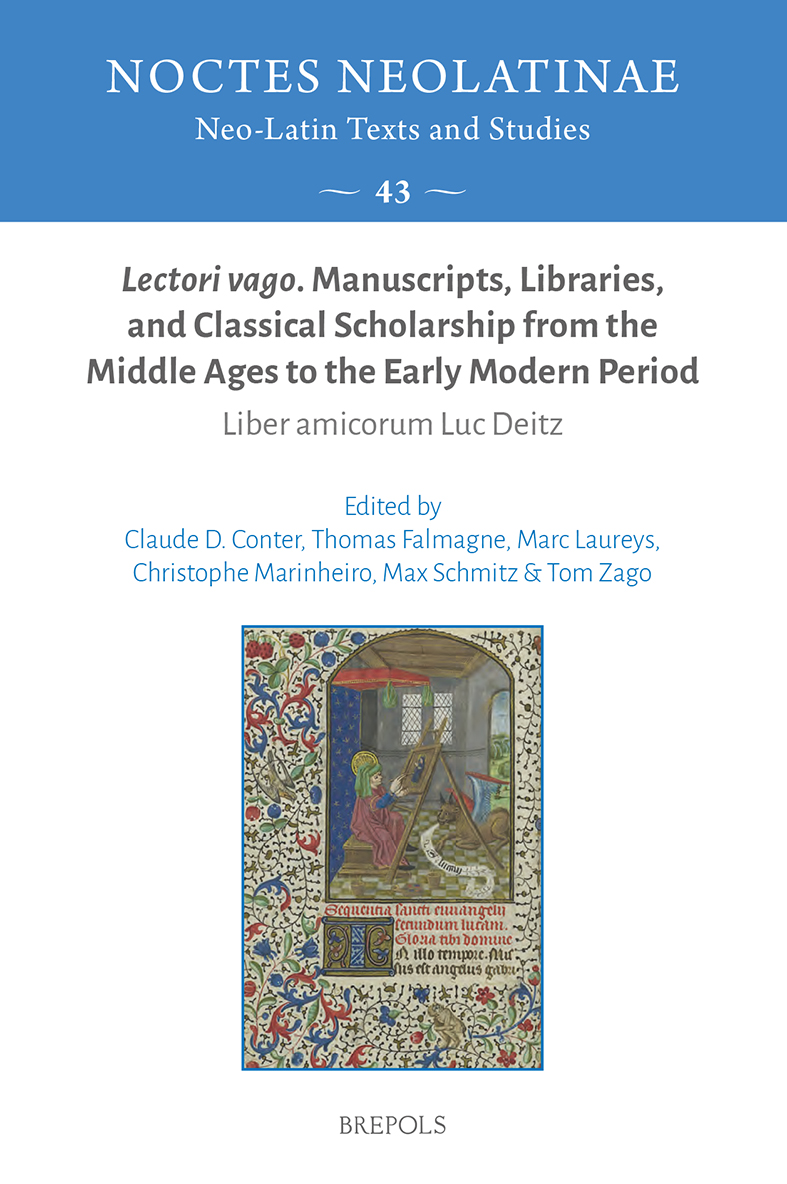 Lectori vago. Manuscripts, Libraries, and Classical Scholarship from the Middle Ages to the Early Modern Period
Liber amicorum Luc Deitz
Volume 43


