
Plutarch’s Lives
Parallelism and Purpose
edited by Noreen Humble
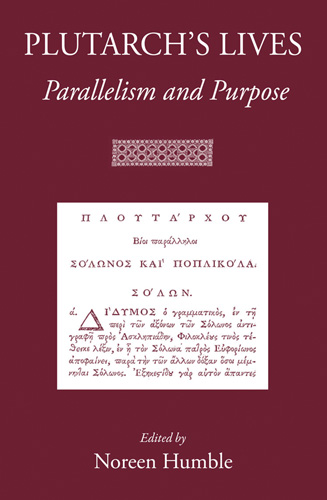
Hardback (Published)
(December 2010)
ISBN: 9781905125418
6.1 x 9.17 inches
Price: $85.00
In stock
Plutarch’s Parallel Lives were written to compare famous Greeks and Romans. This most obvious aspect of their parallelism is frequently ignored in the drive to mine Plutarch for historical fact. However, the eleven contributors to the present volume, who include most of the world’s leading commentators on Plutarch, together bring out many ways in which Plutarch invoked aspects of parallelism. They show how pervasive and how central the whole notion was to his thinking. With new analysis of the synkriseis; with discussion of parallels within and across the Lives and in the Moralia; with an examination of why the basic parallel structure of the Lives lost its importance in the Renaissance, this volume presents fresh ideas on a neglected topic crucial to Plutarch’s literary creation.
1. Why Parallel Lives? - W. Jeffrey Tatum 2. Parallels and contrasts: Plutarch's Comparison of Coriolanus and Alcibiades - Simon Verdegem 3. Plutarch's Themistocles and Camillus - Timothy E. Duff 4. Dion and Brutus: philosopher kings adrift in a hostile world - John Dillon 5. Asemotatos or autokrator? Obscurity and glory in Plutarch's Sertorius - Jeffrey Beneker 6. Plutarch, 'parallelism' and the Persian-War Lives - John Marincola 7. A life unparalleled: Artaxerxes - Judith Mossman 8. The rhetoric and philosophy of Plutarch's mirrors - Alexei V. Zadorojnyi 9. Parallels in three dimensions - Philip A. Stadter 10. 'Plutarch's tale of two cities: do the Parallel Lives combine as global histories?' - Christopher Pelling 11. Parallelism and the Humanists - Noreen Humble
- Edited by Noreen Humble
Other Titles in this Series



Similar Books


 Contesting Labeled Identities
The Sociology of Gentilics in Biblical and Northwest Semitic Literature

 Drunk the Potion, No Whit Charmed
The Doctrine of Pure and Perfect Souls from Iamblichus to Damascius

 Epigraphic “Shades” from Hellenistic Thrace
Contextualizing Inscriptions in Greek from Thracian Tombs

 Epiphanies of the Divine in the Septuagint and the New Testament
Fifth International Symposium of the Corpus Judaeo-Hellenisticum Novi Testamenti (CJHNT), 14-17 May 2015, Nottingham


 Gold, Silver and Glass: Power Networks, Cultural Identities, Technology Transfers and Agency across the Old World (7th Century BC – 1st Century AD)
Proceedings of a Conference Held at the British Museum, 16–18 June 2023
 Language and Power in the Roman Empire and Early India
Hierarchy, Ambiguity, and the Art of Reading the Signs in Cosmopolitan Cultures
 Late Antique villae in the Balkans (3rd–7th c. AD): Current Research Questions and Perspectives
HAEMUS Companion to the Late Antique Balkans 1
Volume 4


 Nurturing the Elite
Representations of Drinking, Eating, and Religious Vessels in Palmyrene Funerary Iconography
Volume 13





 Roman Copies, Collecting, and Culture in the Bay of Naples and Beyond
Papers in Honor of Eugene J. Dwyer





 The Compositional History of the Book of Kings
An Analysis of the Evaluative Frameworks in 1 Kings 14–2 Kings 25




 Zooarchaeology of Ancient Greek Sanctuaries in Southwestern Sicily
Faunal Analysis from Selinus and Akragas as Evidence of Differences in the Treatment of Animals for Ritual Purposes