
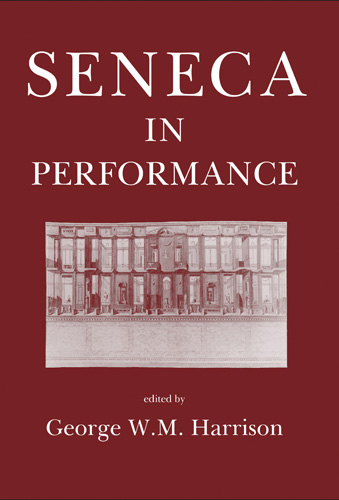
Seneca in Performance
edited by George W.M. Harrison
Hardback (Published)
(December 2000)
ISBN: 9780715629314
6.1 x 9.17 inches
Price: $80.00
On back order
The plays of Seneca the Younger, minister and philosopher under Nero, are today increasingly studied, appreciated and performed. Here, in twelve new papers from a distinguished international cast, scholars explore established questions, such as whether the plays were written for the stage, and newer topics such as the playwright’s subtleties of characterisation, his relation to contemporary Roman spectacle and art – and the problems arising in translating him to modern text or stage.
Introduction SENECA ON THE ANCIENT STAGE 1. Playing Seneca? - John G. Fitch 2. Production of Seneca's Trojan Women, ancient? and modern - Elaine Fantham 3. Location! Location! Location! Choral absence and theatrical space in the Troades - C.W. Marshall 4. Nothing within which passeth show: Character and color in Senecan Tragedy - Brian S. Hook CONTEMPORARY ROMAN SOCIAL INFLUENCES ON SENECA 5. A new look at Seneca's Phaedra - Hanna M. Roisman 6. The spectacle of death in Seneca's Troades - Jo-Ann Shelton 7. Grotesque vision: Seneca's Tragedies and Neronian art - Eric R. Varner 8. Semper ego auditor tantum?: Performance and physical setting of Seneca's plays - George W.M. Harrison MODERN TRANSLATION AND STAGING 9. Seneca and Chaucer: Translating both poetry and sense - Frederick Ahl 10. Seneca's Trojan Women: Identity and survival in the aftermath of war - Gyllian Raby 11. Putting Andromacha on stage: A performer's perspective - Katharina Volk 12. Going for Baroque: Seneca and the English - Sander M. Goldberg Bibliography Index
- Edited by George W.M. Harrison
Other Titles in this Series





Similar Books


 Drunk the Potion, No Whit Charmed
The Doctrine of Pure and Perfect Souls from Iamblichus to Damascius

 Epiphanies of the Divine in the Septuagint and the New Testament
Fifth International Symposium of the Corpus Judaeo-Hellenisticum Novi Testamenti (CJHNT), 14-17 May 2015, Nottingham


 John Dunstaple Reading Boethius
John Dunstaple’s Annotations to Boethius’s “De institutione musica” in the Manuscript Oxford, Corpus Christi College Library, MS 118
 Language and Power in the Roman Empire and Early India
Hierarchy, Ambiguity, and the Art of Reading the Signs in Cosmopolitan Cultures
 Late Antique villae in the Balkans (3rd–7th c. AD): Current Research Questions and Perspectives
HAEMUS Companion to the Late Antique Balkans 1
Volume 4
 Music and Colonialism in Fascist Italy
Identity, Propaganda, and Ethnographic Representation
Volume 13



 Nurturing the Elite
Representations of Drinking, Eating, and Religious Vessels in Palmyrene Funerary Iconography
Volume 13


 The Compositional History of the Book of Kings
An Analysis of the Evaluative Frameworks in 1 Kings 14–2 Kings 25




 Contesting Labeled Identities
The Sociology of Gentilics in Biblical and Northwest Semitic Literature
