
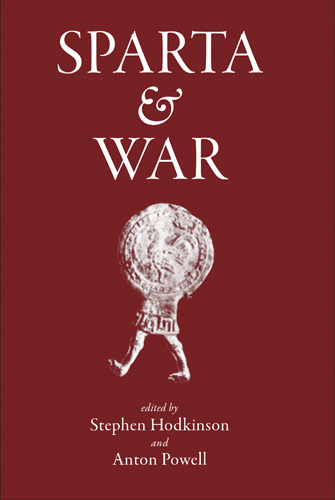
Sparta and War
edited by Stephen Hodkinson and Anton Powell
Hardback (Published)
(December 2006)
ISBN: 9781905125111
6.1 x 9.17 inches
Price: $85.00
In stock
Ten new essays from a distinguished international cast treat Sparta’s most famous area of activity. The results are challenging. Among the contributors, Thomas Figueira explores the paradox that Sparta’s cavalry was an undistinguished institution. Jean Ducat conducts the most thorough study to date of Sparta’s official cowards, the ‘tremblers’. Anton Powell asks why Sparta chose not to destroy Athens after the Peloponnesian War. And Stephen Hodkinson argues that the image of Spartan society as militaristic may after all be a?mirage. This is the sixth volume from the International Sparta Seminar, founded by Powell and Hodkinson in 1988. The series has established itself as the main forum for the study of Spartan history.
Introduction - Stephen Hodkinson 1. The Spartan 'tremblers' - Jean Ducat Translated by P.-J. Shaw 2. The Spartan hippeis - Thomas J. Figueira 3. Commemorating the Spartan war-dead - Polly Low 4. Was classical Sparta a military society? - Stephen Hodkinson 5. The Lacedaemonian state: fortifications, frontiers and historical problems - Jacqueline Christien Translated by Anton Powell 6. Amompharetos, the lochos of Pitane and the Spartan system of villages - Marcello Lupi 7. Why the Spartans fight so welleven in disorder? -- Xenophon's view - Noreen Humble 8. The politics of Spartan mercenary service - Ellen Millender 9. Spartans and the use of treachery among their enemies -Francoise Ruze 10. Why did Sparta not destroy Athens in 404, or 403 BC? -Anton Powell Index
- Edited by Stephen Hodkinson
- Edited by Anton Powell
Other Titles in this Series
 Sparta’s German Children
The ideal of ancient Sparta in the Royal Prussian Cadet-Corps, 1818-1920, and in National-Socialist elite schools (the Napolas), 1933-1945


Similar Books

 Drunk the Potion, No Whit Charmed
The Doctrine of Pure and Perfect Souls from Iamblichus to Damascius

 Epiphanies of the Divine in the Septuagint and the New Testament
Fifth International Symposium of the Corpus Judaeo-Hellenisticum Novi Testamenti (CJHNT), 14-17 May 2015, Nottingham


 Language and Power in the Roman Empire and Early India
Hierarchy, Ambiguity, and the Art of Reading the Signs in Cosmopolitan Cultures
 Late Antique villae in the Balkans (3rd–7th c. AD): Current Research Questions and Perspectives
HAEMUS Companion to the Late Antique Balkans 1
Volume 4
 Nurturing the Elite
Representations of Drinking, Eating, and Religious Vessels in Palmyrene Funerary Iconography
Volume 13


 The Compositional History of the Book of Kings
An Analysis of the Evaluative Frameworks in 1 Kings 14–2 Kings 25

 Contesting Labeled Identities
The Sociology of Gentilics in Biblical and Northwest Semitic Literature


 After Life in Roman Paganism. L’Égypte des astrologues. Les Mages hellénisés
Introductions historiographiques
Volume 7


 Diodor über den ersten Sklavenaufstand auf Sizilien
Ein philologischer und historischer Kommentar
Volume 67


 Frauen im römischen Erbrecht
Historische Entwicklungen, familiäre Rollenbilder und die erbrechtliche Reskriptenpraxis
Volume 241

 Frieden schaffen durch ein gemeinsames Bekenntnis?
Eine Predigtreihe zur Vergegenwärtigung des Nizänischen Glaubensbekenntnises von 325
Volume 7
 I Germani e l’Impero Romano. Storia e diritti
Saggi delle edizioni degli incontri 2024-2025
Volume 14


 Nach der Zerstörung
Die gewaltsame Einnahme von Städten von der Antike bis zum 20. Jahrhundert zwischen Disruption und Kontinuität

 Religiöse Erfahrung in Korinth
Paulus und die frühchristliche Bewegung im Kontext ihrer griechisch-römischen Erfahrungswelt


 But the Wise Shall Understand
Reuse of Prophecies, Chronotope, and Merging of Eschatological Horizons in Daniel 10-12

