
Spartan Education
Youth and Society in the Classical Period
by Jean Ducat
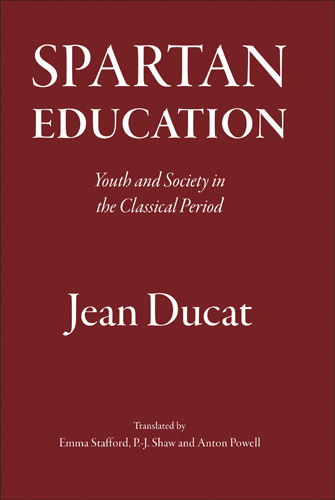
Hardback (Published)
(December 2006)
ISBN: 9781905125074
6.1 x 9.17 inches
Price: $95.00
In stock
Jean Ducat is the leading French authority on classical Sparta. Here is what is likely to be seen as his magnum opus. Ducat systematically collects, translates and evaluates the sources – famous and obscure alike – for Spartan education. He deploys his familiar combination of good judgement and uncompromising recognition of the limits to our knowledge, while drawing at times on aspects of French structuralism. This book is likely to become the definitive reference on its subject, while also informing and provoking the future work of others. Sparta was admitted by Greeks generally, even by its Athenian enemies, to be the School of Hellas. Ducat’s work is thus a major contribution to our understanding of Greek ideas, and indeed to the history of education.
Jean Ducat was born in Morocco in 1933. He followed the usual French cursus in classical studies, as a pupil of the Ecole Normale Superieure (1953-7), then as a member of the French School of Archaeology in Athens (1960-3). He spent the major part of his professional life as a Professor of Greek History in the University of Nice. First known as a specialist in Greek archaic sculpture, since 1974 (‘Le mepris des Hilotes’) he has been increasingly interested in Spartan matters: first in the Spartan way of slavery (Les Hilotes, 1990; Les Penestes, 1994), then more generally in Spartan life and society, on which he has written and is still writing many articles. He now lives in Metz.
- By (author) Jean Ducat
Other Titles in this Series
 Sparta’s German Children
The ideal of ancient Sparta in the Royal Prussian Cadet-Corps, 1818-1920, and in National-Socialist elite schools (the Napolas), 1933-1945





Similar Books


 Contesting Labeled Identities
The Sociology of Gentilics in Biblical and Northwest Semitic Literature

 Drunk the Potion, No Whit Charmed
The Doctrine of Pure and Perfect Souls from Iamblichus to Damascius

 Epigraphic “Shades” from Hellenistic Thrace
Contextualizing Inscriptions in Greek from Thracian Tombs

 Epiphanies of the Divine in the Septuagint and the New Testament
Fifth International Symposium of the Corpus Judaeo-Hellenisticum Novi Testamenti (CJHNT), 14-17 May 2015, Nottingham


 Gold, Silver and Glass: Power Networks, Cultural Identities, Technology Transfers and Agency across the Old World (7th Century BC – 1st Century AD)
Proceedings of a Conference Held at the British Museum, 16–18 June 2023
 Language and Power in the Roman Empire and Early India
Hierarchy, Ambiguity, and the Art of Reading the Signs in Cosmopolitan Cultures
 Late Antique villae in the Balkans (3rd–7th c. AD): Current Research Questions and Perspectives
HAEMUS Companion to the Late Antique Balkans 1
Volume 4


 Nurturing the Elite
Representations of Drinking, Eating, and Religious Vessels in Palmyrene Funerary Iconography
Volume 13





 Roman Copies, Collecting, and Culture in the Bay of Naples and Beyond
Papers in Honor of Eugene J. Dwyer




 The Compositional History of the Book of Kings
An Analysis of the Evaluative Frameworks in 1 Kings 14–2 Kings 25




 Zooarchaeology of Ancient Greek Sanctuaries in Southwestern Sicily
Faunal Analysis from Selinus and Akragas as Evidence of Differences in the Treatment of Animals for Ritual Purposes