
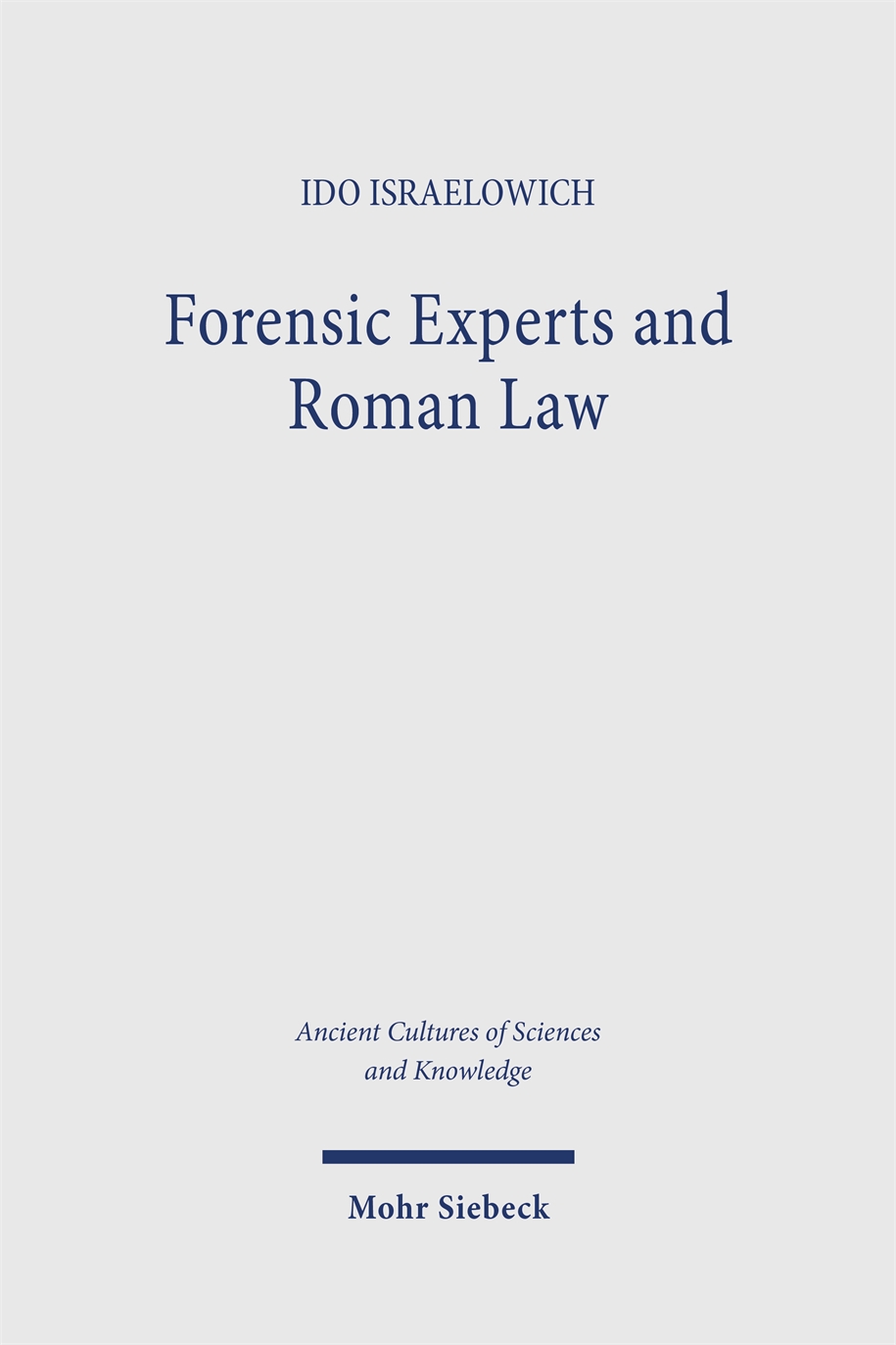
Forensic Experts and Roman Law
By (author) Ido Israelowich
Paperback (Forthcoming)
(January 2027)
ISBN: 9783162009913
6.1 x 9.13 inches
Price: $105.00
Roman judges increasingly relied on specialists to decide disputed facts. Ido Israelowich reveals how physicians, midwives, surveyors, engineers, and wine experts gained (or failed to gain) legal authority, transforming both Roman justice and the development of law.
Roman law is usually told as the work of jurists. Ido Israelowich shows that its factual groundwork lay elsewhere – with the physicians, midwives, surveyors, and wine experts whose judgement Roman courts came to treat as authoritative. He traces the incentives that led those courts to rely on specialists in resolving factual questions. He asks how and why the authority of such experts came to be recognised and sanctioned: whether this development resulted primarily from advances within the disciplines themselves or from external legal, institutional, and social pressures. He further explores whether the role of forensic experts was confined to adjudicating individual disputes or whether the recognition of forensic authority also shaped the development of Roman positive law. Israelowich focuses on experts whose authority the courts formally acknowledged – land surveyors, physicians, midwives, civil engineers, and wine experts – while also considering representatives of other disciplines who sought, but ultimately failed, to obtain judicial recognition. By tracing the interaction between legal institutions and specialised knowledge, Israelowich shows that forensic authority did not merely settle individual cases but left its mark on Roman positive law itself.
Introduction
Chapter 1. Habitus and the Emergence of Expert Status
Land Surveyors and Professional Authority
The Lex Mamilia
Surveyors as Arbitri ex Compromisso
Surveyors in the Service of Roman Magistrates
Actio si Mensor Falsum Modum Dixerit
The Scope of the Actio si Mensor Falsum Modum Dixerit
Wine Experts and Forensic Skills
Conclusion
Chapter 2. Medicine as a Legal Skill
Medicine and the Aedilian Edict
The Aedilian Edict
The Legalization of Medical Practice
The Emergence of Forensic Medicine
Conclusion
Chapter 3. Medical Expertise in the Roman Court
The Legal Infrastructure
Case Study I. Physicians and Violent Injury
Physicians as Judicial Authorities
Documentary Evidence and the Petition Procedure
Public Physicians
Case Study II. Midwives and Reproductive Disputes
The Midwife in Graeco-Roman Medicine
Midwives and Forensic Authority
Pregnancy and Lineage Disputes
Birth Registration and the Professio Liberorum
The Senatus Consultum Plancianum and Disputed Paternity
The Rescript De Inspiciendo Ventre Custodiendoque Partu
The Duty to Recognize One's Child
The Carbonian Edict and Posthumous Heirs
Child Exposure as Evidence
Habitus, Professionalization, and the Transformation of Authority
The Paterfamilias and the Limits of Domestic Authority
Case Study III. Physicians and Mental Illness
Medicine and Impaired Cognition
Literary Evidence
Conclusion
Chapter 4. Professional Liability and the Development of Forensic Science
The Lex Aquilia
Professional Responsibility
Professional Liability and Forensic Science
- By (author) Ido Israelowich
Other Titles in this Series
 Female Bodies and Female Practitioners
Gynaecology, Women's Bodies, and Expertise in the Ancient to Medieval Mediterranean and Middle East
Volume 2


Similar Books
 East Meets West: Justice, Law, and Politics
The 13th Kobe Lecture and the 2nd IVR Japan International Conference, Chiba, September 2023
 False Friends in Comparative Law
Advantages and Risks of Legal Transplants in Civil Law – the Polish-German Perspective

 Law, Economics, and Inequalities in the Welfare State
Proceedings of the Special Workshops held at the 31st World Congress of the International Association for Philosophy of Law and Social Philosophy in Seoul, Republic of Korea, 2024
 Legal Pluralism and the Tajik Experience of Xinjiang
Between Custom and the Chinese State: An Ethnographic Perspective
 Liturgia semper reformanda
Adaptations and accommodations in the liturgy in light of canon 838 of the Code of Canon Law


 The EPPO/OLAF Compendium of National Procedures: Estonia
Desktop codes on the procedural law of the Member States with annotations by national experts
 The EPPO/OLAF Compendium of National Procedures: Greece
Desktop codes on the procedural law of the Member States with annotations by national experts
 The EPPO/OLAF Compendium of National Procedures: Italy
Desktop codes on the procedural law of the Member States with annotations by national experts
 The Right to Regulate of Developing Countries in International Investment Law
A Contextual Approach to International Investment Agreements
Volume 11

 (Bloß) symbolische Rechtsetzung
Eine interdisziplinäre Untersuchung der deutschen Glücksspielregulierung auf ihre funktionelle und symbolische Wirkung
 Active Space Debris Removal
Rechte und Pflichten der Staaten im Kontext der aktiven Weltraumabfallbeseitigung
Volume 268

 Annäherungen an das japanische Recht
Festschrift für Heinrich Menkhaus zum 70. Geburtstag
Volume 245
 Ausforschung und Rechtsdurchsetzung im Unionsprivatrecht
Herleitung und Ausgestaltung eines allgemeinen unionsrechtlichen Informationsrechts





 Credit Default Swap-Aktivismus
Eine ökonomische Analyse und rechtliche Bewertung der Einflussnahme von Credit Default Swap-Investoren auf Unternehmen


 Das rechtliche Erbe Österreichs im polnischen Verwaltungsverfahren
Zum 100-jährigen Jubiläum des Allgemeinen Verwaltungsverfahrensgesetzes (AVG 1925–2025)
 Das Rheinische Recht
Neue Perspektiven auf die Geschichte des französischen Rechts an Rhein und Mosel, ca. 1750 bis 1900
 Das Rückschrittsverbot als Instrument Europäischen Werteschutzes
Schutz unionaler Werte im Spannungsfeld nationalstaatlichen Pluralismus
 Das Spannungsverhältnis von Freiwilligkeit und Zwang
Eine grenzüberschreitende Untersuchung obligatorischer Schiedsverfahren
Volume 248

 Der Einsatz Künstlicher Intelligenz beim Erlass polizeilicher Platzverweisungen
Zulässigkeit eines Ermessensverwaltungsaktes durch Künstliche Intelligenz im Lichte des allgemeinen Verwaltungsrechts und des Grundgesetzes am Beispiel der polizeilichen Platzverweisung
Volume 37
 Der gewöhnliche Aufenthalt des Erblassers
Grundlagen und Grenzen der Aufenthaltsanknüpfung in der Europäischen Erbrechtsverordnung
Volume 249
 Der politische Streik im deutschen Arbeitskampfrecht
Dogmatische Entwicklungslinien von 1869 bis in die 1980er Jahre
Volume 393


