
Exclusivity and Variety
Perspectives on Multidimensional Exegesis
By (author) L.C. Jonker

The present state of the exegetical discipline is characterized in this book by the exploration of the concepts exclusivity and variety. There is variety not only in the numerous methods and approaches, but also in variants in methodological application, hermeneutical presuppositions, confessional and dogmatic specialization areas and the increasingly volume of scholarly literature. To escape the abyss of variety, exegetes often resort to exclusivistic claims, sometimes deliberately. The main interest of this book is methodological, with the implication that the discussion is limited to the variety of exegetical methodologies. The working hypothesis is that a multidimensional and/or integrational aproach to exegesis can evade the dangers of exclusivity and variety. Various theoretical guidelines, which should be taken into consideration in this discussion, are filtered out from previous attempsts in this regard. Two methodologies, namely a historical-critical one and a narrative one, are used as examples in this investigation. In order to investigate the practical implementation of these methodologies, the Samson Cycle (Judges 13-16) is analyzed. Subsequently, both methodologies are evaluated to the theoretical guidelines formulated earlier. The multidimensional and/or integrational possibilities of these methodologies are then scrutinized. The investigation leads to the formulation of three models which may serve as guidelines for further discussion on this topic. Preference is given to an adapted communication model which serves as a hermeneutical ‘map’ on which exegetical methodologies can be ‘plotted’. It is proposed that the operative factor of such a communication model is a reading strategy which consists of two components,namely (I) a specialized component and (II) a competence component.
The present state of the exegetical discipline is characterized in this book by the exploration of the concepts exclusivity and variety. There is variety not only in the numerous methods and approaches, but also in variants in methodological application, hermeneutical presuppositions, confessional and dogmatic specialization areas and the increasingly volume of scholarly literature. To escape the abyss of variety, exegetes often resort to exclusivistic claims, sometimes deliberately. The main interest of this book is methodological, with the implication that the discussion is limited to the variety of exegetical methodologies. The working hypothesis is that a multidimensional and/or integrational aproach to exegesis can evade the dangers of exclusivity and variety. Various theoretical guidelines, which should be taken into consideration in this discussion, are filtered out from previous attempsts in this regard. Two methodologies, namely a historical-critical one and a narrative one, are used as examples in this investigation. In order to investigate the practical implementation of these methodologies, the Samson Cycle (Judges 13-16) is analyzed. Subsequently, both methodologies are evaluated to the theoretical guidelines formulated earlier. The multidimensional and/or integrational possibilities of these methodologies are then scrutinized. The investigation leads to the formulation of three models which may serve as guidelines for further discussion on this topic. Preference is given to an adapted communication model which serves as a hermeneutical ‘map’ on which exegetical methodologies can be ‘plotted’. It is proposed that the operative factor of such a communication model is a reading strategy which consists of two components,namely (I) a specialized component and (II) a competence component.
- By (author) L.C. Jonker
Other Titles in this Series
 Law, Prophets, and Wisdom
On the Provenance of Translators and their Books in the Septuagint Version
Volume 68


 Heilige oder Hure?
Die Rezeptionsgeschichte von Juda und Tamar (Genesis 38) von der Antike bis zur Reformationszeit
Volume 48

 Texts and Contexts of Jeremiah
The Exegesis of Jeremiah 1 and 10 in Light of Text and Reception History
Volume 82
 Transformations in the Septuagint
Towards an Interaction of Septuagint Studies and Translation Studies
Volume 47
 Oh God of Battles! Steal My Soldier’s Hearts!
A Study of the Hebrew and Greek Text Forms of Jeremiah 10:1-18
Volume 83

 Like Nails Firmly Fixed (Qoh 12:11)
Essays on the Text and Language of the Hebrew and Greek Scriptures Presented to Peter J. Gentry on the Occasion of His Retirement
Volume 115

 The Akedah Servant Complex
The Soteriological Linkage of Genesis 22 and Isaiah 53 in Ancient Jewish and Early Christian Writings
Volume 69
 In Spirit and Truth
An Exegetical Study of John 4:19-26 and a Theological Investigation of the Replacement Theme in the Fourth Gospel
Volume 46
 Insights into Editing in the Hebrew Bible and the Ancient Near East
What Does Documented Evidence Tell Us about the Transmission of Authoritative Texts?
Volume 84

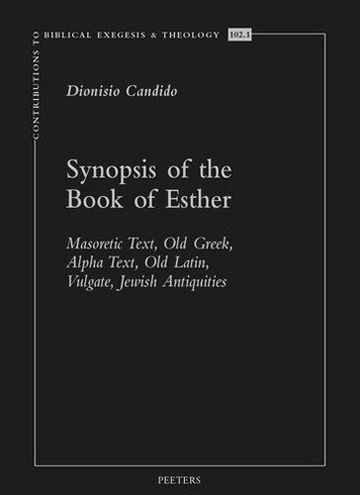 Synopsis of the Book of Esther
Masoretic Text, Old Greek, Alpha Text, Old Latin, Vulgate, Jewish Antiquities
 Prophecy after the Prophets?
The Contribution of the Dead Sea Scrolls to the Understanding of Biblical and Extra-Biblical Prophecy
Volume 52





Similar Books

 A Companion to Christianity and Sport in Europe and North America (19th-21st centuries)
Volume 1: Western and Eastern Europe
 A Connecting Polemic in the Medieval Mediterranean
The Correspondence of Leo III and ʿUmar II
Volume 6





 Ars Prophetica
Theology in the Poetry of Twentieth-Century Hebrew Poets Avraham Halfi, Shin Shalom, Amir Gilboa, and T. Carmi
 As Messianism Turns to Heresy
The Regenstein Chair Lectures On Lurianic Kabbalah and Shabbatai Tzevi at Hebrew Union College - Cincinnati


 Creating the Woman in Antiquity
Proceedings of the 16th Melammu Workshop, Innsbruck, 2–3 June 2022
Volume 13
 Cultic Kisses
Fruitful Encounters Between Deities and Humans. Festschrift for Angelika Berlejung on the Occasion of Her 65th Birthday
 De/colonizing Theologies
Glocal Histories, Contemporary Challenges, Theoretical Reflections
Volume 4
 Drunk the Potion, No Whit Charmed
The Doctrine of Pure and Perfect Souls from Iamblichus to Damascius






 Extracanonical Traditions and the Holy Land
Texts, Rituals, and Material Culture in Late Antique Palestine
 Fear, Fear of God, God-Fearers
Philological and Historical Perspectives on the World of Ancient Judaism and Christianity


 Gender and Iconography in Antiquity
Femininities, Masculinities, Ambiguities, and Beyond in the Ancient Levant, Near East, and Mediterranean