
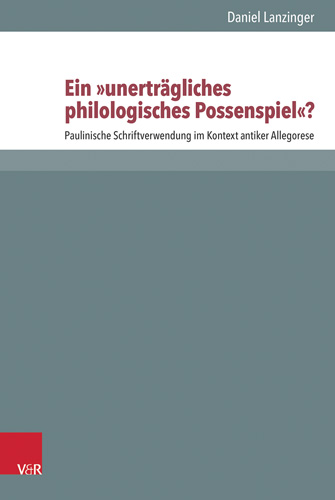
Ein „unerträgliches philologisches Possenspiel“?
Paulinische Schriftverwendung im Kontext antiker Allegorese
By (author) Daniel Lanzinger
Hardback (Published)
(April 2016)
ISBN: 9783525593707
6.34 x 9.33 inches
Price: $188.00
In stock
Allegorische Auslegung – Methode mit klaren Spielregeln
English summary: How St. Paul dealt with scripture is often viewed because it is far removed from modern standards of textual interpretation. This is particularly true in those passages where Paul employs allegorical interpretations in which the meaning of a text is construed in such a way that it seems to contradict the plain wording of the text. For example, in 1 Corinthians 9:8-12a, Paul advances the argument that the text from Deuteronomy 24:4, which advocates muzzling oxen while they thresh grain, does not refer to oxen but rather to the material support given by Christians to the apostles. Such interpretive positions are only understandable when one takes the ancient concepts of proper textual interpretation as the standard against which to judge Paul’s exegesis, rather than modern standards. In this work, Daniel Lanzinger assembles a representative selection of texts that were contemporary with the New Testament (such as works by Heraclitus, Plutarch, Philo, and the writings of Qumran) and analyses which methods were used in contemporary religious traditions. Ancient treatises on rhetoric also prove to be important instruments of analysis for this study. The results of this survey show that allegorical interpretation in the ancient world was concerned with established and accepted interpretive approaches to literature that offered specific guidelines for interpretation. Lanzinger then applies his findings to relevant passages in Paul’s writing (such as Gal. 4:21-31, 1 Cor. 9:8-12a, 10:1-14, and Gal. 3:16). This investigation ultimately shows that Paul knew the contemporary methods of allegorical interpretation and he deployed them in his writings in order to emphasis his arguments in an elegant manner. German description: Die Art und Weise, wie Paulus mit der Schrift umgeht, ist vielen Exegeten eher peinlich, weil sie von heutigen Standards der Textinterpretation weit entfernt ist. Ganz besonders gilt dies fur jene Stellen, an denen sich Paulus einer allegorischen Auslegung bedient, d.h. dem Text einen Sinn unterstellt, der dem Wortlaut widerspricht: In 1 Kor 9,8-12a vertritt Paulus beispielsweise die These, dass sich das Verbot, einem Ochsen beim Dreschen einen Maulkorb anzulegen (Dtn 25,4), nicht auf Ochsen beziehe, sondern die Alimentierung von Aposteln regele. Solche Stellen sind nur verstehbar, wenn man nicht die moderne, sondern die antike Auffassung von sachgemasser Textinterpretation zum Massstab nimmt. Zu diesem Zweck untersucht Lanzinger eine reprasentative Auswahl von Vergleichstexten aus der Umwelt des Neuen Testaments (Heraklit, Plutarch, Philon, Qumranschriften) unter der Fragestellung, mit welcher Methodik darin religiose Traditionen aktualisiert werden. Als wichtiges Analyseinstrument erweisen sich dabei die antiken Rhetorikhandbucher. Es ergibt sich, dass es sich bei der Allegorese um eine in der antiken Welt etablierte und akzeptierte Verfahrensweise mit bestimmten Spielregeln handelt. Diesen Befund wendet Lanzinger auf die einschlagigen Stellen bei Paulus an (v.a. Gal 4,21-31; 1 Kor 9,8-12a; 10,1-14; Gal 3,16). Dabei stellt sich heraus, dass Paulus die Methodik der Allegorese kennt und sie in seinen Briefen gezielt einsetzt, um auf elegante Weise seine Argumente zu unterstreichen.
Dr. Daniel Lanzinger is Assistant Professor at the University of Hamburg, Germany.
- By (author) Daniel Lanzinger
Other Titles in this Series


 Christlich-jüdische Momente des Neuen Testaments
Exegetische und rezeptionsgeschichtliche Studien – zu verschiedentlich als antijudaistisch eingeschätzten Texten

 Doppelkodierung im Lukasevangelium und in der Apostelgeschichte
Neue Perspektiven auf eine lukanische Strategie
 Die Weisheit der Gottesherrschaft
Eine Untersuchung zur jesuanischen Synthese von traditioneller und apokalyptischer Weisheit



 Allegorie – Metapher – Mythos – Schrift
Beiträge zur religiösen Sprache im Neuen Testament und in seiner Umwelt

 Montanistische Orakel und kirchliche Opposition
Der frühe Streit zwischen den phrygischen »neuen Propheten« und dem Autor der vorepiphanischen Quelle als biblische Wirkungsgeschichte des 2. Jh. n.Chr
 Allgegenwärtiger Konflikt im Matthäusevangelium
Exegetische und sozialpsychologische Analyse der Konfliktgeschichte
 »If Christ has not been raised …«
Studies on the Reception of the Resurrection Stories and the Belief in the Resurrection in the Early Church
 Sprachbilder und Bildsprache
Studien zur Kontextualisierung biblischer Texte. Festschrift für Max Küchler zum 75. Geburtstag
 Frühes Christentum und Religionsgeschichtliche Schule
Festschrift zum 65. Geburtstag von Gerd Lüdemann

 The ‘New Testament’ as a Polemical Tool
Studies in Ancient Christian Anti-Jewish Rhetoric and Beliefs


 ABBA Vater
Der literarische Befund vom Altaramäischen bis zu den späten Midrasch- und Haggada-Werken in Auseinandersetzung mit den Thesen von Joachim Jeremias
 “Montanism” in the Roman World
The New Prophecy Movement from Historical, Sociological, and Ecclesiological Perspectives. Festschrift for William Tabbernee on the Occasion of His 80th Birthday

 Idumea and the Idumeans
An Oriental Ethnos at the Crossroads of Levantine Cultures in Hellenistic and Roman Times
 Asceticism and Exegesis in Early Christianity
The Reception of New Testament Texts in Ancient Ascetic Discourses
Similar Books


 Apocrypha, Magic, Liturgy
The Multiple Identities of Coptic Prayers in Late Antique and Early Islamic Egypt
 Athanasius of Alexandria, Epistula ad episcopos Aegypti et Libyae
Old Slavonic Version and English Translation
Volume 261



 Contesting Labeled Identities
The Sociology of Gentilics in Biblical and Northwest Semitic Literature
 Cyril of Alexandria’s Christological Exegesis
Explorations of Partitive Exegesis in the Dialogues on the Trinity
Volume 70


 Epiphanies of the Divine in the Septuagint and the New Testament
Fifth International Symposium of the Corpus Judaeo-Hellenisticum Novi Testamenti (CJHNT), 14-17 May 2015, Nottingham


 Extracanonical Traditions and the Holy Land
Texts, Rituals, and Material Culture in Late Antique Palestine
 From Joseph to Jesus
The Joseph Narrative as a Compositional Template from Old Greek Esther to the Gospel of Luke
Volume 125





 Nicholas of Lyra’s Commentaries on the Gospels of Matthew and Luke
Franciscan Exegesis in a Time of Crisis
 Paradise Lost in Transmission
The Return to Eden in the Apocalypse of Peter within Its Ethiopic and Early Christian Contexts




 Punning in Odd or Elegant Constructions in Jeremiah
The Convergence of Linguistics, Rhetoric, and Textuality in the Hebrew Text of Jeremiah


 Reformed Covenantal Eudaimonism
Wilhelmus à Brakel (1635–1711) on Highest Good, Virtue, and Law
Volume 87