
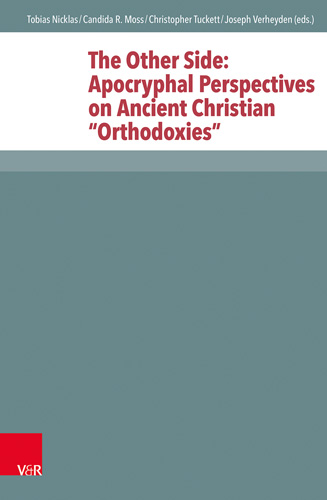
The Other Side: Apocryphal Perspectives on Ancient Christian “Orthodoxies”
Contributions by Christoph Markschies Contributions by Tobias Nicklas Contributions by Ismo Dunderberg Contributions by Petri Luomanen Contributions by Reidar Aasgaard Contributions by Meghan Henning Contributions by Judith Hartenstein Contributions by Jens Schröter Contributions by Christopher Tuckett Contributions by Candida R. Moss Contributions by Jacques van der Vliet Contributions by Jan Dochhorn Contributions by Basil Lourié Contributions by John Carey Edited by Tobias Nicklas Edited by Candida R. Moss Edited by Christopher Tuckett Edited by Joseph Verheyden
Hardback (Out of print)
(July 2017)
ISBN: 9783525540589
6.34 x 9.33 inches
Price: $150.00
On back order
Which categories ought to be considered to understand an ancient, multi-dimensionally perceived Christianity?
English summary: Anyone who wishes to manage their sources adequately must work with categories that help to bring order to the transcribed material. In many cases, such categories simultaneously shape the way in which we evaluate our sources. Critical reflection of the chosen categories is therefore crucial for robust historical study. This rings especially true when certain categories are not viewed through neutral eyes, but through polemically judgemental eyes. One extreme case would be the category of “apocryphalness”. In some areas, associations like “fraudulent” versus and “secret” – interlinked to this term in Antiquity – are still shaping the way Christian apocrypha are considered to this day. Closely associated with this is the use of the adjectival categories like “(proto)-orthodox”, “majority church” versus those like “heretical” (again polemically pejorative).In their chapters, the contributors demonstrate not only how the set limits – as referred to the categories above – do indeed play a role, but more importantly, where these limits have been exceeded and where we must therefore work with new and different categories to understand the meaning of “apocryphal” writings and/or writings that have “become apocryphal” in terms of the history of an ancient Christianity perceived as multi-dimensional and dynamic. The following questions play a significant role in our understanding of this: In which contexts and by which groups are “newly apocryphal” writings used? Where do apocryphal writings or those “newly apocryphal” play a contextual role that would, nowadays, be perceived as “orthodox”? Which functions are assign thereto? German description: Wer angemessen mit Quellen umgehen will, muss mit Kategorien arbeiten, welche helfen, Ordnung in das uberlieferte Material zu bringen. Gleichzeitig pragen solche Kategorien in vielen Fallen unsere Wertung von Quellen. Deswegen ist auch die kritische Reflexion der verwendeten Kategorien entscheidend fur verantwortliches historisches Arbeiten. Dies gilt besonders dann, wenn bestimmte Kategorien nicht neutral, sondern allzu haufig polemisch wertend verwendet werden. Ein extremer Fall ist die Verwendung der Kategorie “apokryph”. Die sich bereits in der Antike mit dieser Bezeichnung verbindenden Assoziationen von “gefalscht” einerseits und “geheim” andererseits pragen in manchen Bereichen bis heute den Umgang mit “christlichen Apokryphen”. Eng verbunden ist damit haufig die Verwendung der Kategorien “(proto-)orthodox”, “mehrheitskirchlich” einerseits und (erneut polemisch abwertend) “haretisch” andererseits.In den Beitragen des vorliegenden Bandes wird gezeigt, wo Grenzen, die in den oben diskutierten Kategorien gesetzt werden, tatsachlich eine Rolle spielen, vor allem aber, wo diese Grenzen uberschritten sind und wir deswegen mit neuen, anderen Kategorien arbeiten mussen, um die Bedeutung “apokrypher” bzw. “apokryph gewordener” Schriften fur die Geschichte eines vieldimensional und dynamisch verstandenen antiken Christentums zu verstehen.Folgende Fragen spielen dabei eine entscheidende Rolle: In welchen Kontexten und durch welche Gruppen werden apokryph gewordene Schriften verwendet? Wo spielen apokryphe bzw. apokryph gewordene Texte in Kontexten eine Rolle, die wir heute als “orthodox” bezeichnen wurden? Welche Funktionen kommen ihnen dabei zu?
Dr. theol. Christoph Markschies ist Professor für Kirchengeschichte in Berlin.
- Contributions by Christoph Markschies
- Contributions by Tobias Nicklas
- Contributions by Ismo Dunderberg
- Contributions by Petri Luomanen
- Contributions by Reidar Aasgaard
- Contributions by Meghan Henning
- Contributions by Judith Hartenstein
- Contributions by Jens Schröter
- Contributions by Christopher Tuckett
- Contributions by Candida R. Moss
- Contributions by Jacques van der Vliet
- Contributions by Jan Dochhorn
- Contributions by Basil Lourié
- Contributions by John Carey
- Edited by Tobias Nicklas
- Edited by Candida R. Moss
- Edited by Christopher Tuckett
- Edited by Joseph Verheyden
Other Titles in this Series
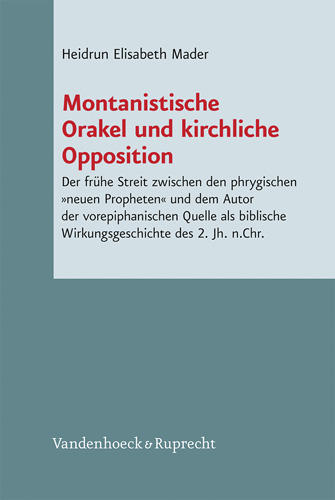 Montanistische Orakel und kirchliche Opposition
Der frühe Streit zwischen den phrygischen »neuen Propheten« und dem Autor der vorepiphanischen Quelle als biblische Wirkungsgeschichte des 2. Jh. n.Chr
 The ‘New Testament’ as a Polemical Tool
Studies in Ancient Christian Anti-Jewish Rhetoric and Beliefs
 »If Christ has not been raised …«
Studies on the Reception of the Resurrection Stories and the Belief in the Resurrection in the Early Church
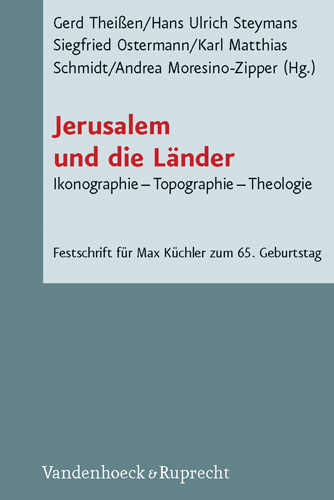

 Frühes Christentum und Religionsgeschichtliche Schule
Festschrift zum 65. Geburtstag von Gerd Lüdemann

 Idumea and the Idumeans
An Oriental Ethnos at the Crossroads of Levantine Cultures in Hellenistic and Roman Times

 ABBA Vater
Der literarische Befund vom Altaramäischen bis zu den späten Midrasch- und Haggada-Werken in Auseinandersetzung mit den Thesen von Joachim Jeremias
 “Montanism” in the Roman World
The New Prophecy Movement from Historical, Sociological, and Ecclesiological Perspectives. Festschrift for William Tabbernee on the Occasion of His 80th Birthday
 The Great Controversy
The Individual’s Struggle Between Good and Evil in the Testaments of the Twelve Patriarchs and in their Jewish and Christian Contexts


 Asceticism and Exegesis in Early Christianity
The Reception of New Testament Texts in Ancient Ascetic Discourses
 Paulus als Briefroman erzählt
Studien zum antiken Briefroman und seiner christlichen Rezeption in den Pastoralbriefen


 Zwischen Synoptikern und Gnosis – ein viertes Evangelium
Studien zum Johannesevangelium und zur Gnosis



Similar Books


 Apocrypha, Magic, Liturgy
The Multiple Identities of Coptic Prayers in Late Antique and Early Islamic Egypt
 Athanasius of Alexandria, Epistula ad episcopos Aegypti et Libyae
Old Slavonic Version and English Translation
Volume 261



 Contesting Labeled Identities
The Sociology of Gentilics in Biblical and Northwest Semitic Literature
 Cyril of Alexandria’s Christological Exegesis
Explorations of Partitive Exegesis in the Dialogues on the Trinity
Volume 70


 Epiphanies of the Divine in the Septuagint and the New Testament
Fifth International Symposium of the Corpus Judaeo-Hellenisticum Novi Testamenti (CJHNT), 14-17 May 2015, Nottingham


 Extracanonical Traditions and the Holy Land
Texts, Rituals, and Material Culture in Late Antique Palestine
 From Joseph to Jesus
The Joseph Narrative as a Compositional Template from Old Greek Esther to the Gospel of Luke
Volume 125





 Nicholas of Lyra’s Commentaries on the Gospels of Matthew and Luke
Franciscan Exegesis in a Time of Crisis
 Paradise Lost in Transmission
The Return to Eden in the Apocalypse of Peter within Its Ethiopic and Early Christian Contexts




 Punning in Odd or Elegant Constructions in Jeremiah
The Convergence of Linguistics, Rhetoric, and Textuality in the Hebrew Text of Jeremiah


 Reformed Covenantal Eudaimonism
Wilhelmus à Brakel (1635–1711) on Highest Good, Virtue, and Law
Volume 87