
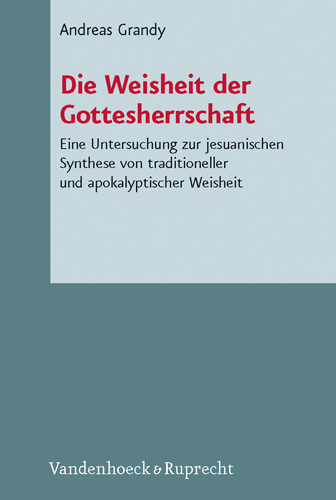
Die Weisheit der Gottesherrschaft
Eine Untersuchung zur jesuanischen Synthese von traditioneller und apokalyptischer Weisheit
By (author) Andreas Grandy
Hardback (Published)
(July 2012)
ISBN: 9783525539781
6.34 x 9.33 inches
Price: $125.00
In stock
The question of Jesus’ wisdom has already been raised in the Gospel of Mark (6.2). Andreas Grandy takes a closer look at this issue: he sets it in the context of the Jewish concepts of wisdom of the Hellenistic-Roman time. He also examines it in the light of academic research on the New Testament of the last decade. German text.
English summary: The slightly revised version of a doctoral dissertation directed by M. Kuchler and L. Devillers and presented in 2011 to the theological faculty of the University of Fribourg in Switzerland, this volume takes its starting point from Mk 6:2 (“What is this wisdom that has been given to him?”) and surveys research on Jewish wisdom concepts in the Hellenistic-Roman period; attempts at interpreting Jesus’ wisdom; Jesus’ wisdom as the transformation of traditional and apocalyptic wisdom; and Synoptic wisdom sayings, motif-analytical comparisons, and the historical Jesus. Next it considers Jesus’ wisdom sayings in the traditional sapiential milieu and under the apocalyptic-sapiential horizon: Jesus’ transformation of the apocalypticsapiential horizon-first and last, great and small, and high and low; Jesus’ transformation of the traditional-sapiential milieu-riches, possessions, and earning a living; and the new quality of the present in the free space of the Basileiva tou’ Qeou’-faith that moves mountains. Then it reflects on the wisdom of God’s reign as Jesus’ synthesis of traditional and apocalyptic wisdom. New Testament Abstracts (57/1-2013), Boston College School of Theology and Ministry German description: Die Frage nach der Weisheit Jesu von Nazareth, die schon in Mk 6,2 (Was ist das fur eine Weisheit, die ihm gegeben ist?) gestellt wurde, ordnet Andreas Grandy forschungsgeschichtlich sowohl im Rahmen der judischen Weisheitskonzeptionen in hellenistisch-romischer Zeit als auch anhand der wissenschaftlichen Fragestellungen und Antwortversuche der neutestamentlichen Forschung der letzten Jahrzehnte ein. Unter Verwendung von ausgewahlten Weisheitslogien aus den synoptischen Evangelien zeigt Grandy die jesuanische Transformation des traditionell-weisheitlichen Nahrbodens und des apokalyptisch-weisheitlichen Horizontes Schritt fur Schritt auf; scharft ihr Profil im innerjudischen und interkulturellen Vergleich mit der griechisch-romischen Umwelt und fuhrt unter dem Stichwort der Weisheit der Gottesherrschaft einer neuen synthetischen Darstellung zu. Jesuanische Weisheit zeichnet sich dadurch aus, dass sie die traditionell-weisheitliche Ruhe der Geschichte aufbricht und die apokalyptisch-weisheitliche Dramatik hinter den Kulissen irdischen Geschehens umwandelt in eine lebensforderliche Dynamik innerhalb der Geschichte. Aufgrund dieser Dynamik konnen Freiraume des Heilens und Heilwerdens im Rahmen der sich bereits machtvoll realisierenden Gottesherrschaft eroffnet werden. Im Hinblick auf das menschliche Handeln folgt daraus die jesuanische Provokation, die Gegenwart in der Macht der Gottesherrschaft aktiv umzugestalten: anfanghaft, fragmentarisch und in bestandigem Scheitern und Hoffen. Dies ist eine bleibende Aufgabe christlicher Existenz: Kirchen mussen zu jenen Orten gehoren, die davon gepragt sind, dass Gottes Wille geschieht.
Dr. theol. Andreas Grandy ist Mittelschullehrer für Mathematik und Religion an der Kantonsschule Solothurn.
- By (author) Andreas Grandy
Other Titles in this Series

 Talking God in Society
Multidisciplinary (Re)constructions of Ancient (Con)texts. Festschrift for Peter Lampe. Vol. 1: Theories and Applications

 Men and Women in the Household of God
A Contextual Approach to Roles and Ministries in the Pastoral Epistles
 Christliche Hauskirche und Neues Testament
Die Ikonologie des Baptisteriums von Dura Europos und das Diatessaron Tatians
 Von Paulus zur Apokalypse – und weiter
Exegetische und rezeptionsgeschichtliche Studien zum Neuen Testament; (samt englischsprachigen summaries)
 Early Christian Encounters with Town and Countryside
Essays on the Urban and Rural Worlds of Early Christianity


 Ecce Agnus Dei
Rezeptionsästhetische Untersuchung zum neutestamentlichen Gotteslamm in der bildenden Kunst

 Das Gesetz im frühen Judentum und im Neuen Testament
Festschrift für Christoph Burchard zum 75. Geburtstag



 Der eine und einzige Gott
Monotheistische Formeln im Urchristentum und ihre Vorgeschichte bei Griechen und Juden
 Zweifelskonzepte im Frühchristentum
Dipsychia und Oligopistia im Rahmen menschlicher Dissonanz- und Einheitsvorstellungen in der Antike
 Ein „unerträgliches philologisches Possenspiel“?
Paulinische Schriftverwendung im Kontext antiker Allegorese

 Christlich-jüdische Momente des Neuen Testaments
Exegetische und rezeptionsgeschichtliche Studien – zu verschiedentlich als antijudaistisch eingeschätzten Texten

 Doppelkodierung im Lukasevangelium und in der Apostelgeschichte
Neue Perspektiven auf eine lukanische Strategie

Similar Books


 Apocrypha, Magic, Liturgy
The Multiple Identities of Coptic Prayers in Late Antique and Early Islamic Egypt
 Athanasius of Alexandria, Epistula ad episcopos Aegypti et Libyae
Old Slavonic Version and English Translation
Volume 261



 Contesting Labeled Identities
The Sociology of Gentilics in Biblical and Northwest Semitic Literature
 Cyril of Alexandria’s Christological Exegesis
Explorations of Partitive Exegesis in the Dialogues on the Trinity
Volume 70


 Epiphanies of the Divine in the Septuagint and the New Testament
Fifth International Symposium of the Corpus Judaeo-Hellenisticum Novi Testamenti (CJHNT), 14-17 May 2015, Nottingham


 Extracanonical Traditions and the Holy Land
Texts, Rituals, and Material Culture in Late Antique Palestine
 From Joseph to Jesus
The Joseph Narrative as a Compositional Template from Old Greek Esther to the Gospel of Luke
Volume 125





 Nicholas of Lyra’s Commentaries on the Gospels of Matthew and Luke
Franciscan Exegesis in a Time of Crisis
 Paradise Lost in Transmission
The Return to Eden in the Apocalypse of Peter within Its Ethiopic and Early Christian Contexts




 Punning in Odd or Elegant Constructions in Jeremiah
The Convergence of Linguistics, Rhetoric, and Textuality in the Hebrew Text of Jeremiah


 Reformed Covenantal Eudaimonism
Wilhelmus à Brakel (1635–1711) on Highest Good, Virtue, and Law
Volume 87