
The Spirit Helps our Weakness
Rom 8:26a in Light of Paul's Missiological Purpose for Writing the Letter to the Romans
by T. Vollmer
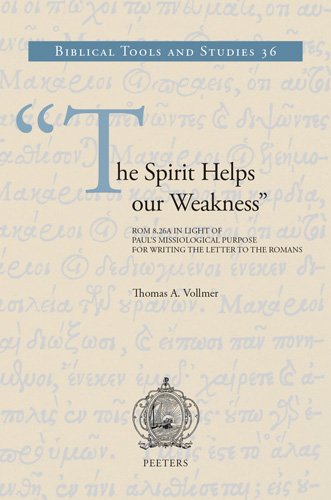
“The Spirit Helps Our Weakness” examines the fundamental question of how precisely the Spirit aids the weakness of believers. After an initial discussion on the way Rom 8,26-27 has been interpreted, the study explores the central issues and conclusions in scholarship on the Romans debate. Building upon that scholarship, this study contends that Paul’s purpose in writing the letter revolved around a missiological imperative, which permeates the letter. The second part of the work provides an exegetical analysis of Rom 8,26a, including the way in which the clause fits within its broader context, particularly within vv. 26-27.
“The Spirit Helps Our Weakness” examines the fundamental question of how precisely the Spirit aids the weakness of believers. After an initial discussion on the way Rom 8,26-27 has been interpreted, the study explores the central issues and conclusions in scholarship on the Romans debate. Building upon that scholarship, this study contends that Paul’s purpose in writing the letter revolved around a missiological imperative, which permeates the letter. The second part of the work provides an exegetical analysis of Rom 8,26a, including the way in which the clause fits within its broader context, particularly within vv. 26-27. In light of Paul’s missiological motivation, this study argues that the Spirit serves as activating agent to accomplish God’s mission. Ultimately, the missiological nature of the Spirit, working within believers, underlines the priority for Paul’s ministry and by extension, his purpose for writing the Letter to the Romans.
- By (author) T Vollmer
Other Titles in this Series


 L’ange et la sueur de sang (Lc 22,43-44) ou comment on pourraitbien encore écrire l’histoire
Volume 7
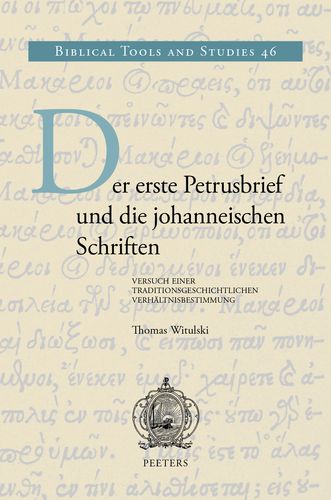 Der erste Petrusbrief und die johanneischen Schriften
Versuch einer traditionsgeschichtlichen Verhältnisbestimmung
Volume 46
 Theologizing in the Corinthian Conflict
Studies in the Exegesis and Theology of 2 Corinthians
Volume 16

 Studien zu Einleitungsfragen und zur Theologie und Exegese des Neuen Testaments
Gesammelte Aufsatze von Peter Dschulnigg
Volume 9


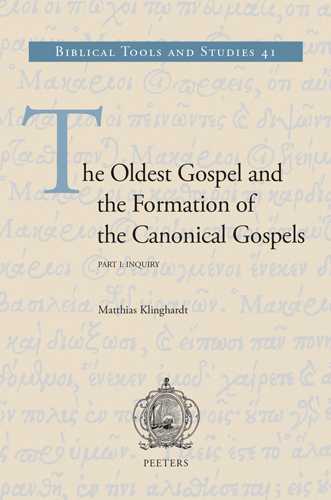 The Oldest Gospel and the Formation of the Canonical Gospels
Part I: Inquiry. Part II: Reconstruction - Translation - Variants
Volume 41


 Paul and God’s Temple
A Historical Interpretation of Cultic Imagery in the Corinthian Correspondence
Volume 2
 Early Christian Commentators of the New Testament
Essays on Their Aims, Methods and Strategies
Volume 42


 Woman, Mother and Bride
An Exegetical Investigation into the "Ecclesial" Notions ofthe Apocalypse
Volume 3

 Ausgewahlte Studien zum Johannesevangelium / Selected Studies in the Gospel of John. 1998-2013
Volume 28

 Die eschatologische Rede des Spruchevangeliums Q
Redaktions- und traditionsgeschichtliche Studies zu Q 17,23-37
Volume 19



Similar Books


 Athanasius of Alexandria, Epistula ad episcopos Aegypti et Libyae
Old Slavonic Version and English Translation
Volume 261



 Contesting Labeled Identities
The Sociology of Gentilics in Biblical and Northwest Semitic Literature
 Cyril of Alexandria’s Christological Exegesis
Explorations of Partitive Exegesis in the Dialogues on the Trinity
Volume 70


 Epiphanies of the Divine in the Septuagint and the New Testament
Fifth International Symposium of the Corpus Judaeo-Hellenisticum Novi Testamenti (CJHNT), 14-17 May 2015, Nottingham


 Extracanonical Traditions and the Holy Land
Texts, Rituals, and Material Culture in Late Antique Palestine
 From Joseph to Jesus
The Joseph Narrative as a Compositional Template from Old Greek Esther to the Gospel of Luke
Volume 125





 Nicholas of Lyra’s Commentaries on the Gospels of Matthew and Luke
Franciscan Exegesis in a Time of Crisis
 Paradise Lost in Transmission
The Return to Eden in the Apocalypse of Peter within Its Ethiopic and Early Christian Contexts




 Punning in Odd or Elegant Constructions in Jeremiah
The Convergence of Linguistics, Rhetoric, and Textuality in the Hebrew Text of Jeremiah


 Reformed Covenantal Eudaimonism
Wilhelmus à Brakel (1635–1711) on Highest Good, Virtue, and Law
Volume 87
