
Renaissance Religions
Modes and Meanings in History
Edited by Peter Howard Edited by Nicholas Terpstra Edited by Riccardo Saccenti

Several decades of cultural and inter-disciplinary scholarship have yielded, and continue to yield, new insights into the diversity of religious experience in Europe from the fifteenth through the seventeenth centuries. Revisionist approaches to humanism and humanists have led to a re-evaluation of the framing of belief; the boundaries between Christianity, Judaism, and Islam are seen to be more fluid and porous; a keen interest in devotion and materiality has lent new voice to ‘subaltern’ elements in society; sermon studies has emerged as a distinct discipline and a preacher’s omissions are now understood to be often more telling than what was said; under the influence of the ‘spatial turn’ art and architectural history is generating new understandings of how belief and devotion translated into material culture; the emphasis in defining early modern Catholic culture and identity has moved from emphasizing reactions to Protestantism towards exploring roots and forms in fifteenth century reform movements; globalization, mass migration and issues surrounding social inclusion have re-positioned our understanding of reform in the late medieval and early modern period. The essays in this volume reflect these historiographical and methodological developments and are organized according to four themes:Negotiating Boundaries, Modelling Spirituality, Sense and Emotion, and Space and Form. This organization underscores how analysis of religious life clarifies the questions that are at the core of Renaissance studies today.
Several decades of cultural and inter-disciplinary scholarship have yielded, and continue to yield, new insights into the diversity of religious experience in Europe from the fifteenth through the seventeenth centuries. Revisionist approaches to humanism and humanists have led to a re-evaluation of the framing of belief; the boundaries between Christianity, Judaism, and Islam are seen to be more fluid and porous; a keen interest in devotion and materiality has lent new voice to ‘subaltern’ elements in society; sermon studies has emerged as a distinct discipline and a preacher’s omissions are now understood to be often more telling than what was said; under the influence of the ‘spatial turn’ art and architectural history is generating new understandings of how belief and devotion translated into material culture; the emphasis in defining early modern Catholic culture and identity has moved from emphasizing reactions to Protestantism towards exploring roots and forms in fifteenth century reform movements; globalization, mass migration and issues surrounding social inclusion have re-positioned our understanding of reform in the late medieval and early modern period. The essays in this volume reflect these historiographical and methodological developments and are organized according to four themes:Negotiating Boundaries, Modelling Spirituality, Sense and Emotion, and Space and Form. This organization underscores how analysis of religious life clarifies the questions that are at the core of Renaissance studies today.
- Edited by Peter Howard
- Edited by Nicholas Terpstra
- Edited by Riccardo Saccenti
Other Titles in this Series


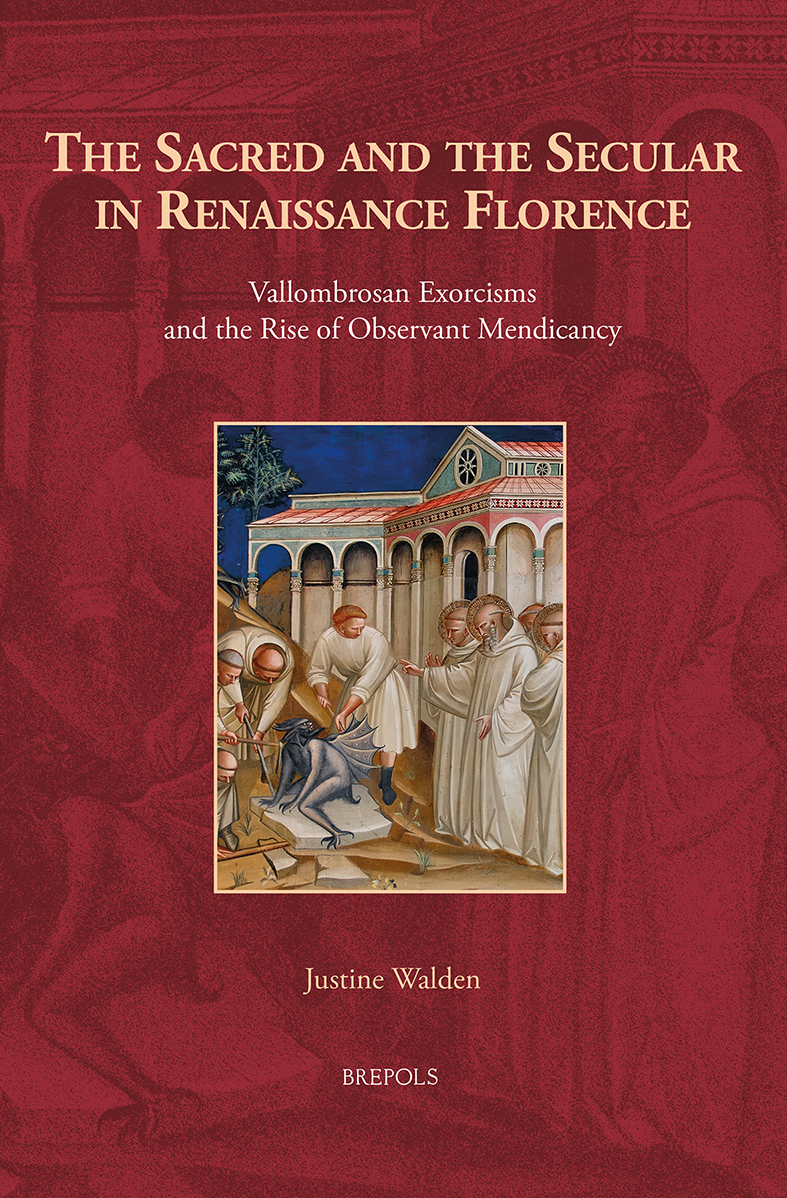 The Sacred and the Secular in Renaissance Florence
Vallombrosan Exorcisms and the Rise of Observant Mendicancy
Volume 31
 Orthodoxy and Controversy in Twelfth-Century Religious Discourse
Peter Lombard's 'Sentences' and the Development of Theology
Volume 8
 Careers and Opportunities at the Roman Curia, 1300-1500
A Socio-Economic History of Papal Administration
Volume 29
 Nature, Virtue, and the Boundaries of Encyclopaedic Knowledge
The Tropological Universe of Alexander Neckam (1157-1217)
Volume 13


 Mulieres Religiosae
Shaping Female Spiritual Authority in the Medieval and Early Modern Periods
Volume 12


 Gendered Identities in Bernard of Clairvaux’s ‘Sermons on the Song of Songs’
Performing the Bride
Volume 15

 Witchcraft, Superstition, and Observant Franciscan Preachers
Pastoral Approach and Intellectual Debate in Renaissance Milan
Volume 18
 Communities of Learning
Networks and the Shaping of Intellectual Identity in Europe, 1100-1500
Volume 9


 Confraternity, Mendicant Orders, and Salvation in the Middle Ages
The Contribution of the Hungarian Sources (c.1270-c.1530)
Volume 23


Similar Books

 A Companion to Christianity and Sport in Europe and North America (19th-21st centuries)
Volume 1: Western and Eastern Europe
 A Connecting Polemic in the Medieval Mediterranean
The Correspondence of Leo III and ʿUmar II
Volume 6





 Ars Prophetica
Theology in the Poetry of Twentieth-Century Hebrew Poets Avraham Halfi, Shin Shalom, Amir Gilboa, and T. Carmi
 As Messianism Turns to Heresy
The Regenstein Chair Lectures On Lurianic Kabbalah and Shabbatai Tzevi at Hebrew Union College - Cincinnati
 Balthasar Caymox of Nuremberg
Early Modern German Print Publishers: Popular Prints of the Seventeenth Century


 Beyond Sovereign Courts
Agents and Practices in Early Modern Spanish and Habsburg Diplomacy
Volume 3


 Circulation, Use, Impact
The Consumption of Architectural Books in the Early Modern Eastern Adriatic
Volume 1



 Councils, Conflicts, Correspondence
Urban Diplomacy in Reval (Tallinn) and Lübeck (c. 1470–1570)
Volume 67
 Creating the Woman in Antiquity
Proceedings of the 16th Melammu Workshop, Innsbruck, 2–3 June 2022
Volume 13
 Cultic Kisses
Fruitful Encounters Between Deities and Humans. Festschrift for Angelika Berlejung on the Occasion of Her 65th Birthday
 De/colonizing Theologies
Glocal Histories, Contemporary Challenges, Theoretical Reflections
Volume 4

 Drunk the Potion, No Whit Charmed
The Doctrine of Pure and Perfect Souls from Iamblichus to Damascius

