
Greek Scripture and the Rabbis
Edited by T. Law Edited by A. Salvesen

Greek was widely used by Jews in the eastern Mediterranean, from Alexander the Great until the Holocaust. However, its role in the translation of Hebrew Scripture for Jewish communities has not received sustained attention. The European Seminar in Advanced Jewish Studies, held at the Oxford Centre for Hebrew and Jewish Studies in 2009 provided an international scholarly forum on the subject. The papers in this volume represent the fruits of the residential workshop. They cover biblical textual criticism, the later Jewish Greek revisions, rabbinic attitudes towards Scripture in Greek, early Christian views of Jewish Greek versions, imperial legislation on Jews and the public reading of Scripture, Greek loanwords in rabbinic literature, and medieval Greek biblical glosses in Jewish manuscripts.
Greek was widely used by Jews in the eastern Mediterranean, from Alexander the Great until the Holocaust. However, its role in the translation of Hebrew Scripture for Jewish communities has not received sustained attention. The European Seminar in Advanced Jewish Studies, held at the Oxford Centre for Hebrew and Jewish Studies in 2009 provided an international scholarly forum on the subject. The papers in this volume represent the fruits of the residential workshop. They cover biblical textual criticism, the later Jewish Greek revisions, rabbinic attitudes towards Scripture in Greek, early Christian views of Jewish Greek versions, imperial legislation on Jews and the public reading of Scripture, Greek loanwords in rabbinic literature, and medieval Greek biblical glosses in Jewish manuscripts.
- Edited by T. Law
- Edited by A. Salvesen
Other Titles in this Series



 “With All Your Soul Fear the Lord” (Sir. 7:27)
Collected Essays on the Book of Ben Sira II
Volume 87


 Re-thinking the Death of Jesus
An Exegetical and Theological Study of Hilasmos and Agape in 1 John 2:1-2 and 4:7-10
Volume 73
 “If Christ is Preached as Raised from the Dead…”
Studies in Honour of Riemer Roukema on the Occasion of His Retirement
Volume 123


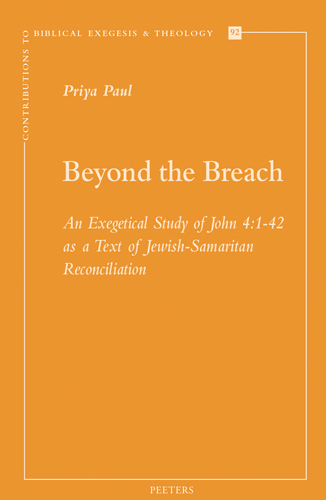 Beyond the Breach
An Exegetical Study of John 4:1-42 as a Text of Jewish-Samaritan Reconciliation
Volume 92


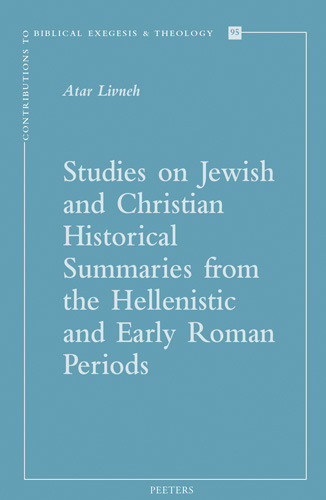 Studies on Jewish and Christian Historical Summaries from the Hellenistic and Early Roman Periods
Volume 95
 In the Footsteps of Sherlock Holmes
Studies in the Biblical Text in Honour of Anneli Aejmelaeus
Volume 72


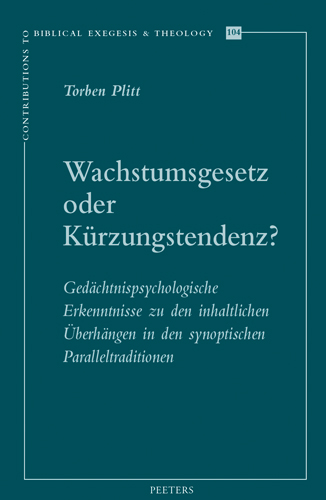 Wachstumsgesetz oder Kurzungstendenz?
Gedachtnispsychologische Erkenntnisse zu den inhaltlichen Uberhangen in den synoptischen Paralleltraditionen
Volume 104

 A Cosmic Leap of Faith
An Authorial, Structural, and Theological Investigation of the Cosmic Christology in Col 1:15-20
Volume 41
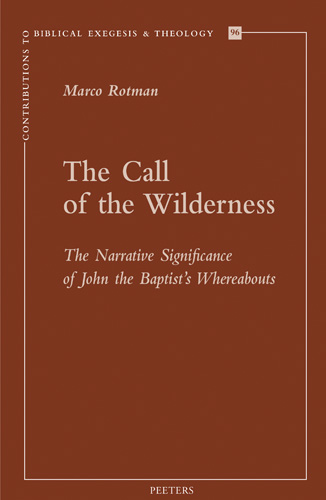
 Three Versions of Esther
Their Relationship to Anti-Semitic and Feminist Critique of the Story
Volume 74
 From Joseph to Jesus
The Joseph Narrative as a Compositional Template from Old Greek Esther to the Gospel of Luke
Volume 125

Similar Books


 Athanasius of Alexandria, Epistula ad episcopos Aegypti et Libyae
Old Slavonic Version and English Translation
Volume 261



 Contesting Labeled Identities
The Sociology of Gentilics in Biblical and Northwest Semitic Literature
 Cyril of Alexandria’s Christological Exegesis
Explorations of Partitive Exegesis in the Dialogues on the Trinity
Volume 70


 Epiphanies of the Divine in the Septuagint and the New Testament
Fifth International Symposium of the Corpus Judaeo-Hellenisticum Novi Testamenti (CJHNT), 14-17 May 2015, Nottingham


 Extracanonical Traditions and the Holy Land
Texts, Rituals, and Material Culture in Late Antique Palestine
From Joseph to Jesus
The Joseph Narrative as a Compositional Template from Old Greek Esther to the Gospel of Luke
Volume 125





 Nicholas of Lyra’s Commentaries on the Gospels of Matthew and Luke
Franciscan Exegesis in a Time of Crisis
 Paradise Lost in Transmission
The Return to Eden in the Apocalypse of Peter within Its Ethiopic and Early Christian Contexts




 Punning in Odd or Elegant Constructions in Jeremiah
The Convergence of Linguistics, Rhetoric, and Textuality in the Hebrew Text of Jeremiah


 Reformed Covenantal Eudaimonism
Wilhelmus à Brakel (1635–1711) on Highest Good, Virtue, and Law
Volume 87
