
Nominalization via Verbal Derivation
Amharic, Tigrinya and Oromo
by Shimelis Mazengia

All languages are in a state of flux, and the viable ones employ various devices to introduce new words into their vocabularies. In the formation of new words and other expressions, noun formation or nominalization has pride of place over the other word-classes. Shimelis Mazengia describes and contrastively compares, in considerable detail, the mechanisms which three major Ethiopian languages use to satisfy their needs for nominals at word, phrasal and clausal levels – in other words, the operations utilized for lexical, phrasal, and clausal nominalizations. The languages in question are the Semitic languages Amharic and Tigrinya, and the Cushitic language Oromo. However, Amharic is sometimes considered to have undergone significant Cushitic influence and is therefore often assumed to be structurally intermediate between Semitic and Cushitic. The description and analyses take tone into account for Oromo, as tone is considered to have some bearing on the nominalization processes of the language. The author is a native speaker of Amharic and Oromo and is also well acquainted with Tigrinya. His competence in the languages has helped him to insightfully deal with the description and analysis of the languages with a wealth of data.
- By (author) Shimelis Mazengia
Other Titles in this Series

 Die Schlangensprüche als älteste semitische Textbelege?
Analyse und kritische Betrachtung von Richard C. Steiners „Early Northwest Semitic Serpent Spells in the Pyramid Texts“
Volume 140
 Strategies of Clause Linking in Semitic Languages
Proceedings of the International Symposium on Clause Linking in Semitic Languages, Kivik, Sweden, 5-7 August 2012
Volume 93
 Another Tract for the Buryats
including I. J. Schmidt's recentlly identified Kalmuck Originals
Volume 82


 Yuan Hongdao – Eine Geschichte der Vasen
Ein Beitrag zur Literatur der Kennerschaft der spaten Ming-Zeit
Volume 108

 Studien zu ‘sabab’ in der arabischen Kunstprosa des 10.-15. Jahrhunderts
Ein Beitrag zur arabischen Lexik, Phraseologie und Stilgeschichte
Volume 126
 The Beginning of the Subtle School of Taoism
An Official Perception of Taoism in the Early T'ang Period
Volume 94

 Bible Translations – Linguistic and Cultural Issues
Proceedings of the Erlangen Workshop on October 5 and 6, 2018
Volume 122

 Verbal Festivity in Arabic and Other Semitic Languages
Proceedings of the Workshop at the Universitatsclub Bonn on January 16, 2009
Volume 72
 Daoist perspectives on knowing the future
Selections from the Scripture on Great Peace (Taiping jing)
Volume 110
 Ahmad ibn Yusuf at-Tifasis ‘Buch der koniglichen Steine’
Eine Mineralienkunde fur die arabischen Herrscher des 7./13. Jahrhunderts Eingeleitet, ubersetzt und mit Anmerkungen versehen von Armin Schopen und Karl W. Strauss Mit 38 Abbildungen von Alfred K. Schuster
Volume 92
 Die vokalische Gestalt des arabischen Wortstamms
Ihr Kodierungspotential im dreiradikaligen Masdar
Volume 127
 Fujian – Penghu – Taiwan
Fruhe Kontakte, nach Texten zusammengefasst (ca. 200-1450 n.Chr.)
Volume 95

 Arabische Kunstprosa im 14. Jahrhundert
Drei Einsetzungen fur Oberrichter 'Imad ad-Din at-Tarasusi in Lehramter an Damaszener Hochschulen
Volume 123

 Hochsprache und Dialekt im Arabischen
Untersuchungen zur heutigen arabischen Zweisprachigkeit
Volume 41.1
 The morphological-to-analytic causative continuum in Hausa
New insights and analyses in a typological perspective
Volume 109


 The Lexical Field of the Substantives of ‘Word’ in Ancient Hebrew
From the Bible to the Mishnah
Volume 124

Similar Books


 Des mots aux actes
Traduction épistémique et littéraire. Nouvelles tendances en histoire et didactique
Volume 15


 Punning in Odd or Elegant Constructions in Jeremiah
The Convergence of Linguistics, Rhetoric, and Textuality in the Hebrew Text of Jeremiah


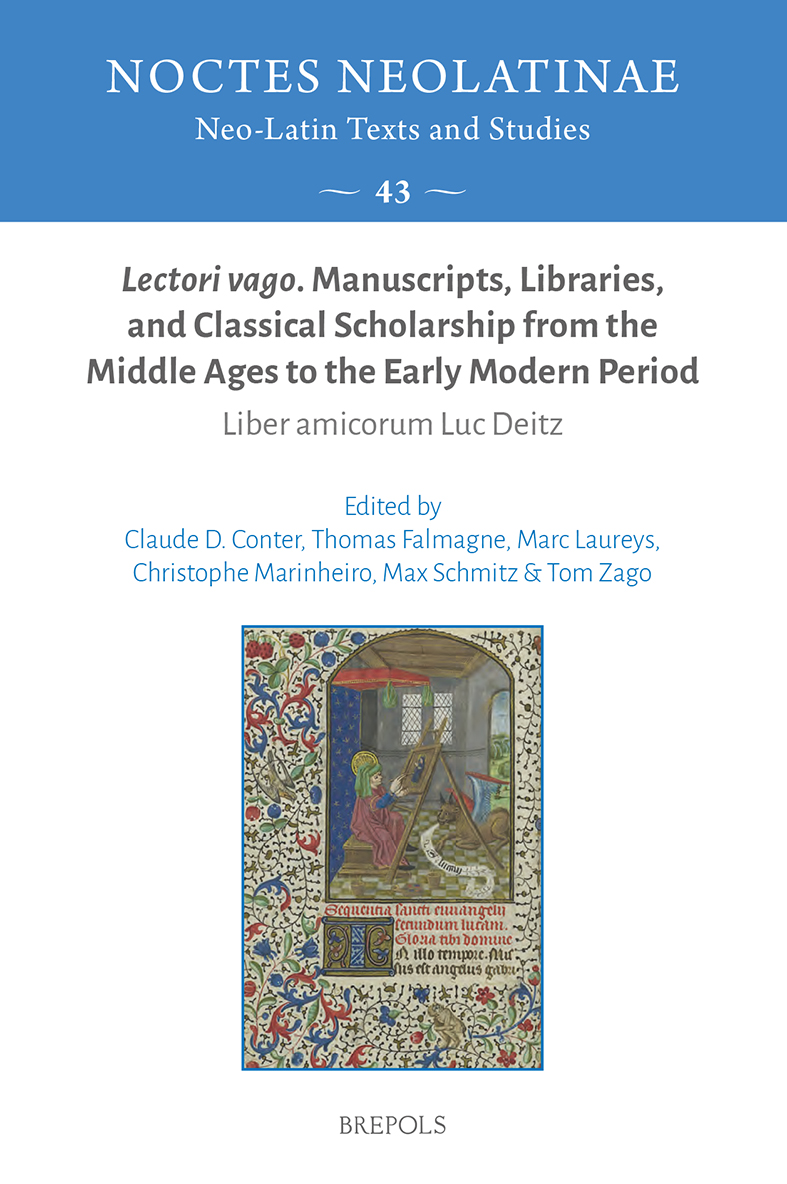 Lectori vago. Manuscripts, Libraries, and Classical Scholarship from the Middle Ages to the Early Modern Period
Liber amicorum Luc Deitz
Volume 43



 Ein Schatzhaus indischer Erzählkunst –– Die Erzählliteratur der Jainas
Band 2: Ein „Lesebuch“ originalsprachlicher Texte zur jainistischen „Universalgeschichte“ samt eines Jaina-Māhārāṣṭrī-Wörterbuchs zu allen Text- und Lesestücken.


