
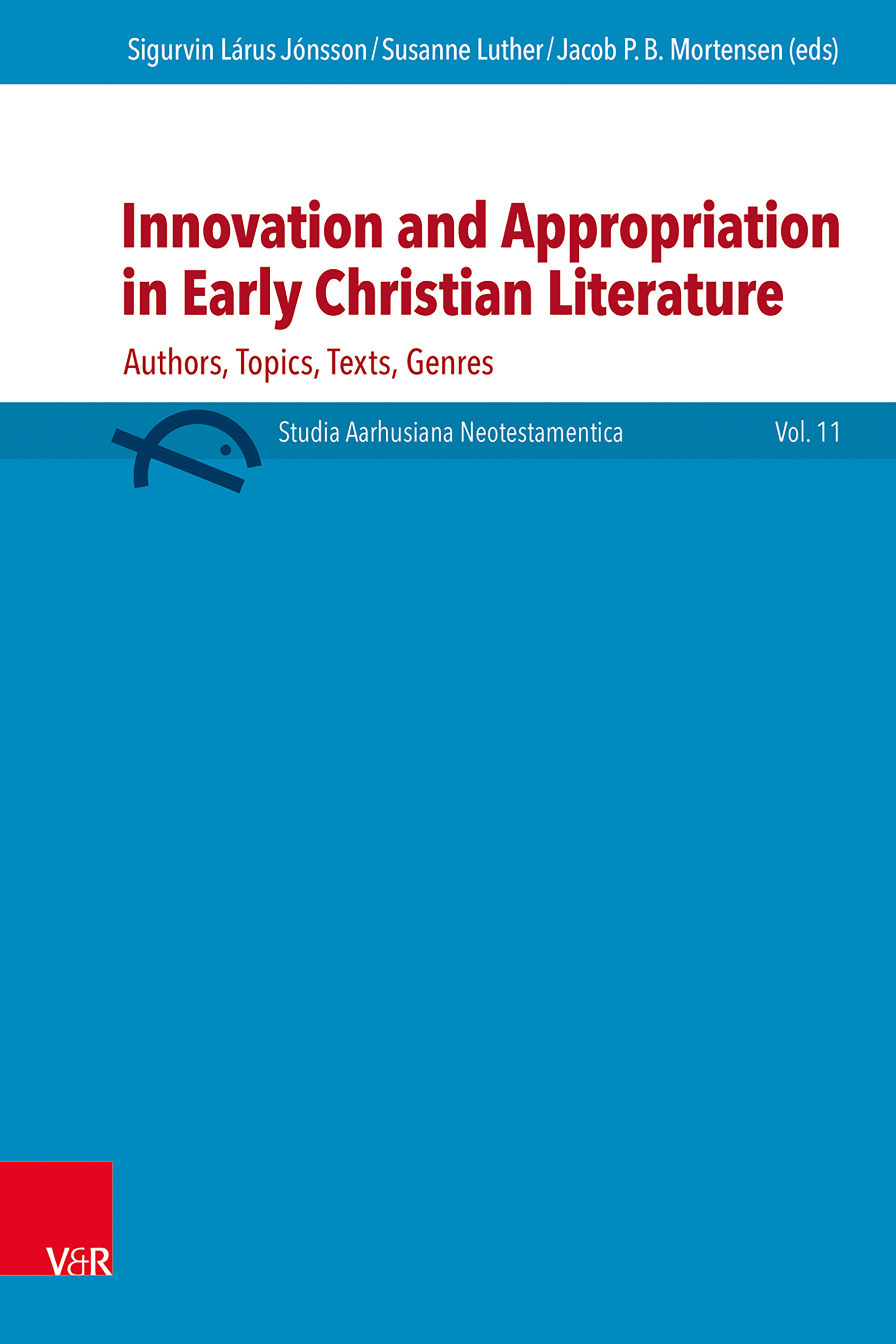
Innovation and Appropriation in Early Christian Literature
Authors, Topics, Texts, Genres
Contributions by Oda Wischmeyer Contributions by Eve-Marie Becker Contributions by Sigurvin Lárus Jónsson Contributions by Susanne Luther Contributions by Jacob P.B. Mortensen Contributions by Jörg Rüpke Contributions by Anders Klostergaard Petersen Contributions by Bruno Bleckmann Contributions by Henriette Van der Blom Contributions by Lutz Doering Contributions by **Greg Sterling Contributions by Michael Tilly Contributions by Erich Benjamin Pracht Contributions by Christina Hoegen-Rohls Contributions by Kasper Bro Larsen Contributions by Sylvie Honigman Contributions by Christoph Hammann Contributions by John S. Kloppenborg Contributions by Holger Strutwolf Contributions by Sean Adams Contributions by Francesca Minonne Contributions by Teresa Morgan Contributions by Bronwen Neil Edited by Sigurvin Lárus Jónsson Edited by Susanne Luther Edited by Jacob P.B. Mortensen Series edited by Eve-Marie Becker Series edited by Ole Davidsen Series edited by Jan Dochhorn Series edited by Kasper Bro Larsen Series edited by Nils Arne Pedersen
Hardback (Published)
(May 2026)
ISBN: 9783525500637
6.34 x 9.25 inches
Price: $150.00
In stock
Early Christian authors combined literary forms. Their literary works are therefore comparable to both Jewish and Greco-Roman contemporary writings, but they adopt, modify and transform literary conventions according to their interests to communicate their message showing signs of literary creativity. This volume shows the innovative aspect of early Christian literature, by integrating adjacent fields of research as ancient history, classical studies, Jewish studies, patristics and religious studies. The analyses explore how and why early Christian literature unexpectedly established itself as a literary force in the early imperium.
The rise of early Christianity was accompanied by a period of impressive literary production. Early Christian authors combined literary forms from Greco-Roman writings with the style and content of Hellenistic Jewish literature to create a tertium quid. Their literary works are therefore comparable to both Jewish and Greco-Roman contemporary writings, but they adopt, modify and transform literary conventions according to their needs and interests to communicate their message showing signs of literary innovation and creativity. This volume shows the innovative aspect of early Christian literature, by integrating adjacent fields of research as ancient history, classical studies, Jewish studies, patristics and religious studies. The analyses explore how and why early Christian literature unexpectedly established itself as a literary force in the early imperium.
- Contributions by Oda Wischmeyer
- Contributions by Eve-Marie Becker
- Contributions by Sigurvin Lárus Jónsson
- Contributions by Susanne Luther
- Contributions by Jacob P.B. Mortensen
- Contributions by Jörg Rüpke
- Contributions by Anders Klostergaard Petersen
- Contributions by Bruno Bleckmann
- Contributions by Henriette Van der Blom
- Contributions by Lutz Doering
- Contributions by **Greg Sterling
- Contributions by Michael Tilly
- Contributions by Erich Benjamin Pracht
- Contributions by Christina Hoegen-Rohls
- Contributions by Kasper Bro Larsen
- Contributions by Sylvie Honigman
- Contributions by Christoph Hammann
- Contributions by John S. Kloppenborg
- Contributions by Holger Strutwolf
- Contributions by Sean Adams
- Contributions by Francesca Minonne
- Contributions by Teresa Morgan
- Contributions by Bronwen Neil
- Edited by Sigurvin Lárus Jónsson
- Edited by Susanne Luther
- Edited by Jacob P.B. Mortensen
- Series edited by Eve-Marie Becker
- Series edited by Ole Davidsen
- Series edited by Jan Dochhorn
- Series edited by Kasper Bro Larsen
- Series edited by Nils Arne Pedersen
Other Titles in this Series
 Collected Studies on Philo and Josephus
Edited by Eve-Marie Becker, Morten Hørning Jensen and Jacob Mortensen





Similar Books

 A Companion to Christianity and Sport in Europe and North America (19th-21st centuries)
Volume 1: Western and Eastern Europe
 A Connecting Polemic in the Medieval Mediterranean
The Correspondence of Leo III and ʿUmar II
Volume 6





 Ars Prophetica
Theology in the Poetry of Twentieth-Century Hebrew Poets Avraham Halfi, Shin Shalom, Amir Gilboa, and T. Carmi
 As Messianism Turns to Heresy
The Regenstein Chair Lectures On Lurianic Kabbalah and Shabbatai Tzevi at Hebrew Union College - Cincinnati


 Creating the Woman in Antiquity
Proceedings of the 16th Melammu Workshop, Innsbruck, 2–3 June 2022
Volume 13
 Cultic Kisses
Fruitful Encounters Between Deities and Humans. Festschrift for Angelika Berlejung on the Occasion of Her 65th Birthday
 De/colonizing Theologies
Glocal Histories, Contemporary Challenges, Theoretical Reflections
Volume 4
 Drunk the Potion, No Whit Charmed
The Doctrine of Pure and Perfect Souls from Iamblichus to Damascius






 Extracanonical Traditions and the Holy Land
Texts, Rituals, and Material Culture in Late Antique Palestine
 Fear, Fear of God, God-Fearers
Philological and Historical Perspectives on the World of Ancient Judaism and Christianity


 Gender and Iconography in Antiquity
Femininities, Masculinities, Ambiguities, and Beyond in the Ancient Levant, Near East, and Mediterranean