
Paul as homo novus
Authorial Strategies of Self-Fashioning in Light of a Ciceronian Term
Contributions by Oda Wischmeyer Contributions by Andreas Mehl Contributions by Henriette Van der Blom Contributions by Christopher Degelmann Contributions by Ulrike Egelhaaf-Gaiser Contributions by Therese Fuhrer Contributions by Christopher Mount Contributions by Johanna Schumm Contributions by Tobias Uhle Contributions by Maik Patzelt Contributions by Lauri Thurén Contributions by Uta Heil Contributions by René Falkenberg Edited by Eve-Marie Becker Edited by Jacob Mortensen
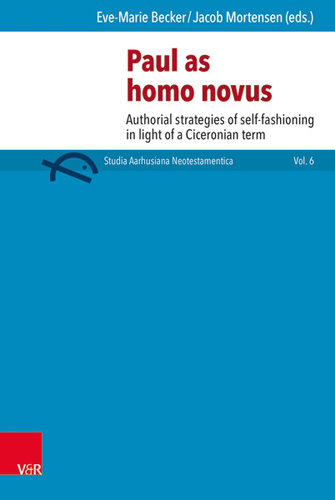
Hardback (Published)
(April 2018)
ISBN: 9783525540480
6.34 x 9.33 inches
Price: $119.00
In stock
Where does the concept a »New Man« originate?
Twentieth century research in St. Paul is widely impacted by Adolf Deissmann’s prominent view on the apostle as a “homo novus” (1911). But where does this concept originate from, and what does it imply? This collection of articles does not only re-evaluate Deissmann’s concept by tracing it back to its historical and socio-political origins in Cicero and exploring how authors from (early) Imperial Time perceive and transform the homo novus paradigm by diverse modes and strategies of literary self-fashioning. Scholars ranging the fields of New Testament Studies, Greek and Latin Philology, Ancient History, Patristics, and Comparative Literature also examine how the Ciceronian paradigm was early on transformed, disseminated, and applied as a literary concept and an authorial topos of self-molding. One of the leading questions throughout the volume thus is: How do authors like Cicero, Horace, Paul, Tacitus, Seneca, Athanasius, and Augustine fashion themselves in accordance to or in difference from the idea of being a “new man”? It is argued that by means of literary self-configuration, indeed, some of these writers – such as Paul and Augustine – want to appear as “new men” by either altering traditional social, moral, religious, or political roles, or by creating new patterns of social behavior and religious self-understanding.
- Contributions by Oda Wischmeyer
- Contributions by Andreas Mehl
- Contributions by Henriette Van der Blom
- Contributions by Christopher Degelmann
- Contributions by Ulrike Egelhaaf-Gaiser
- Contributions by Therese Fuhrer
- Contributions by Christopher Mount
- Contributions by Johanna Schumm
- Contributions by Tobias Uhle
- Contributions by Maik Patzelt
- Contributions by Lauri Thurén
- Contributions by Uta Heil
- Contributions by René Falkenberg
- Edited by Eve-Marie Becker
- Edited by Jacob Mortensen
Other Titles in this Series

 Collected Studies on Philo and Josephus
Edited by Eve-Marie Becker, Morten Hørning Jensen and Jacob Mortensen




Similar Books


 Athanasius of Alexandria, Epistula ad episcopos Aegypti et Libyae
Old Slavonic Version and English Translation
Volume 261




 Contesting Labeled Identities
The Sociology of Gentilics in Biblical and Northwest Semitic Literature

 Cyril of Alexandria’s Christological Exegesis
Explorations of Partitive Exegesis in the Dialogues on the Trinity
Volume 70
 Drunk the Potion, No Whit Charmed
The Doctrine of Pure and Perfect Souls from Iamblichus to Damascius


 Epigraphic “Shades” from Hellenistic Thrace
Contextualizing Inscriptions in Greek from Thracian Tombs

 Epiphanies of the Divine in the Septuagint and the New Testament
Fifth International Symposium of the Corpus Judaeo-Hellenisticum Novi Testamenti (CJHNT), 14-17 May 2015, Nottingham


 Extracanonical Traditions and the Holy Land
Texts, Rituals, and Material Culture in Late Antique Palestine


 From Joseph to Jesus
The Joseph Narrative as a Compositional Template from Old Greek Esther to the Gospel of Luke
Volume 125

 Gold, Silver and Glass: Power Networks, Cultural Identities, Technology Transfers and Agency across the Old World (7th Century BC – 1st Century AD)
Proceedings of a Conference Held at the British Museum, 16–18 June 2023


 Language and Power in the Roman Empire and Early India
Hierarchy, Ambiguity, and the Art of Reading the Signs in Cosmopolitan Cultures