
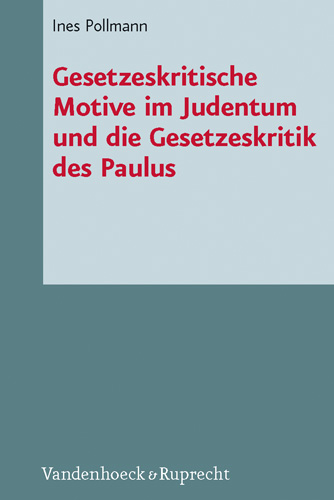
Gesetzeskritische Motive im Judentum und die Gesetzeskritik des Paulus
By (author) Ines Pollmann
Hardback (Published)
(October 2012)
ISBN: 9783525593578
6.34 x 9.33 inches
Price: $138.00
In stock
English summary: Were there any potential law critical motives in Jewish texts from which Paul could pursue linguistically and factually? Ines Pollmann examines this and makes the origin of Pauline law criticism historically plausible. In four texts such motives become manifest but they are usually rejected: the repression of the law in Ant. 4.145-149, the impossible fulfilment of the law in 4Esra 8.20-36, the spiritualisation of ritual laws in Philo migr. 89-93 and the posterior addition of the states law in Philo Jos. 28-31. Pollmann then demonstrates that these four motives are representative and embedded in mentality trends of Judaism. The trends within Judaism itself give evidence of general traditions of antiquity: the sophistic law criticism, the consciousness of the imperfection of the human nature, the allegorical interpretation of religious praxis and the high esteem of unspoilt origins. Paul was the first to combine these diverse motives and, as a consequence of his belief in Christ, turned them into law criticism. His attitude towards the law is ambivalent and combines the respect for the law with a criticism on the law’s downside. German description: Ines Pollmann macht Entstehung der paulinischen Gesetzeskritik historisch plausibel und untersucht, ob es im Judentum potenziell gesetzeskritische Motive gab, an die Paulus sachlich und sprachlich anknupfen konnte. In vier Texten werden solche Motive manifest und in der Regel zuruckgewiesen. Diese Motive werden in breitere Mentalitatsstrome im Judentum eingebettet und damit als reprasentativ und resonanzfahig erwiesen: Die Kritik des Simri spiegelt Akkulturationstendenzen im Judentum, pessimistische Aussagen uber den Menschen finden sich in Qumrantexten, im Diasporajudentum gab es eine Tendenz zur spirituellen Auffassung der Thora und auch die Abwertung eines spater eingefuhrten Gesetzes ist im Judentum bezeugt. Diese innerjudischen Stromungen sind ihrerseits in allgemein antike Traditionen eingebettet: in die sophistische Gesetzeskritik, in ein Bewusstsein der Unvollkommenheit des Menschen, in eine allegorisierende Auslegung religioser Traditionen und eine Hochschatzung des Alten und Ursprunglichen. Pollmann zeigt auf, dass Paulus die verschiedenen Motive aufgriff, zum ersten Mal kombinierte und aufgrund seines Christusglaubens zu einer Gesetzeskritik zuspitzte. Seine Haltung zum Gesetz ist ambivalent und verbindet Hochschatzung vor dem Gesetz mit Kritik an seinen Schattenseiten.
Dr. theol. Ines Pollmann ist Vikarin der Rheinischen Landeskirche in Kempen am Niederrhein.
- By (author) Ines Pollmann
Other Titles in this Series


 Die Weisheit der Gottesherrschaft
Eine Untersuchung zur jesuanischen Synthese von traditioneller und apokalyptischer Weisheit
 Allgegenwärtiger Konflikt im Matthäusevangelium
Exegetische und sozialpsychologische Analyse der Konfliktgeschichte

 Sprachbilder und Bildsprache
Studien zur Kontextualisierung biblischer Texte. Festschrift für Max Küchler zum 75. Geburtstag
 Allegorie – Metapher – Mythos – Schrift
Beiträge zur religiösen Sprache im Neuen Testament und in seiner Umwelt

 Montanistische Orakel und kirchliche Opposition
Der frühe Streit zwischen den phrygischen »neuen Propheten« und dem Autor der vorepiphanischen Quelle als biblische Wirkungsgeschichte des 2. Jh. n.Chr
 The ‘New Testament’ as a Polemical Tool
Studies in Ancient Christian Anti-Jewish Rhetoric and Beliefs
 »If Christ has not been raised …«
Studies on the Reception of the Resurrection Stories and the Belief in the Resurrection in the Early Church

 Frühes Christentum und Religionsgeschichtliche Schule
Festschrift zum 65. Geburtstag von Gerd Lüdemann
 “Montanism” in the Roman World
The New Prophecy Movement from Historical, Sociological, and Ecclesiological Perspectives. Festschrift for William Tabbernee on the Occasion of His 80th Birthday


 Idumea and the Idumeans
An Oriental Ethnos at the Crossroads of Levantine Cultures in Hellenistic and Roman Times

 Paulus als Briefroman erzählt
Studien zum antiken Briefroman und seiner christlichen Rezeption in den Pastoralbriefen
 ABBA Vater
Der literarische Befund vom Altaramäischen bis zu den späten Midrasch- und Haggada-Werken in Auseinandersetzung mit den Thesen von Joachim Jeremias

 The Great Controversy
The Individual’s Struggle Between Good and Evil in the Testaments of the Twelve Patriarchs and in their Jewish and Christian Contexts

 Asceticism and Exegesis in Early Christianity
The Reception of New Testament Texts in Ancient Ascetic Discourses

Similar Books


 Apocrypha, Magic, Liturgy
The Multiple Identities of Coptic Prayers in Late Antique and Early Islamic Egypt
 Athanasius of Alexandria, Epistula ad episcopos Aegypti et Libyae
Old Slavonic Version and English Translation
Volume 261



 Contesting Labeled Identities
The Sociology of Gentilics in Biblical and Northwest Semitic Literature
 Cyril of Alexandria’s Christological Exegesis
Explorations of Partitive Exegesis in the Dialogues on the Trinity
Volume 70


 Epiphanies of the Divine in the Septuagint and the New Testament
Fifth International Symposium of the Corpus Judaeo-Hellenisticum Novi Testamenti (CJHNT), 14-17 May 2015, Nottingham


 Extracanonical Traditions and the Holy Land
Texts, Rituals, and Material Culture in Late Antique Palestine
 From Joseph to Jesus
The Joseph Narrative as a Compositional Template from Old Greek Esther to the Gospel of Luke
Volume 125





 Nicholas of Lyra’s Commentaries on the Gospels of Matthew and Luke
Franciscan Exegesis in a Time of Crisis
 Paradise Lost in Transmission
The Return to Eden in the Apocalypse of Peter within Its Ethiopic and Early Christian Contexts




 Punning in Odd or Elegant Constructions in Jeremiah
The Convergence of Linguistics, Rhetoric, and Textuality in the Hebrew Text of Jeremiah


 Reformed Covenantal Eudaimonism
Wilhelmus à Brakel (1635–1711) on Highest Good, Virtue, and Law
Volume 87