
Early Christian Commentators of the New Testament
Essays on Their Aims, Methods and Strategies
Edited by J. Verheyden Edited by T. Nicklas

The Early Church has produced a diversified and influential tradition of commenting on the Bible. The tradition is rich in content, in methods, and in the goals pursued. The present volume offers a selection of papers read at an international colloquium held in Leuven in December 2018. Basically, three guidelines were followed in selecting the material: language, representative authors, and the wish to cover various parts of the New Testament. Three of the ten essays deal with Greek authors. Origen takes a place of honour, and through him is also heard the voice of one of the oldest Christian commentators, Heracleon. The third one is Theodore of Mopsuestia, the major representative of the non-Alexandrian tradition, averse of an allegorical reading of the Bible. The Latins are represented by their two greatest exegetes (Jerome and Augustine), a recently rediscovered gospel commentator (Fortunatianus), two commentators on Paul (Marius Victorinus and Ambrosiaster), an influential commentator of the Apocalypse (Victorinus of Pettau), and an author who was instrumental in transmitting the legacy of the ancient Church to a new era (Bede).
The Early Church has produced a diversified and influential tradition of commenting on the Bible. The tradition is rich in content, in methods, and in the goals pursued. The present volume offers a selection of papers read at an international colloquium held in Leuven in December 2018. Basically, three guidelines were followed in selecting the material: language, representative authors, and the wish to cover various parts of the New Testament. Three of the ten essays deal with Greek authors. Origen takes a place of honour, and through him is also heard the voice of one of the oldest Christian commentators, Heracleon. The third one is Theodore of Mopsuestia, the major representative of the non-Alexandrian tradition, averse of an allegorical reading of the Bible. The Latins are represented by their two greatest exegetes (Jerome and Augustine), a recently rediscovered gospel commentator (Fortunatianus), two commentators on Paul (Marius Victorinus and Ambrosiaster), an influential commentator of the Apocalypse (Victorinus of Pettau), and an author who was instrumental in transmitting the legacy of the ancient Church to a new era (Bede).
- Edited by J. Verheyden
- Edited by T. Nicklas
Other Titles in this Series

 Ausgewahlte Studien zum Johannesevangelium / Selected Studies in the Gospel of John. 1998-2013
Volume 28

 Die eschatologische Rede des Spruchevangeliums Q
Redaktions- und traditionsgeschichtliche Studies zu Q 17,23-37
Volume 19






 Die sieben Sendschreiben Apk 2-3
Studien zu ihrer Entstehung und ihrem Verhaltnis zum apokalyptischen Hauptteil Apk 4-22
Volume 39




 Ephesische Enthullungen 1
Fruhe Christen in einer antiken Grossstadt. Zugleich ein Beitrag zur Frage nach den Kontexten der Johannesapokalypse
Volume 6

 Constructing Religious Identities during the Second Temple Period / Construction des identites religieuses a l’epoque du Second Temple
Festschrift for Jean Duhaime on the Occasion of his 86th birthday
Volume 24

 The Vocabulary of Luke
An Alphabetical Presentation and a Survey of Characteristic and Noteworthy Words and Word Groups in Luke's Gospel
Volume 10
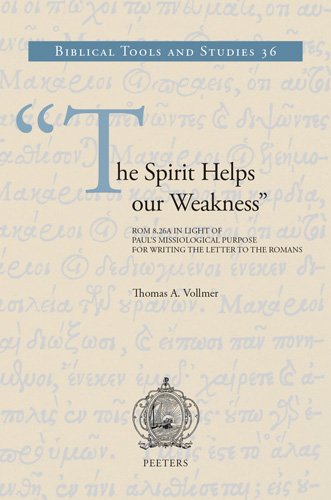 The Spirit Helps our Weakness
Rom 8:26a in Light of Paul's Missiological Purpose for Writing the Letter to the Romans
Volume 36

Similar Books


 Athanasius of Alexandria, Epistula ad episcopos Aegypti et Libyae
Old Slavonic Version and English Translation
Volume 261




 Contesting Labeled Identities
The Sociology of Gentilics in Biblical and Northwest Semitic Literature

 Cyril of Alexandria’s Christological Exegesis
Explorations of Partitive Exegesis in the Dialogues on the Trinity
Volume 70
 Drunk the Potion, No Whit Charmed
The Doctrine of Pure and Perfect Souls from Iamblichus to Damascius


 Epigraphic “Shades” from Hellenistic Thrace
Contextualizing Inscriptions in Greek from Thracian Tombs

 Epiphanies of the Divine in the Septuagint and the New Testament
Fifth International Symposium of the Corpus Judaeo-Hellenisticum Novi Testamenti (CJHNT), 14-17 May 2015, Nottingham


 Extracanonical Traditions and the Holy Land
Texts, Rituals, and Material Culture in Late Antique Palestine


 From Joseph to Jesus
The Joseph Narrative as a Compositional Template from Old Greek Esther to the Gospel of Luke
Volume 125

 Gold, Silver and Glass: Power Networks, Cultural Identities, Technology Transfers and Agency across the Old World (7th Century BC – 1st Century AD)
Proceedings of a Conference Held at the British Museum, 16–18 June 2023


 Language and Power in the Roman Empire and Early India
Hierarchy, Ambiguity, and the Art of Reading the Signs in Cosmopolitan Cultures
 Late Antique villae in the Balkans (3rd–7th c. AD): Current Research Questions and Perspectives
HAEMUS Companion to the Late Antique Balkans 1
Volume 4