
Digital Philology and Quantitative Criticism of Medieval Literature
Unconventional Approaches to Medieval Latin Literature II
By (author) Francesco Stella

Building on The Carolingian Revolution: Unconventional Approaches to Medieval Latin Literature I, this is the second of two volumes proposing ways of reading medieval Latin texts which, up to now, have had little or no attention within literary studies. This volume is founded on the belief that ‘the unprecedented empirical power of digital tools and archives offers a unique chance to rethink the categories of literary study’ (F. Moretti). The book’s first section presents cases studies applying ‘quantitative’ criticism based on the linguistic and stylistic use of frequency wordlists which, thanks to digital tools and to a larger literature, are becoming more easily accessible and more powerful. The chapters of this section lead the reader from an application of stylometry within a traditional critical exercise, via the structured use of frequency indexing as a warning light for cultural or stylistic phenomena undetectable to the naked eye, to more technical corpus analysis experiments based on linguistic evolution or authorship attribution. The second section explores the encoding problems the author has faced when working on the realisation of digital editing projects such as the Corpus Rhythmorum Musicum, the Archivio della Latinita Italiana del Medioevo (ALIM), Lexicon, and the Eurasian Latin Archive (ELA), and proposes reflections on the typology of digital philological editions.
Building on The Carolingian Revolution: Unconventional Approaches to Medieval Latin Literature I, this is the second of two volumes proposing ways of reading medieval Latin texts which, up to now, have had little or no attention within literary studies. This volume is founded on the belief that ‘the unprecedented empirical power of digital tools and archives offers a unique chance to rethink the categories of literary study’ (F. Moretti). The book’s first section presents cases studies applying ‘quantitative’ criticism based on the linguistic and stylistic use of frequency wordlists which, thanks to digital tools and to a larger literature, are becoming more easily accessible and more powerful. The chapters of this section lead the reader from an application of stylometry within a traditional critical exercise, via the structured use of frequency indexing as a warning light for cultural or stylistic phenomena undetectable to the naked eye, to more technical corpus analysis experiments based on linguistic evolution or authorship attribution. The second section explores the encoding problems the author has faced when working on the realisation of digital editing projects such as the Corpus Rhythmorum Musicum, the Archivio della Latinita Italiana del Medioevo (ALIM), Lexicon, and the Eurasian Latin Archive (ELA), and proposes reflections on the typology of digital philological editions.
- By (author) Francesco Stella
Other Titles in this Series


 Homo Legens
Styles et pratiques de lecture: Analyses comparees des traditions orales et ecrites au Moyen Age / Styles and Practices of Reading: Comparative Analyses of Oral and Written Traditions in the Middle Ages
Volume 26


 Manuscript Communication
Visual and Textual Mechanics of Communication in Hagiographical Texts from the Southern Low Countries, 900-1200
Volume 32
 Medieval Women in Letters
Letters by Women, to Women, and about Women in Medieval Literatures
Volume 66


 Writing Names in Medieval Sacred Spaces
Inscriptions in the West, from Late Antiquity to the Early Middle Ages
Volume 56

 Documenting the Everyday in Medieval Europe
The Social Dimensions of a Writing Revolution, 1250-1350
Volume 42


 Literacy in Medieval and Early Modern Vilnius
Forms of Writing and Rhetorical Spaces in the City
Volume 55
 Orality and Literacy in the Middle Ages
Essays on a Conjunction and its Consequences in Honour of D. H. Green
Volume 12


 Understanding Monastic Practices of Oral Communication (Western Europe, tenth-thirteenth centuries)
Volume 21

 Seeing the Invisible in Late Antiquity and the Early Middle Ages
Papers from Verbal and Pictorial Imaging: Representing and Accessing Experience of the Invisible, 400-1000 (Utrecht, 11-13 December 2003)
Volume 14
 Stilus – modus – usus
Regeln der Konflikt- und Verhandlungsfuhrung am Papsthof des Mittelalters / Rules of Negotiation and Conflict Resolution at the Papal Court in the Middle Ages
Volume 44


 Reading Images and Texts
Medieval Images and Texts as Forms of Communication. Papers from the Third Utrecht Symposium on Medieval Literacy, Utrecht, 7-9 December 2000
Volume 8
Similar Books

 A Collaborative Tapestry in Honour of Shirley Ann Brown / Une fresque brodée en l’honneur de Shirley Ann Brown
The Bayeux Tapestry Seen by her Colleagues and Friends / La Tapisserie de Bayeux vue par ses collègues et amis


 Ars Prophetica
Theology in the Poetry of Twentieth-Century Hebrew Poets Avraham Halfi, Shin Shalom, Amir Gilboa, and T. Carmi
 Behind the Scenes of Medieval Roofs
An Overview of the Roofing Systems of Italian Churches
Volume 90


 Cahiers de littérature française
Les Métamorphoses du texte. Enjeux intertextuels et transpositions visuelles
Volume 25


 Des mots aux actes
Traduction épistémique et littéraire. Nouvelles tendances en histoire et didactique
Volume 15




 European Drama and Performance Studies
Dramatisations politiques. Théâtre, politique et idéologie au XIXe siècle (1806-1914)
Volume 27


 Innovation and Medieval Communities
The Circulation of Ideas and Practices in and out of the Town (1200-1500)
Volume 63

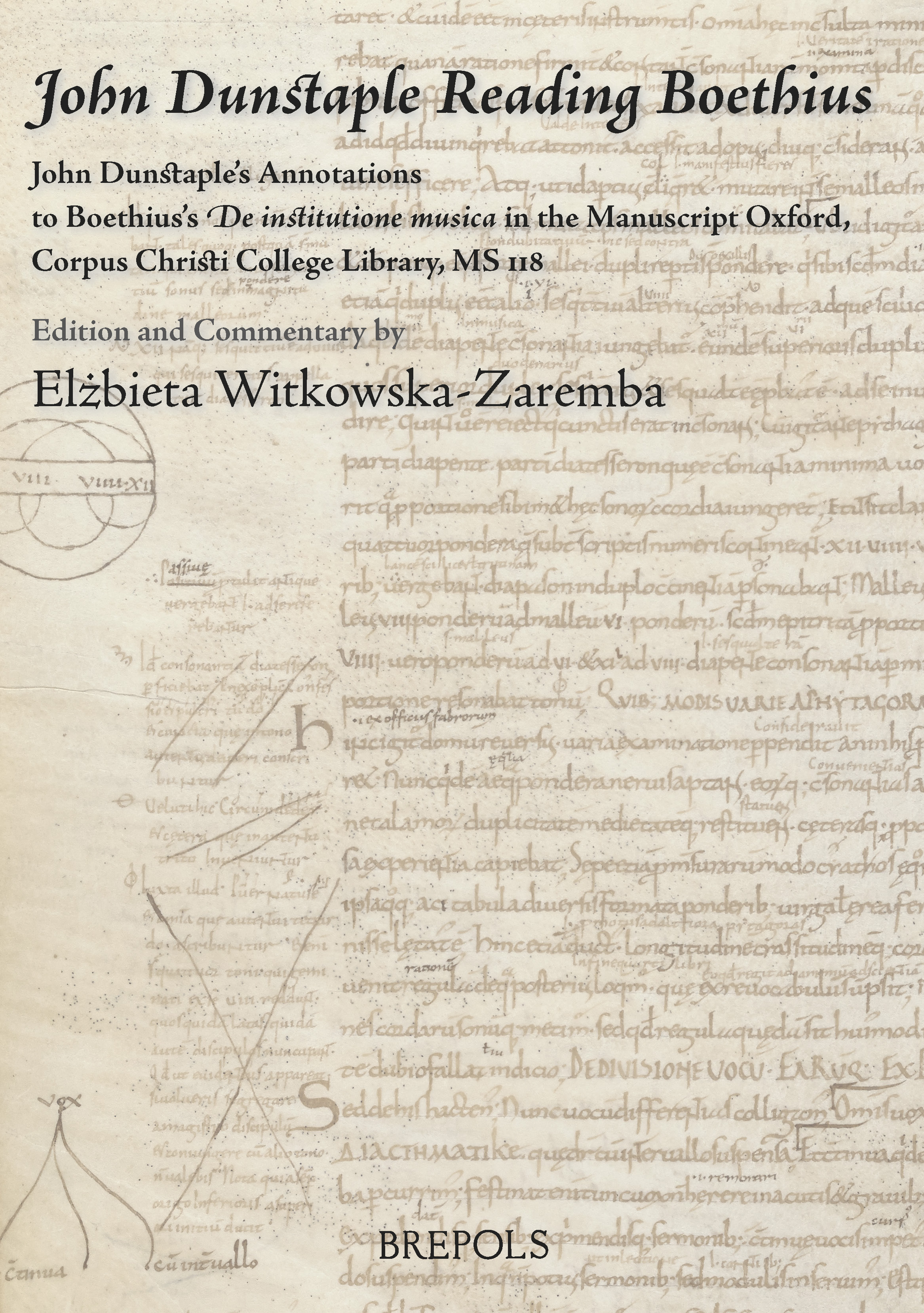 John Dunstaple Reading Boethius
John Dunstaple’s Annotations to Boethius’s “De institutione musica” in the Manuscript Oxford, Corpus Christi College Library, MS 118

