
An English-French Dictionary of Clipped Words
by F. Antoine

This dictionary deals with the little words which everyone uses every day without even noticing them and which are so liable to escape the grasp of a speaker of another language – clipped words, obtained by back-clipping or apocope (the dropping of one or more final syllables), by front-clipping or aphesis (the dropping of one or more final syllables), by the combination of these two processes and sometimes further transformed, especially in slang, by the addition of a new ending. The aim is not of course merely to list all these words and say from which longer words they were obtained; an attempt is made here to retrace the history of each of them, its stylistic, semantic and often morphological evolution, to illustrate this with authentic and often pungent or humorous quotations and also to show how each can be translated into the other language. Indeed this is an English-French bilingual dictionary, whose aim is to translate clipped words according to priciples of historical and register fidelity which bilingual dictionaries do not ordinarily set for this type of headword. Thus, clipped words will be shown to have meaning precisely because they are clipped; consequently, this meaning must be preserved and conveyed in translation. This dictionary thus aims at being different from traditional bilingual dictionaries, dictionaries of slang and colloquialisms included, in the structure and content of its articles, in which much space is devoted to the lexicological data, which inform the strictly lexicographical information. Special attention and care have been devoted to the system of cross-references, the recording and presentation of derived forms, variants and compounds and to the presentation of slang or colloquial synonyms of the headwords. The body of the dictionary is preceded by a preface in which the editing principles and methods are outlined and an attempt is made at analyzing the corpus : its historical, sociological and morphological aspects are reviewed, together with the motivations of those that coin or use clippings. These motivations appear essential to the proper appraisal of this body of slang and colloquial words; this dictionary’s intention is to pay homage to all the unknown paople who have made the lexicon richer by playing with and on words, with joyful humour, zest and gusto. It is hoped that all lovers of words will have the same pleasure exploring this dictionary as its author had writing it. Professor Fabrice Antoine teaches English at the Universite Charles-de-Gaulle Lille III (France). His research fields are bilingual lexicography, lexicology and translation; he has been a consulting editor for a dozen bilingual dictionaries, general as well as slang ones. He is especially interested in French and English slang and colloquialisms and co-hairs ELEXTRA (Etudes sur le Lexique et la Traduction), a research centre at the University of Lille.
- By (author) F Antoine
Other Titles in this Series

 In and Out of Africa. Languages in Question. In Honour of Robert Nicolai
Volume 1. Language Contact and Epistemological Issues
Volume 130


 Prodige a voir
Recherches comparatives sur l'origine casuelle de l'infinitif en grec ancien
Volume 103

 In and Out of Africa. Languages in Question. In Honour of Robert Nicolai
Volume 2. Language Contact and Language Change in Africa
Volume 132
 Les dictionnaires specialises et l’analyse de la valeur
Actes du colloque organise en avril 1995 par le Centre de terminologie de Bruxelles (Institut Libre Marie Haps)
Volume 87
 Le nom des langues III
Le nom des langues en Afrique sub-saharienne: pratiques, denominations, categorisations. Naming Languages in Sub-Saharan Africa: Practices, Names, Categorisations
Volume 124

 Décodage et interprétation
Ordres linguistique, iconique et pragmatique en néerlandais contemporain
Volume 110

 VSVS. Grammaire latine. Description du latin classique en vue de la lecture des auteurs
Deuxième édition
Volume 88

 Le verbe grec ancien. Éléments de morphologie et de syntaxe historiques
Deuxième édition, revue et augmentée
Volume 104
 Hethitica XV. Pantheons locaux de l’Asie Mineure pre-chretienne
Premier Colloque Louis Delaporte - Eugene Cavaignac (Institut Catholique de Paris, 26-27 mai 2000)
Volume 109


 Hellenikes dialektoi ston archaio kosmo
Actes du VIe Colloque international sur les dialectes grecs anciens (Nicosie, Universite de Chypre, 26-29 septembre 2011)
Volume 137


 Bourouchaskiana
Actes du Colloque sur le bourouchaski organise a l'occasion du XXXVIeme Congres international sur les Etudes asiatiques et nord-africaines (Montreal, 27 aout - 2 septembre 2002)
Volume 113


 Langues à niveaux multiples
Hommage au Professeur Jacques Lerot à l'occasion de son éméritat
Volume 112


Similar Books


 Des mots aux actes
Traduction épistémique et littéraire. Nouvelles tendances en histoire et didactique
Volume 15


 Punning in Odd or Elegant Constructions in Jeremiah
The Convergence of Linguistics, Rhetoric, and Textuality in the Hebrew Text of Jeremiah


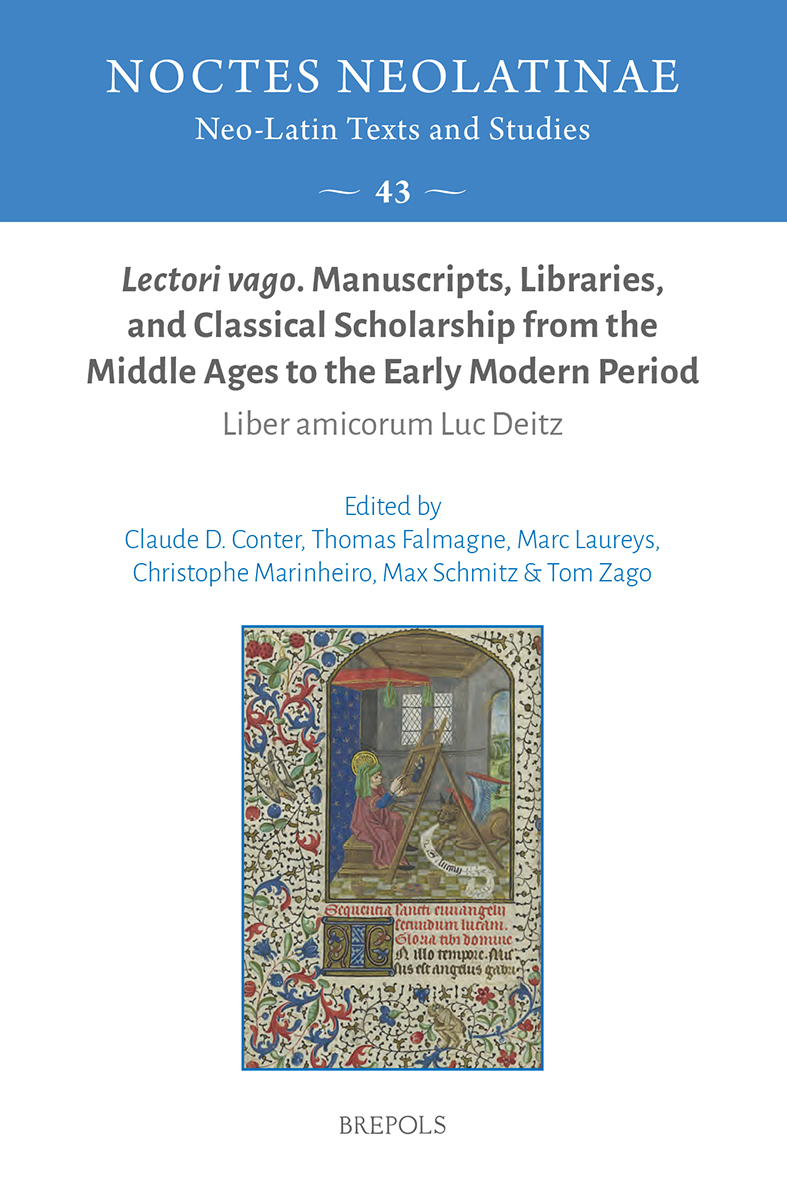 Lectori vago. Manuscripts, Libraries, and Classical Scholarship from the Middle Ages to the Early Modern Period
Liber amicorum Luc Deitz
Volume 43


 Ein Schatzhaus indischer Erzählkunst –– Die Erzählliteratur der Jainas
Band 2: Ein „Lesebuch“ originalsprachlicher Texte zur jainistischen „Universalgeschichte“ samt eines Jaina-Māhārāṣṭrī-Wörterbuchs zu allen Text- und Lesestücken.


