
La Samarie, la Diaspora et l’achèvement de la Torah
Territorialités et internationalités dans l’Hexateuque
By (author) Dany Nocquet
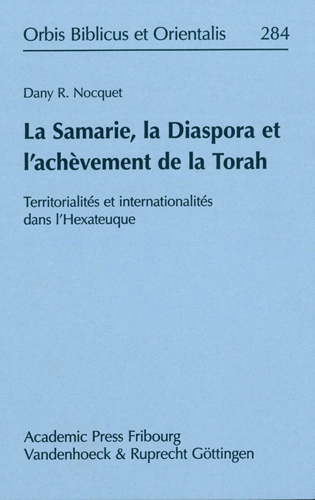
This book offers an inquiry into the concepts and representations of territoriality beyond Judah and the relations of the people of Israel with neighbouring peoples. References to Shechem, Bethel, regions beyond the Jordan river, Edom, Philistia and Egypt are closely scrutinized. The author’s findings point to largely positive representations of these territories and their inhabitants from the books of Genesis through Joshua. According to Nocquet, the xenophile perspective and recognition of other peoples and neighbouring regions are related to Yahwist communities in Samaria and the diaspora of the late Persian and early Hellenistic periods. Taking into account archaeological data, most notably the presence of a late-5th-century BCE Yahweh temple on Mount Garizim, the author evaluates the literary and historical consequences of his exegetical findings for the concepts of promised land and election, and for the final redaction of the Torah.
This book offers an inquiry into the concepts and representations of territoriality beyond Judah and the relations of the people of Israel with neighbouring peoples. References to Shechem, Bethel, regions beyond the Jordan river, Edom, Philistia and Egypt are closely scrutinized. The author’s findings point to largely positive representations of these territories and their inhabitants from the books of Genesis through Joshua. According to Nocquet, the xenophile perspective and recognition of other peoples and neighbouring regions are related to Yahwist communities in Samaria and the diaspora of the late Persian and early Hellenistic periods. Taking into account archaeological data, most notably the presence of a late-5th-century BCE Yahweh temple on Mount Garizim, the author evaluates the literary and historical consequences of his exegetical findings for the concepts of promised land and election, and for the final redaction of the Torah.
Remerciements Introduction 1. Le context historique et litteraire Introduction 1.1. Les yahwismes de l'epoque perse au-dela de la Judee: Samarie, Egypte et Babylonie 1.1.1. Samarie 1.1.2. Egypte 1.1.3. Babylonie 1.2. Questions et perspectives de la recherche sur le Pentateuque 1.2.1. Le travail compositionnel de l'ecole sacerdotale: le document P 1.2.2. Le travail compositionnel de l'ecole de Saintete (H): Lv 17-26 1.2.3. Le travail compositionnel final du Pentateuque 1.2.4. Questions et perspectives 2. Sichem, Bethel dans la tradition patriarcale 2.1.1. Sichem et Bethel en Gn 12,6-9 2.1.2. Sichem et Bethel dans le cycle de Jacob et de Joseph 2.1.2.1. Bethel dans le cycle de Jacob: Gn 28,10-22 2.1.2.2. Sichem dans le cycle de Jacob Gn 33, 18-20 Gn 34 Gn 35,2-4 2.1.2.3. Sichem en Gn 37 2.2. Sichem dans la tradition de Josue: Jos 24 2.3. Le Garizim en Deuteronome et Josue: Dt 11,26-32
27,1-13 Jos 8,30-35 2.3.1. Dt 11,26-32 2.3.2. Dt 27,1-13 2.3.3. Jos 8,30-35 Bilan La Philistie, terre de migration pour les patriarches Introduction 6.1. Abraham chez Abimelek, roi de Guerar: Gn 20,1-18 et 21,22-34 6.1.1. Une lecture de Gn 20,1-18 6.1.2. Une lecture de Gn 21,22-34 6.1.3. Gn 20,1-18 et 21,22-34 et leur cadre litteraire et historique 6.2. Isaac chez Abimelek: Gn 26 6.2.1. Une lecture de Gn 26 6.2.2. Gn 26 et son cadre litteraire et historique Bilan 7. Israel et ses voisins: une inimite revisitee Introduction: Ex 15,14-16
Nb 24,15-20
Dt 23,4-5 7.1. Amalec contre Israel: Ex 17,8-16 7.1.1. Une lecture d'Ex 17,8-16 7.1.2. Ex 17,8-16 et son cadre litteraire et historique 7.2. Edom, Madian et Israel, une inimitie revisitee 7.2.1. Edom contre Israel: Nb 20,14-21? 7.2.1.1. Une lecture de Nb 20,14-21 7.2.1.2. Nb 20, 14-21 et son cadre litteraire et historique 7.2.2. Israel elimine Madian: Nb 31,1-24? 7.2.2.1. Une lecture de Nb 31,1-24 7.2.2.2. Nb 31,1-24 et son cadre litteraire et historique 7.3. Le pays de Moab libere: Nb 21,26-31? 7.3.1. Une lecture de Nb 21,26-31 7.3.2. Nb 21,26-31 et son cadre litteraire et historique Bilan Conclusion 1. Une centralite cultuelle redefinie 2. L'elargissement de la terre promise 3. L'election partagee et reconnaissance reciproque 4. Samarie, diaspora et l'achevement de la Torah Liste des abreviations et des sigles Bibliographie
- By (author) Dany Nocquet
Other Titles in this Series
 Oral et écrit dans l’Antiquité orientale: les processus de rédaction et d’édition
Actes du colloque organisé par le Collège de France, Paris, les 26 et 27 mai 2016
Volume 291



 The Power of Images
The Poetics of Violence in Lamentations 2 and Ancient Near Eastern Art
Volume 297

 Wortschöpfung
Die Memphitische Theologie und die Siegesstele des Pije - zwei Zeugen kultureller Repräsentation in der 25. Dynastie
Volume 243
 Le peuple aux trois noms
Une histoire de l'ancien Israël à travers le prisme de ses ethnonymes
Volume 298
 Représenter dieux et hommes dans le Proche-Orient ancien et dans la Bible
Actes du colloque organisé par le Collège de France, Paris, les 5 et 6 mai 2015
Volume 287
 Israeliten und Phönizier
Ihre Beziehungen im Spiegel der Archäologie und der Literatur des Alten Testaments und seiner Umwelt
Volume 235


 Architecture, Iconography, and Text
New Studies on the Northwest Palace Reliefs of Ashurnasirpal II
Volume 301
 When Gods Speak to Men
Divine Speech according to Textual Sources in the Ancient Mediterranean Basin
Volume 289

 Divine Names on the Spot II
Exploring the Potentials of Names through Images and Narratives
Volume 299

 Les fluides corporels en Égypte et au Proche-Orient anciens
Actes du colloque organisé à l'Université Paul-Valéry, Montpellier, 5-7 septembre 2019
Volume 309

 Khirbet Qeiyafa in the Shephelah
Papers Presented at a Colloquium of the Swiss Society of Ancient Near Eastern Studies Held at the University of Bern, September 6, 2014
 Images of Anonymous Women
A Semiotic Approach to Image-Text Relations in Interpretation of Ancient Near Eastern Art and the Hebrew Bible
Volume 310
 ‘Trinkt von dem Wein, den ich mischte!’ ‘Drink of the Wine which I have Mingled!’
Festschrift für Silvia Schroer zum 65. Geburtstag
Volume 303
 Entre dieux et hommes : anges, démons et autres figures intermédiaires
Actes du colloque organisé par le Collège de France, Paris, les 19 et 20 mai 2014
 The Hebrew Bible/Old Testament and Scribal Scholarship in Antiquity
Studies in Honor of Arie van der Kooij on the Occasion of his Eightieth Birthday
Volume 306
 The Text of Leviticus
Proceedings of the Third International Colloquium of the Dominique Barthelemy Institute, held in Fribourg (October 2015)
Volume 292

Similar Books


 Athanasius of Alexandria, Epistula ad episcopos Aegypti et Libyae
Old Slavonic Version and English Translation
Volume 261



 Cyril of Alexandria’s Christological Exegesis
Explorations of Partitive Exegesis in the Dialogues on the Trinity
Volume 70


 Epiphanies of the Divine in the Septuagint and the New Testament
Fifth International Symposium of the Corpus Judaeo-Hellenisticum Novi Testamenti (CJHNT), 14-17 May 2015, Nottingham

 Extracanonical Traditions and the Holy Land
Texts, Rituals, and Material Culture in Late Antique Palestine


 Paradise Lost in Transmission
The Return to Eden in the Apocalypse of Peter within Its Ethiopic and Early Christian Contexts


 Punning in Odd or Elegant Constructions in Jeremiah
The Convergence of Linguistics, Rhetoric, and Textuality in the Hebrew Text of Jeremiah

 Shame in the Worlds of the Hebrew Bible and Akkadian Texts
A Linguistic Study and Its Implications
Volume 33

 Tabernacle, Table, Ark, and Text
Richard of Saint Victor on the Interpretation of Scripture
Volume 67
 The Anglo-Norman Bible’s Books of Kings, a Critical Edition
(BL Royal 1 C III, fols 234r-274v)
Volume 37
 The Body
Lived, Cultured, Adorned: Essays on Dress and the Body in the Bible and Ancient Near East in Honor of Nili S. Fox

 The Compositional History of the Book of Kings
An Analysis of the Evaluative Frameworks in 1 Kings 14–2 Kings 25
 The Discourse of Rites
Shaping and Reshaping the (Counter-)Priestly Rituals Conducted Outside the Tabernacle


 The Therapeutae as the Best Paradigm for the Contemplative Life
A Contextual Reading of Philo of Alexandria's De Vita Contemplativa