
The Ultimate and the Penultimate Text of the Book of Joshua
by K. De Troyer

In this monograph, differences between the Hebrew and the Greek text of the Book of Joshua are studied. In chapter 1 the differences in commands and their executions are analysed, with examples from the story of the collapse of the wall of Jericho (Josh 6) and the battle against Ai (Josh 8). In chapter 2, examples, like “all the law that Joshua commanded” (e.g. Josh 1:7) and the concept of “crossing this Jordan,” are analysed and explained using the category of “nomistic alterations.” Then, the texts dealing with the concept of “burning with fire” (Josh 7) and “stoning and hanging (Josh 8:29), and Josh 8:30-35 are studied. In each of these cases, the final editor of the Hebrew Masoretic Text revised an older Hebrew text and sought to make sure that the text of the final version better reflected the laws as given in the book of Deuteronomy. The problematic variant with regard to “returning to Gilgal” in Josh 10 is studied in chapter 3. In chapter 4, the line of command is studied: Joshua clearly, albeit rather late in his life, stands in the shadow of Moses and continues in his line. In all the chapters, text critical data of the Masoretic Text, the Old Greek, the Dead Sea Scrolls, the Vetus Latina and Josephus are taken into account, as well as the data from the early Jewish revisers and the Hexaplaric and the Lucianic revisions. Moreover, the translation technique of specific passages is studied as well as the literary- and redactional development of the text. After studying all the variants, it is proposed that the Masoretic Text grosso modo is a further development of the Hebrew text underlying the Vorlage of the Old Greek text of the book of Joshua and the editorial strategies by which the penultimate text of the book of Joshua was transformed into the ultimate Hebrew, Masoretic Text of the book of Joshua are described.
In this monograph, differences between the Hebrew and the Greek text of the Book of Joshua are studied. In chapter 1 the differences in commands and their executions are analysed, with examples from the story of the collapse of the wall of Jericho (Josh 6) and the battle against Ai (Josh 8). In chapter 2, examples, like “all the law that Joshua commanded” (e.g. Josh 1:7) and the concept of “crossing this Jordan,” are analysed and explained using the category of “nomistic alterations.” Then, the texts dealing with the concept of “burning with fire” (Josh 7) and “stoning and hanging (Josh 8:29), and Josh 8:30-35 are studied. In each of these cases, the final editor of the Hebrew Masoretic Text revised an older Hebrew text and sought to make sure that the text of the final version better reflected the laws as given in the book of Deuteronomy. The problematic variant with regard to “returning to Gilgal” in Josh 10 is studied in chapter 3. In chapter 4, the line of command is studied: Joshua clearly, albeit rather late in his life, stands in the shadow of Moses and continues in his line. In all the chapters, text critical data of the Masoretic Text, the Old Greek, the Dead Sea Scrolls, the Vetus Latina and Josephus are taken into account, as well as the data from the early Jewish revisers and the Hexaplaric and the Lucianic revisions. Moreover, the translation technique of specific passages is studied as well as the literary- and redactional development of the text. After studying all the variants, it is proposed that the Masoretic Text grosso modo is a further development of the Hebrew text underlying the Vorlage of the Old Greek text of the book of Joshua and the editorial strategies by which the penultimate text of the book of Joshua was transformed into the ultimate Hebrew, Masoretic Text of the book of Joshua are described.
- By (author) K. De Troyer
Other Titles in this Series
 Anthropology in the New Testament and its Ancient Context
Papers from the EABS-Meeting in Piliscsaba / Budapest
Volume 54
 From Joseph to Jesus
The Joseph Narrative as a Compositional Template from Old Greek Esther to the Gospel of Luke
Volume 125


 My Shepherd, though You Do not Know Me
The Persian Royal Propaganda Model in the Nehemiah Memoir
Volume 78
 Happy the One who Meditates on Wisdom (Sir. 14,20)
Collected Essays on the Book of Ben Sira
Volume 43
 Sabbath in the Making
A Study of the Inner-Biblical Interpretation of the Sabbath Commandment
Volume 97
 The Old Greek of Isaiah: Issues and Perspectives
Papers read at the Conference on the Septuagint of Isaiah, held in Leiden 10-11 April 2008
Volume 55
 “Have You Not Read this Scripture?”
Memory Variation and Context-Based Modification in the Old Testament Quotations in the Gospel of Mark
Volume 116
 Jesus, the Eschatological Temple
An Exegetical Study of Jn 2,13-22 in the Light of the Pre 70 C.E. Eschatological Temple Hopes and the Synoptic Temple Action
Volume 58
 A Divine Round Trip
The Literary and Christological Function of the Descent/Ascent Leitmotif in the Gospel of John
Volume 79

 Qumran and the Bible
Studying the Jewish and Christian Scriptures in Light of the Dead Sea Scrolls
Volume 57
 Meaningful Meetings with Foreigners in the World of the Bible
Essays in Honour of Klaas Spronk on the Occasion of His Retirement
Volume 119


 The Sources of Celsus’s Criticism of Jesus
Theological Developments in the Second Century AD
Volume 108
 Between Israelite Religion and Old Testament Theology
Essays on Archaeology, History, and Hermeneutics
Volume 80


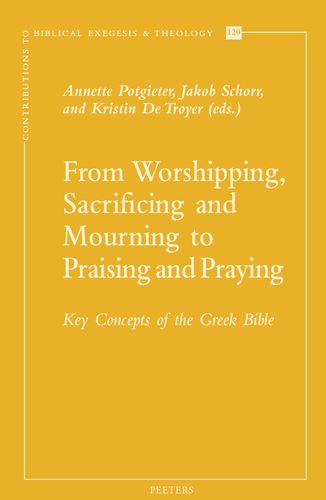 From Worshipping, Sacrificing and Mourning to Praising and Praying
Key Concepts of the Greek Bible
Volume 120
 Law, Prophets, and Wisdom
On the Provenance of Translators and their Books in the Septuagint Version
Volume 68


Similar Books


 Athanasius of Alexandria, Epistula ad episcopos Aegypti et Libyae
Old Slavonic Version and English Translation
Volume 261



 Contesting Labeled Identities
The Sociology of Gentilics in Biblical and Northwest Semitic Literature
 Cyril of Alexandria’s Christological Exegesis
Explorations of Partitive Exegesis in the Dialogues on the Trinity
Volume 70


 Epiphanies of the Divine in the Septuagint and the New Testament
Fifth International Symposium of the Corpus Judaeo-Hellenisticum Novi Testamenti (CJHNT), 14-17 May 2015, Nottingham


 Extracanonical Traditions and the Holy Land
Texts, Rituals, and Material Culture in Late Antique Palestine
From Joseph to Jesus
The Joseph Narrative as a Compositional Template from Old Greek Esther to the Gospel of Luke
Volume 125





 Nicholas of Lyra’s Commentaries on the Gospels of Matthew and Luke
Franciscan Exegesis in a Time of Crisis
 Paradise Lost in Transmission
The Return to Eden in the Apocalypse of Peter within Its Ethiopic and Early Christian Contexts




 Punning in Odd or Elegant Constructions in Jeremiah
The Convergence of Linguistics, Rhetoric, and Textuality in the Hebrew Text of Jeremiah


 Reformed Covenantal Eudaimonism
Wilhelmus à Brakel (1635–1711) on Highest Good, Virtue, and Law
Volume 87
