
Vernacular Bible and Religious Reform in the Middle Ages and EarlyModern Era
Edited by W. François Edited by A.A. den Hollander

The central focus of this book concerns vernacular Bibles in various regions of (late) medieval and early modern Europe, as well as the religious and cultural circumstances in which these books found their origin. The contributions represent a cross-section of several research traditions that show an interest in vernacular Bibles. The volume includes articles that demonstrate how vernacular Bibles were liable to censorship measures, viz. Francesca Tasca’s contribution on Peter Valdes of Lyons, and Gigliola Fragnito’s on post-Tridentine Catholic Europe. Other essays, in contrast, inspired by a social-historical approach, emphasize that laypeople in the late Middle Ages and Early Modern Era found ways to read the Bible and other religious works ‘anyway’ and that they were hardly hindered by bans instituted by ecclesiastical or secular governments.
The central focus of this book concerns vernacular Bibles in various regions of (late) medieval and early modern Europe, as well as the religious and cultural circumstances in which these books found their origin. The contributions represent a cross-section of several research traditions that show an interest in vernacular Bibles. The volume includes articles that demonstrate how vernacular Bibles were liable to censorship measures, viz. Francesca Tasca’s contribution on Peter Valdes of Lyons, and Gigliola Fragnito’s on post-Tridentine Catholic Europe. Other essays, in contrast, inspired by a social-historical approach, emphasize that laypeople in the late Middle Ages and Early Modern Era found ways to read the Bible and other religious works ‘anyway’ and that they were hardly hindered by bans instituted by ecclesiastical or secular governments. Two authors who take this position are Andrew C. Gow and Margriet Hoogvliet, who also question the paradigm that the Protestant Reformation was the first to open the Bible to the laity. Suzan A. Folkerts brings this intuition into practice by studying printers’ choices as well as provenance data in books containing the Epistle and Gospel readings from Mass published between 1450 and 1550 in the Netherlands. The volume also contains contributions that focus on that book beyond Western European (Romania: Emanual Conac, Eugen and Lucia-Gabriela Munteanu and Scandinavia: Jonatan Pettersson). In this regard, attention is paid to the (pre)confessional character and literary choices that are constitutive for the text. The confessional Era and its implications in the political field are central to Elizabeth Hodgson’s study of ‘David’s Psalms’ in Reformation England and France/Switzerland. The ‘post-confessional’ eighteenth century Enlightenment Bible – rooted in the Catholic tradition – by Isaac-Joseph Berruyer is the object of an essay by Daniel J. Watkins. Finally, Kees Schepers devotes a study to 33 drawings made by the Brussels canon regular Gielis vander Hecken.
- Edited by W. François
- Edited by A.A. den Hollander
Other Titles in this Series


 The Normativity of History
Theological Truth and Tradition in the Tension between Church History and Systematic Theology
Volume 282


 Kindness, Courage, and Integrity in Biblical Texts and in the Politics of Biblical Interpretation
Festschrift Reimund Bieringer
Volume 333
 Theological Renewal and the Resurgence of Integrism
The René Draguet Case (1942) in Its Context
Volume 266


 The Articulation between Natural Sciences and Systematic Theology
A Philosophical Mediation Based on the Contributions of Jean Ladrièreand Xavier Zubiri
Volume 267


 L’Europe de l’exégèse au XVIe siècle
Interprétations de la parabole des ouvriers à la vigne (Matthieu20,1-16)
Volume 174

 Catholic Approaches in Practical Theology
International and Interdisciplinary Perspectives
Volume 286


 Le lecteur
Sixième Colloque International du RRENAB, Université catholique deLouvain, 24-26 mai 2012
Volume 273

Similar Books

 A Collaborative Tapestry in Honour of Shirley Ann Brown / Une fresque brodée en l’honneur de Shirley Ann Brown
The Bayeux Tapestry Seen by her Colleagues and Friends / La Tapisserie de Bayeux vue par ses collègues et amis




 Athanasius of Alexandria, Epistula ad episcopos Aegypti et Libyae
Old Slavonic Version and English Translation
Volume 261

 Balthasar Caymox of Nuremberg
Early Modern German Print Publishers: Popular Prints of the Seventeenth Century
 Behind the Scenes of Medieval Roofs
An Overview of the Roofing Systems of Italian Churches
Volume 90
 Beyond Sovereign Courts
Agents and Practices in Early Modern Spanish and Habsburg Diplomacy
Volume 3


 Circulation, Use, Impact
The Consumption of Architectural Books in the Early Modern Eastern Adriatic
Volume 1


 Councils, Conflicts, Correspondence
Urban Diplomacy in Reval (Tallinn) and Lübeck (c. 1470–1570)
Volume 67
 Cyril of Alexandria’s Christological Exegesis
Explorations of Partitive Exegesis in the Dialogues on the Trinity
Volume 70


 Epiphanies of the Divine in the Septuagint and the New Testament
Fifth International Symposium of the Corpus Judaeo-Hellenisticum Novi Testamenti (CJHNT), 14-17 May 2015, Nottingham


 Extracanonical Traditions and the Holy Land
Texts, Rituals, and Material Culture in Late Antique Palestine
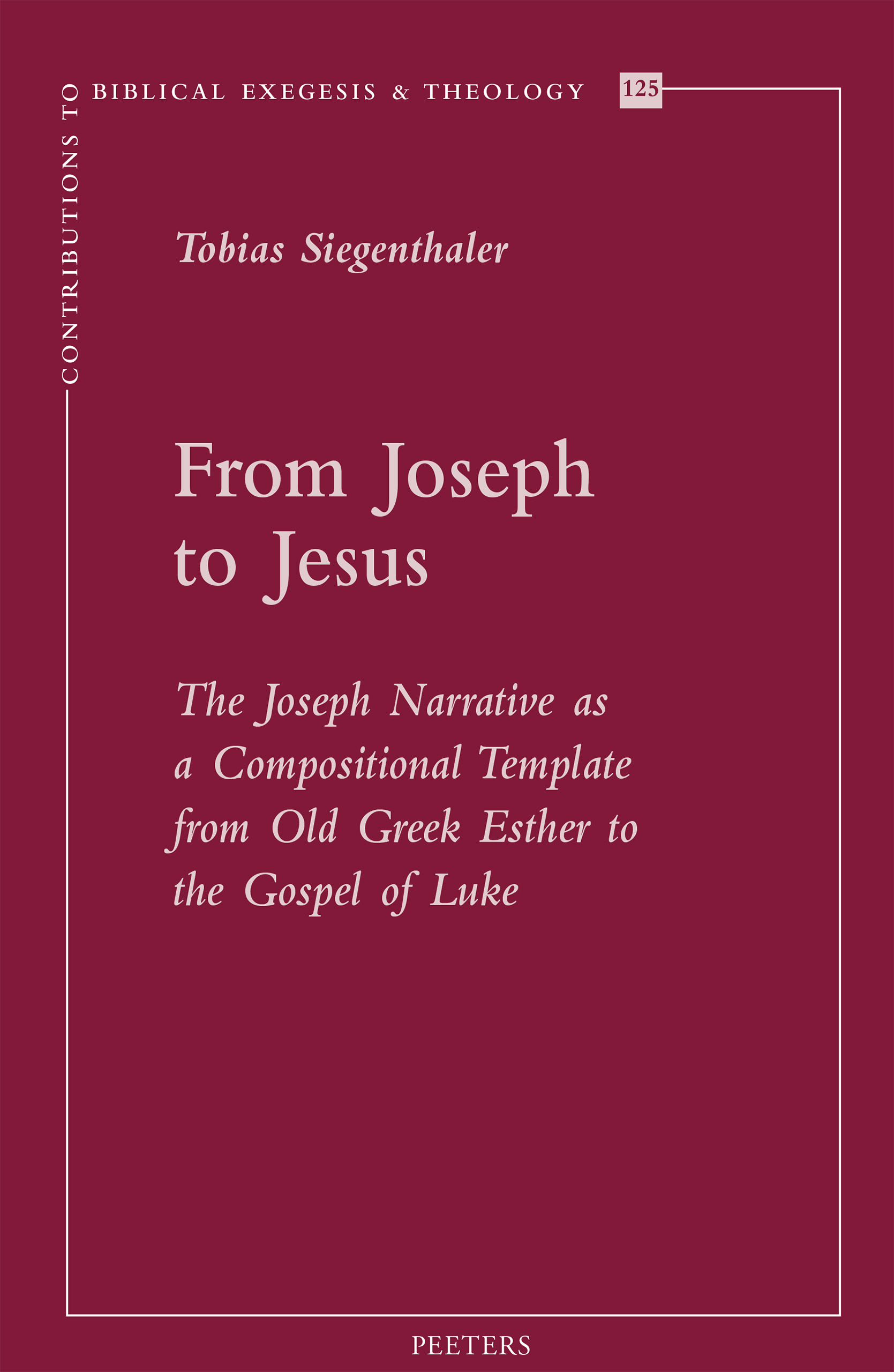 From Joseph to Jesus
The Joseph Narrative as a Compositional Template from Old Greek Esther to the Gospel of Luke
Volume 125


