
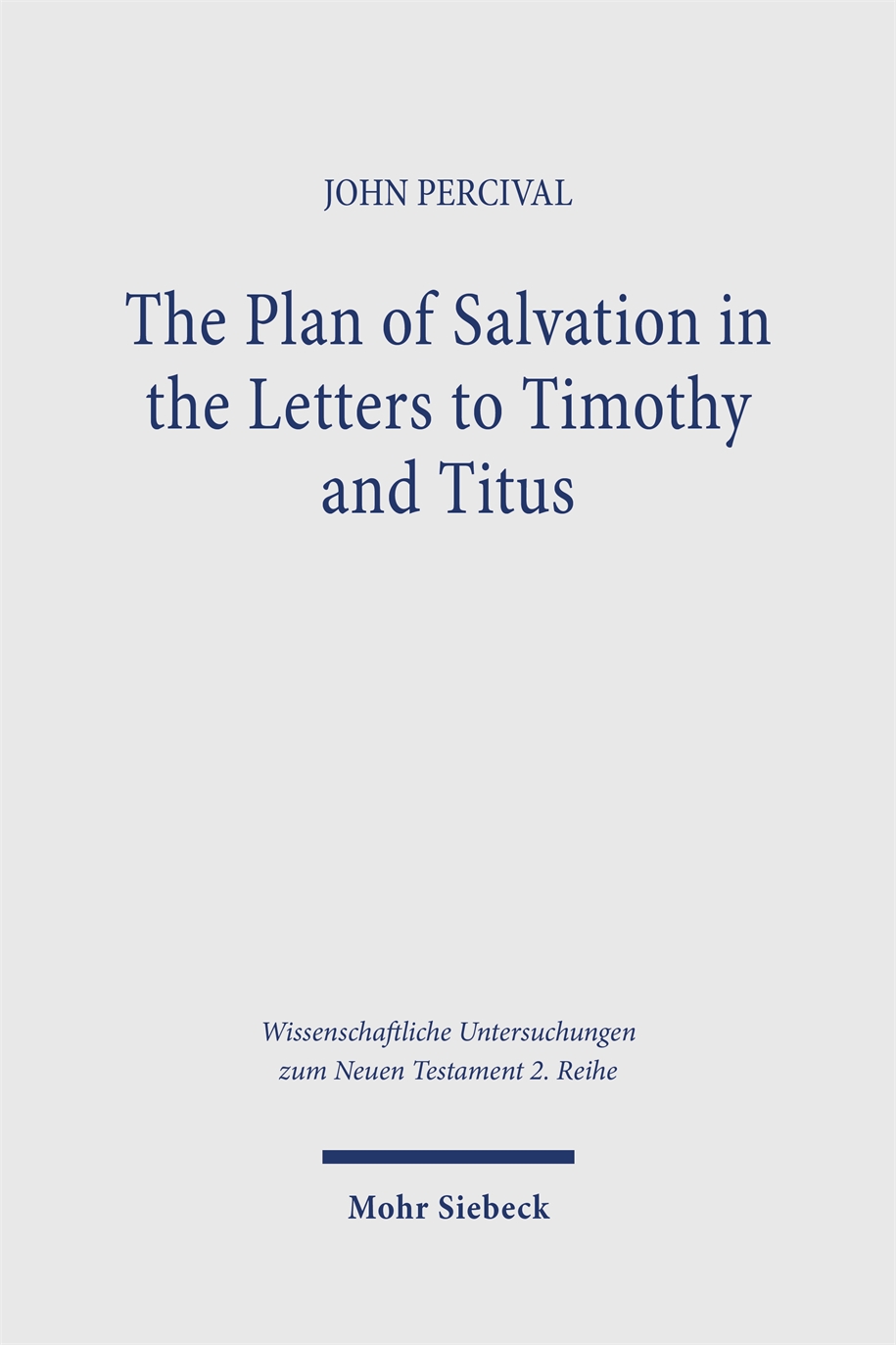
The Plan of Salvation in the Letters to Timothy and Titus
By (author) John Percival
Paperback (Forthcoming)
(December 2026)
ISBN: 9783161705502
6.1 x 9.13 inches
Price: $120.00
John Percival rethinks 1 Timothy, 2 Timothy and Titus by reading each letter on its own terms. Using a narrative “plan of salvation,” the author reveals their distinct voices, purposes, and theology – and offers a fresh, accessible perspective on often-overlooked New Testament texts.
The New Testament letters to Timothy and Titus (LTT) are often lumped together as “The Pastoral Epistles.” While there are understandable reasons for this approach, it has meant that the distinctive contribution of each of the three letters has not been sufficiently considered. Furthermore, narrative approaches to the Pauline letters have led to fruitful explorations of their theology, especially in discussions about salvation-historical and apocalyptic perspectives, but these approaches have not been applied to the LTT, at least in part due to their marginal status in scholarly discussion. Together, these gaps have impoverished our understanding of the theology and purpose of the LTT.
John Percival therefore applies a narrative approach to examine the salvation-historical outlook of each letter. Adopting minimal assumptions about authorship, he reviews each letter in turn, describing the components of a narrative “plan of salvation.” He examines the relationship between the elements of the plan to shed light on the narrative world, theology and, especially, the rhetorical purpose of the letter. Despite their brevity, the three letters display clear differences in narrative data. Percival identifies areas where the letters have been misrepresented or misunderstood in scholarly literature, arriving at a clearer understanding of each letter’s distinctive theological construction and use of the plan of salvation.
Chapter 1: Introduction
1 The Plan of Salvation?
2 The (Implied) Author and Recipients
2.1 An Author-Agnostic Approach to the Letters
2.2 Timothy and Titus as the Implied Recipients
2.3 Conclusion
3 "The Pastoral Epistles": A Loaded Label
4 Narrative Approaches to the Pauline Letters
5 Salvation-Historical Approaches to the Pauline Letters
5.1 A Single Coherent Story?
5.2 Significance of History before Christ
5.3 Future
5.4 Conclusion
6 Outline of Argument
Chapter 2: The Plan of Salvation in 1Tim
1 Introduction
1.1 Aim
1.2 Setting of 1Tim
1.3 Purpose of 1Tim
1.4 Conclusion
2 Before Christ
2.1 The Scriptures (4:13; 5:18)
2.2 Creation
2.3 The Fall
2.4 The Time of Israel
2.5 Conclusion
3 The Christ Event
3.1 Fulfilment of Scriptures (2:5, 15a)
3.2 Christ Jesus Came into the World (1:15)
3.3 The Life of Jesus (6:3-8, 13)
3.4 The Death of Jesus (2:6)
3.5 The Mystery (3:16)
3.6 Conclusion
4 The Present Age
4.1 Paul's Role in God's Plan (1:1, 11-17; 2:6-7)
4.2 Timothy and the Church's Mission (2:1-3:16)
4.3 Apostasy in the Last Times (4:1-2)
4.4 Conclusion
5 The Eschatological End
5.1 The Appearing of Christ (6:14-15)
5.2 Judgment and Salvation
5.3 Eternal Life, in the Coming Age (4:8; 6:19)
5.4 Conclusion
6 Conclusion
6.1 Narrative Elements
6.2 Narrative Substructure
6.3 Rhetorical Significance
Chapter 3: The Plan of Salvation in 2Tim
1 Introduction
1.1 Aim
1.2 Setting of 2Tim
1.3 Purpose and Genre of 2Tim
1.4 Conclusion
2 Before Christ
2.1 Prior to Creation
2.2 From Creation to Christ
3 The Christ Event
3.1 Revelation of Prior Grace (1:9-10)
3.2 Death, Resurrection and Reign (2:8, 11-12)
3.3 Conclusion
4 The Present Age
4.1 The Last Days and False Teaching (2:14-26; 3:1-13; 4:3-4)
4.2 Paul's Role in God's Plan (1:11-12; 4:6-8)
4.3 The Church and Ministry (2:19-21)
4.4 Conclusion
5 The Eschatological End
5.1 The Heavenly Kingdom (4:18)
5.2 The Second Coming as Epiphany (4:1, 8)
5.3 The Timing of the Resurrection (2:17b-18)
5.4 The Day of Judgment (1:12, 18; 2:10-12; 4:1, 8, 14)
5.5 The Ultimate Destiny: An Immortal Life of Reigning (1:10; 2:10-12)
5.6 Conclusion
6 Conclusion
6.1 Narrative Elements
6.2 Narrative Substructure
6.3 Rhetorical Significance
Chapter 4: The Plan of Salvation in Titus
1 Introduction
1.1 Aim
1.2 Setting of Titus
1.3 Purpose and Genre of Titus
2 Before Christ: Prior to Creation
2.1 The Character of God (1:2-4; 2:10, 13; 3:4-8)
2.2 The Divine Promise (1:2)
2.3 Election (1:1)
2.4 Conclusion
3 The Christ Event
3.1 Appearance of God's Qualities (2:11; 3:4)
3.2 Self-giving for Redemption and Purification (2:14)
3.3 The Out-Pouring of the Spirit (3:5b-6)
3.4 Conclusion
4 The Present Age
4.1 Paul's Role as Apostolic Preacher (1:3)
4.2 The Present Age: The Church in the World
4.3 Conclusion
5 The Eschatological End
5.1 Return as Epiphany (2:13)
5.2 Eternal Life (1:2; 3:7)
5.3 Conclusion
6 Conclusion
6.1 Narrative Elements
6.2 Narrative Substructure
6.3 Rhetorical Significance
Chapter 5: Conclusion
1 Summary
1.1 Narrative Elements
1.2 Narrative Substructure
1.3 Rhetorical significance
2 Research Implications
2.1 The Plan of Salvation
2.2 Familiarity with Scripture
2.3 Identity Formation
2.4 Christology and Soteriology
2.5 Eschatology
3 Hermeneutical Reflections
4 Future Study
- By (author) John Percival
Other Titles in this Series


 The Temple Keys of Isaiah 22:22, Revelation 3:7, and Matthew 16:19
The Isaianic Temple Background and Its Spatial Significance for the Mission of Early Christ Followers
Volume 559


 Jesaja 53 als theologische Mitte der Apostelgeschichte
Studien zu ihrer Christologie und Ekklesiologie im Anschluss an Apg 8,26-40
Volume 398

 Luke-Acts and Jewish Historiography
A Study on the Theology, Literature, and Ideology of Luke-Acts
Volume 366


 Jesus’ Transfiguration and the Believers’ Transformation
A Study of the Transfiguration and Its Development in Early Christian Writings
Volume 265
 Jesus, the Tribulation, and the End of the Exile
Restoration Eschatology and the Origin of the Atonement
Volume 204

 Die Wunder an den Widersachern
Wunderhermeneutik am Beispiel der Strafwunder im lukanischen Doppelwerk
Volume 612

 Desire in Paul’s Undisputed Epistles
Semantic Observations on the Use of epithymeo, ho epithymetes, and epithymia in Roman Imperial Texts
Volume 539


 Peter – Apocalyptic Seer
The Influence of the Apocalypse Genre on Matthew's Portrayal of Peter
Volume 348

 Spirits and the Proclamation of Christ
1 Peter 3:18-22 in Light of Sin and Punishment Traditions in Early Jewish and Christian Literature
Volume 305


 Jesus as the Eschatological Davidic Shepherd
Studies in the Old Testament, Second Temple Judaism, and in the Gospel of Matthew
Volume 216

 Schopfungspoetik im Johannesevangelium
Sprachanalytische Untersuchungen zum Lebensmotiv. Kontexte und Normen neutestamentlicher Ethik / Contexts and Norms of New Testament Ethics. Band XVI
Volume 621
Similar Books


 Athanasius of Alexandria, Epistula ad episcopos Aegypti et Libyae
Old Slavonic Version and English Translation
Volume 261


 Cyril of Alexandria’s Christological Exegesis
Explorations of Partitive Exegesis in the Dialogues on the Trinity
Volume 70


 Epiphanies of the Divine in the Septuagint and the New Testament
Fifth International Symposium of the Corpus Judaeo-Hellenisticum Novi Testamenti (CJHNT), 14-17 May 2015, Nottingham

 Extracanonical Traditions and the Holy Land
Texts, Rituals, and Material Culture in Late Antique Palestine
 From Joseph to Jesus
The Joseph Narrative as a Compositional Template from Old Greek Esther to the Gospel of Luke
Volume 125


 Paradise Lost in Transmission
The Return to Eden in the Apocalypse of Peter within Its Ethiopic and Early Christian Contexts



 Punning in Odd or Elegant Constructions in Jeremiah
The Convergence of Linguistics, Rhetoric, and Textuality in the Hebrew Text of Jeremiah

 Shame in the Worlds of the Hebrew Bible and Akkadian Texts
A Linguistic Study and Its Implications
Volume 33

 Tabernacle, Table, Ark, and Text
Richard of Saint Victor on the Interpretation of Scripture
Volume 67
 The Anglo-Norman Bible’s Books of Kings, a Critical Edition
(BL Royal 1 C III, fols 234r-274v)
Volume 37
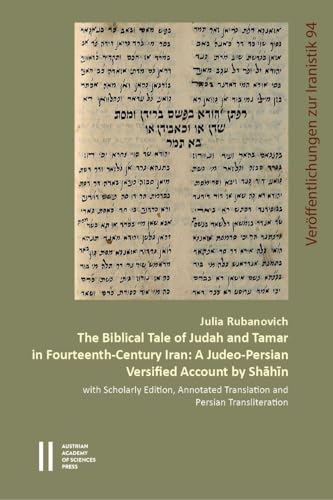 The Biblical Tale of Judah and Tamar in Fourteenth-Century Iran
A Judeo-Persian Versified Account by Shāhīn with Scholarly Edition, Annotated Translation and Persian Transliteration
Volume 94, 951
 The Body
Lived, Cultured, Adorned: Essays on Dress and the Body in the Bible and Ancient Near East in Honor of Nili S. Fox

 The Compositional History of the Book of Kings
An Analysis of the Evaluative Frameworks in 1 Kings 14–2 Kings 25
 The Discourse of Rites
Shaping and Reshaping the (Counter-)Priestly Rituals Conducted Outside the Tabernacle


