
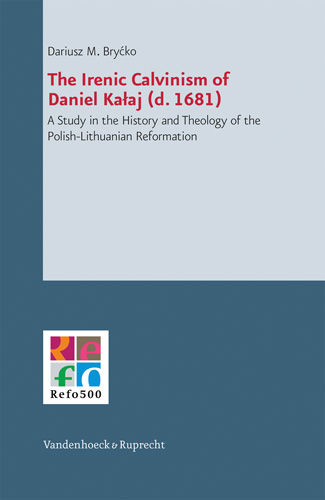
The Irenic Calvinism of Daniel Kalaj (d. 1681)
A Study in the History and Theology of the Polish-Lithuanian Reformation
By (author) Dariusz M. Brycko
Hardback (Published)
(September 2012)
ISBN: 9783525550465
6.34 x 9.33 inches
Price: $138.00
In stock
Life and theology of Daniel Kalaj, a Polish Reformed theologian of the post-Reformation period.
Daniel Kalaj (d.1681) was a Polish Reformer of Hungarian background, born in Little Poland (Malopolska) and trained in Franeker, Friesland, under some of the most brilliant Reformed theologians of seventeenth-century Europe, such as Cocceius and Cloppenburgh. Kalaj’s ministry in the Reformed Church of Little Poland was abruptly interrupted when Catholic authorities wrongly accused him of spreading then-outlawed Arianism, calling him a Calvinoarian. Kalaj became the first Polish Protestant minister to receive a sentence of capital punishment as a result of the new anti-toleration law issued in 1658 against Arians, under the false pretext of military treason during the Second Northern War (1655-1660). He escaped the axe by fleeing to Lithuania (and later to Gdansk), where he wrote his best-known work A Friendly Dialogue between an Evangelical Minister and a Roman Catholic Priest. The Friendly Dialogue is both: Kalaj’s own personal defense and a compendium to Polish Reformed doctrine, and has a strongly irenic disposition. In contrast with many Reformed thinkers of his day, Kalaj is capable of communicating Reformed doctrine in a friendly and peaceful manner. He places special emphasis on the unity of the catholic church, as expressed in his statement that the three churches Roman, and Lutheran, and Reformed are all part of one true church before God, while at the same time attempting to retain his Reformed orthodoxy.
- By (author) Dariusz M. Brycko
Other Titles in this Series




 ‘Church’ at the Time of the Reformation
Invisible Community, Visible Parish, Confession, Building …?
 The Controversy over the Lord’s Supper in Danzig 1561–1567
Presence and Practice – Theology and Confessional Policy
 The Spirituality of the Heidelberg Catechism
Papers of the International Conference on the Heidelberg Catechism Held in Apeldoorn 2013


 On Becoming a Theologian of the Cross
Revisiting Luther’s theologus crucis from the Heidelberg Disputation to the Genesis Lectures

 Constantino de la Fuente (San Clemente, 1502–Seville, 1560)
From acclaimed cathedral preacher to condemned "Lutheran" heretic




 Reformation und Konfessionsbildung in Speyer
Von konfessioneller Unentschiedenheit zum nonkonkordistischen Luthertum im Spannungsfeld von Reichspolitik und bürgerlichem Handeln. Mit Edition der archivalischen Quellen
Similar Books

 A Companion to Christianity and Sport in Europe and North America (19th-21st centuries)
Volume 1: Western and Eastern Europe
 A Connecting Polemic in the Medieval Mediterranean
The Correspondence of Leo III and ʿUmar II
Volume 6





 Ars Prophetica
Theology in the Poetry of Twentieth-Century Hebrew Poets Avraham Halfi, Shin Shalom, Amir Gilboa, and T. Carmi
 As Messianism Turns to Heresy
The Regenstein Chair Lectures On Lurianic Kabbalah and Shabbatai Tzevi at Hebrew Union College - Cincinnati


 Creating the Woman in Antiquity
Proceedings of the 16th Melammu Workshop, Innsbruck, 2–3 June 2022
Volume 13
 Cultic Kisses
Fruitful Encounters Between Deities and Humans. Festschrift for Angelika Berlejung on the Occasion of Her 65th Birthday
 De/colonizing Theologies
Glocal Histories, Contemporary Challenges, Theoretical Reflections
Volume 4
 Drunk the Potion, No Whit Charmed
The Doctrine of Pure and Perfect Souls from Iamblichus to Damascius






 Extracanonical Traditions and the Holy Land
Texts, Rituals, and Material Culture in Late Antique Palestine
 Fear, Fear of God, God-Fearers
Philological and Historical Perspectives on the World of Ancient Judaism and Christianity


 Gender and Iconography in Antiquity
Femininities, Masculinities, Ambiguities, and Beyond in the Ancient Levant, Near East, and Mediterranean