
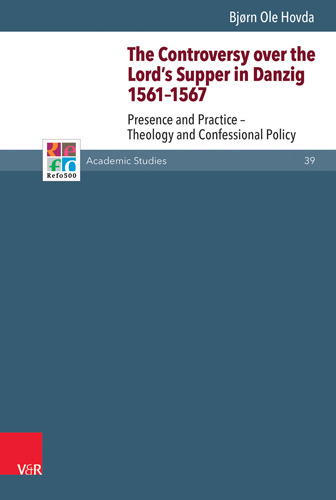
The Controversy over the Lord’s Supper in Danzig 1561–1567
Presence and Practice – Theology and Confessional Policy
By (author) Bjørn Ole Hovda Series edited by Herman J. Selderhuis Associate editor Günter Frank Associate editor Bruce Gordon Associate editor Barbara Mahlmann-Bauer Associate editor Tarald Rasmussen Associate editor Violet Soen Associate editor Zsombor Tóth Associate editor Günther Wassilowsky Associate editor Siegrid Westphal Associate editor David M. Whitford
Hardback (Published)
(December 2017)
ISBN: 9783525552759
6.34 x 9.33 inches
Price: $150.00
In stock
The variety in the controversies of the Lord’s Supper is being shown under a new single spotlight!
In 1561, a Eucharistic controversy erupted in Danzig of the sixteenth century, sparked by disagreements on the real presence and the practical treatment of the Eucharistic elements. It was one of many inner-Lutheran struggles over the Lord’s Supper in the years following the Reformation and therefore Bjorn Ole Hovda supplements the scientific studies on that topic. Different understandings of the presence of Christ during the Lord’s Supper formed different religious norms of practice. On the one hand, the controversy is here analyzed as a discussion on doctrine between opposing ecclesiastical factions, set in the context of reformatory theology and liturgical practice. The theological discussions had important practical and cultic implications. One the other hand – and in contrast with the most of earlier works – the study seeks to treat with equal seriousness the wider societal and political aspects of the controversy. Hovda shows how deeply embedded the Eucharist was within broader discourses of culture, society and politics. Far from being just an abstruse ecclesiastical matter, it was a question of great sociopolitical interest and potency. The Eucharist served both as the prime symbol of Christian unity, as well as a confessional border stone between rivaling groups. Other important aspects of this wider analysis are tensions between the ordained ministry and the city council regarding authority, internal social tensions within the city, as well as the strategic interests of the city in its relations to the Polish crown, the Hanseatic league and the emerging new trading powers, among others.Through a close study of one particular controversy, light is cast on a variety of issues with relevance to the broader field of Reformation studies, especially concerning the centrality of the Eucharist.
- By (author) Bjørn Ole Hovda
- Series edited by Herman J. Selderhuis
- Associate editor Günter Frank
- Associate editor Bruce Gordon
- Associate editor Barbara Mahlmann-Bauer
- Associate editor Tarald Rasmussen
- Associate editor Violet Soen
- Associate editor Zsombor Tóth
- Associate editor Günther Wassilowsky
- Associate editor Siegrid Westphal
- Associate editor David M. Whitford
Other Titles in this Series

 Konsolidierung des reformierten Bekenntnisses im Reich der Stephanskrone
Ein Beitrag zur Kommunikationsgeschichte zwischen Ungarn und der Schweiz in der frühen Neuzeit (1500–1700)
 Petrus Dathenus und der Heidelberger Katechismus
Eine traditionsgeschichtliche Untersuchung zum konfessionellen Wandel in der Kurpfalz um 1563

Similar Books
 ‘For You I Study, For You I Work, For You I Live, For You I Am Ready To Even Give My Life’
Essays in Honour of Francis (Frank) J Moloney, SDB




 Ars Prophetica
Theology in the Poetry of Twentieth-Century Hebrew Poets Avraham Halfi, Shin Shalom, Amir Gilboa, and T. Carmi
 As Messianism Turns to Heresy
The Regenstein Chair Lectures On Lurianic Kabbalah and Shabbatai Tzevi at Hebrew Union College - Cincinnati
 Balthasar Caymox of Nuremberg
Early Modern German Print Publishers: Popular Prints of the Seventeenth Century


 Beyond Sovereign Courts
Agents and Practices in Early Modern Spanish and Habsburg Diplomacy
Volume 3


 Circulation, Use, Impact
The Consumption of Architectural Books in the Early Modern Eastern Adriatic
Volume 1

 Councils, Conflicts, Correspondence
Urban Diplomacy in Reval (Tallinn) and Lübeck (c. 1470–1570)
Volume 67


 Drunk the Potion, No Whit Charmed
The Doctrine of Pure and Perfect Souls from Iamblichus to Damascius



 Extracanonical Traditions and the Holy Land
Texts, Rituals, and Material Culture in Late Antique Palestine
 Fear, Fear of God, God-Fearers
Philological and Historical Perspectives on the World of Ancient Judaism and Christianity


