
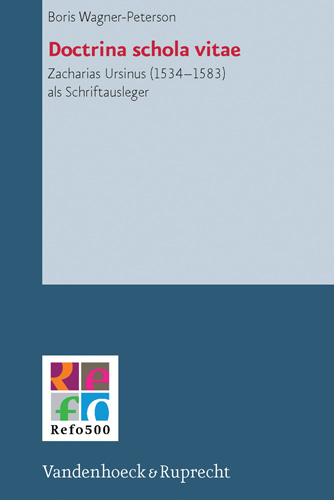
Doctrina schola vitae
Zacharias Ursinus (1534-1583) als Schriftausleger
By (author) Boris Wagner-Peterson
Hardback (Published)
(June 2013)
ISBN: 9783525550557
6.34 x 9.33 inches
Price: $200.00
In stock
Zacharias Ursinus is widely known as the main author of the Heidelberg Catechism (1563). In this thesis, Wagner-Peterson analyses for the first time the late period of Zacharias Ursinus’ theology on the basis of his lecture on Isaiah. The author focuses on the methodology, the hermeneutics, and the theology implicated in this lecture. The results are compared to 16th century commentaries and theological concepts.
English summary: Zacharias Ursinus is widely known as the main author of the Heidelberg Catechism (1563). In this thesis, Wagner-Peterson analyses for the first time the late period of Zacharias Ursinus’ theology on the basis of his lecture on Isaiah. The author focuses on the methodology, the hermeneutics, and the theology implicated in this lecture. The results are compared to 16th century commentaries and theological concepts. A comparative study of Ursinus’ earlier writings illustrates a development of his theological concept. Wagner-Peterson thus offers important new insights into exegesis and theology in the period of confessionalism. The older Ursinus appears as a reformed theological teacher, whose intention was to school his students in a life of continuous study of scriptural doctrine. The study of and the obedience to biblical doctrine was essential for Ursinus as a school for living and dying according to God’s providential will. German description: Boris Wagner-Peterson erschliesst in seiner Untersuchung erstmals das Spatwerk von Zacharias Ursinus, dem mutmasslichen Hauptverfasser des Heidelberger Katechismus (1563). Im Zentrum steht die umfangreiche Jesaja-Vorlesung Ursinus’, die kurz vor seinem Tod entstanden ist. Wagner-Peterson untersucht zunachst diese Vorlesung auf ihre Methodik, Hermeneutik und Theologie hin: Methodisch erweist sich Ursinus als humanistisch gepragter Exeget, der in der Tradition Melanchthons grammatisch-rhetorisch das Schriftwort untersucht, aber gleichzeitig auch in der Tradition der Ecole rhenane den hebraischen Urtext und die mittelalterlich-judische Auslegung rezipiert. Seine Hermeneutik zeigt sich in der Konzentration auf schriftgebundene doctrina und deren applicatio in verschiedene Kontexte (Kontroverstheologie, Pastoraltheologie und seelsorgerlicher Trost). Doctrina und deren applicatio zielen auf einen Glaubensgehorsam (oboedientia) des Erwahlten Gottes. Die Theologie des spaten Ursinus’ weist als Zentrum die doppelte Pradestinationslehre im Rahmen von Gottes Providenz auf. Wagner-Peterson vergleicht daruber hinaus exemplarisch Methodik, Hermeneutik und Theologie Ursinus’ mit Jesaja-Kommentaren vor allem des 16. Jahrhunderts anhand von Jesaja 5. In einem Ausblick zeichnet er die Entwicklung von Ursinus’ Theologie bis hin zu seinem Spatwerk nach. Als Anhang ist der Arbeit erstmalig eine Bibliographie der Schriften und Fragmente Ursinus’ beigefugt. In seinem Werk erschliesst Wagner-Peterson die markante Theologie eines Exponenten des konfessionellen Zeitalters anhand seiner Schriftauslegung: Ursinus hat als reformierter Schultheologe bewusst als Lehrer schriftorientierte doctrina systematisch und didaktisch reflektiert entfaltet, damit doctrina Grundlage fur die Orientierung im Leben und im Sterben werden konnte. Ziel seiner Bemuhungen war die Durchdringung und Internalisierung der Botschaft der Schrift als lebenslanger Lernprozess der Erwahlten Gottes, bei dem doctrina zur Schule fur das Leben (doctrina schola vitae) werden sollte.
- By (author) Boris Wagner-Peterson
"[Wagner-Perterson] has, in this incredibly delightful book, opened up new windows of understanding of Ursinus that have been heretofore unopened. Impressive is the expression that comes to mind again and again as one reads through every word of this book. It's so very good." Jim West, Quartz Hill School of Theology, Zwinglius Redivivus
—
Other Titles in this Series
 From Europe to Overseas
Saints, Martyrs, Heroes, Models and Soft Power in an Early Modern Global Perspective

 allen winkeln auff erden durch so viel bucher furgetragen
Formierung und Konsolidierung des lutherischen Bekenntnisses in Siebenbürgen aufgezeigt am Medium Buch (1550–1650)






 Konfessionelle Vielfalt als Herausforderung und Perspektive
Zur Verschränkung von Religion und Politik im frühneuzeitlichen Ostmitteleuropa
 Konsolidierung des reformierten Bekenntnisses im Reich der Stephanskrone
Ein Beitrag zur Kommunikationsgeschichte zwischen Ungarn und der Schweiz in der frühen Neuzeit (1500–1700)
 The Doctrine of Election in Reformed Perspective
Historical and Theological Investigations of the Synod of Dordt 1618–1619
 Sebastian Castellio (1515–1563) – Dissidenz und Toleranz
Beiträge zu einer internationalen Tagung auf dem Monte Verità in Ascona 2015


 Was there a Lutheran Metaphysics?
The interpretation of communicatio idiomatum in Early Modern Lutheranism

 Petrus Dathenus und der Heidelberger Katechismus
Eine traditionsgeschichtliche Untersuchung zum konfessionellen Wandel in der Kurpfalz um 1563

 Word of God, words of men
Translations, inspirations, transmissions of the Bible in the Polish-Lithuanian Commonwealth in the Renaissance
Similar Books

 A Companion to Christianity and Sport in Europe and North America (19th-21st centuries)
Volume 1: Western and Eastern Europe
 A Connecting Polemic in the Medieval Mediterranean
The Correspondence of Leo III and ʿUmar II
Volume 6





 Ars Prophetica
Theology in the Poetry of Twentieth-Century Hebrew Poets Avraham Halfi, Shin Shalom, Amir Gilboa, and T. Carmi
 As Messianism Turns to Heresy
The Regenstein Chair Lectures On Lurianic Kabbalah and Shabbatai Tzevi at Hebrew Union College - Cincinnati


 Creating the Woman in Antiquity
Proceedings of the 16th Melammu Workshop, Innsbruck, 2–3 June 2022
Volume 13
 Cultic Kisses
Fruitful Encounters Between Deities and Humans. Festschrift for Angelika Berlejung on the Occasion of Her 65th Birthday
 De/colonizing Theologies
Glocal Histories, Contemporary Challenges, Theoretical Reflections
Volume 4
 Drunk the Potion, No Whit Charmed
The Doctrine of Pure and Perfect Souls from Iamblichus to Damascius






 Extracanonical Traditions and the Holy Land
Texts, Rituals, and Material Culture in Late Antique Palestine
 Fear, Fear of God, God-Fearers
Philological and Historical Perspectives on the World of Ancient Judaism and Christianity


 Gender and Iconography in Antiquity
Femininities, Masculinities, Ambiguities, and Beyond in the Ancient Levant, Near East, and Mediterranean