
The Application of the Doctrine of Intertemporality in Contentious Proceedings.
By (author) Edward Martin

Paperback (Published)
(March 2021)
ISBN: 9783428181865
6.18 x 9.17 inches
Price: $95.00
In stock
The doctrine of intertemporality prohibits the retroactive application of norms of international law in contentious proceedings and obliges the deciding court to positively ascertain the applicable historic rules. In situations in which the historic interaction between a European and a non-European entity needs to be litigated, problems arise. The applicable historic law is presently ascertained by recourse to specific (historic) European phenomena. In contentious proceedings, this methodology leads to a situation of »différend« – a situation in which the method of solving the dispute already vindicates the position of one of the parties to the dispute.
The doctrine of intertemporality prohibits the retroactive application of norms of international law in contentious proceedings and obliges the deciding court to positively ascertain the applicable historic rules. In situations in which the historic interaction between a European and a non-European entity needs to be litigated, problems arise. International law is lacking a universally recognised methodology, particularly regarding its unwritten rules. Also, the historic non-European peoples were often relied on oral tradition and did not produce any documentary evidence of their historic legal orders. Historically, different regions of the world produced independent legal regimes. Meta law governing the interactions between entities of different regimes was non-existent since no regional order did claim global rule. Hence there were no rules governing the interactions between European and non-European entities. The applicable historic law is presently ascertained by recourse to specific European phenomena. In contentious proceedings, this methodology leads to a situation of differend a situation in which the method of solving the dispute already vindicates the position of one of the parties to the dispute.
A. Introduction: Intertemporality as a Problem – Distinguishing the Principle of Non-Retroactivity from Positively Ascertaining Historic Rules – Outlining the Research Thesis – Current Relevance of the Doctrine of Intertemporality
B. International Courts and History – The Problem of »Différend«
C. The Problem of Method in International Law: General Methodology in International Law – Methodology of International Legal History
D. Preconceptions in the History of International Law: Subjects – Sources – Genealogy – ConclusionE. Problems Ascertaining Historic Law from the Viewpoint of Historiography: General Problems in Historiography – The Problematic Historiography in Cameroon v. Nigeria – Conclusion
F. Juridical Difficulties Ascertaining Historic Law and the Problem of Normativity: Problems in the Ascertainment Process – Burden of Proof and Intertemporality – The Futility of the Doctrine of Intertemporality
G. The Doctrine of Intertemporality and its Relation to Non Liquet: Lacunae, Non Liquet and International Law – The Duty to Prevent Non-Liquet – Conclusion
H. Reconceptualising the Intertemporality: The Basis for Reconceptualising the Doctrine of Intertemporality – Reconceptualising the Underlying Assumption of the Doctrine of intertemporality – Shifting the Relationship between Intertemporality and Equity – The Possibility of Choosing a Legal Order
I. Conclusion
Bibliography: Books and Monographs – Journal Articles – Other Publications – Table of Cases – Documents – Online Sources
Subject Index
- By (author) Edward Martin
Other Titles in this Series
 Äußerungsfreiheit und Informationsfreiheit als Menschenrechte.
Die Verankerung der Äußerungs-, Informations-, Presse- und Rundfunkfreiheit sowie des Zensurverbots in völkerrechtlichen Übereinkommen und in den Rechtsordnungen der KSZE-Staaten unter besonderer Berücksichtigung rechtsphilosophischer und rechtsgesch
Volume 88
 Versinkende Inselstaaten.
Auswirkungen des Klimawandels auf die Staatlichkeit kleiner Inselstaaten.
Volume 219
 Das Selbstbestimmungsrecht indigener Völker.
Eine völkerrechtliche Bestandsaufnahme am Beispiel der Native Americans in den USA.
Volume 188

 Auslandsinvestitionen in Lateinamerika.
Völkerrechtliche und staatliche Regelungen zwischen Protektionismus und Neoliberalismus.
Volume 136
 “Staatenverantwortlichkeit für Völkermord”.
Unter besonderer Berücksichtigung der Ereignisse der Jahre 1915–1923 im Hinblick auf die armenisch-türkischen Beziehungen.
Volume 231

 Die Möglichkeiten der Grundrechtseinschränkung nach den Art. 8 – 11 Abs. 2 der Europäischen Menschenrechtskonvention.
Dargestellt anhand von Beispielsfällen aus der Rechtsprechung der Konventionsorgane und nationaler Gerichte.
Volume 49

 Der Beitrag der OECD-Leitsätze für multinationale Unternehmen zum Schutz der Menschenrechte.
Volume 208


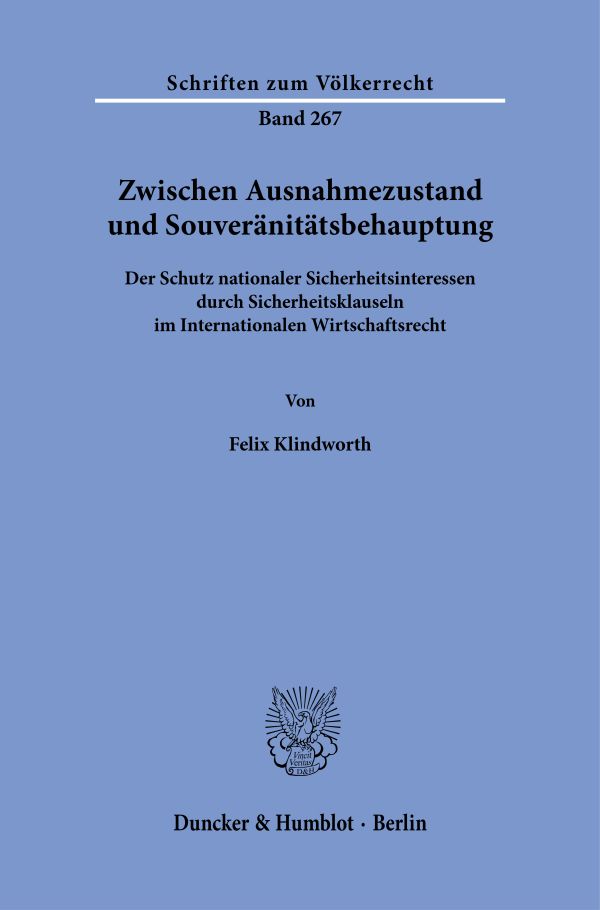 Zwischen Ausnahmezustand und Souveränitätsbehauptung
Der Schutz nationaler Sicherheitsinteressen durch Sicherheitsklauseln im Internationalen Wirtschaftsrecht
Volume 267
 Preemptive Self-Defense.
Die Vereinbarkeit des Konzepts der Preemptive Self-Defense mit dem Völkerrecht.
Volume 222
 Verschleierte Auslieferung durch Ausweisung.
Ein Beitrag zur Abgrenzung von Auslieferungsrecht und Fremdenpolizeirecht.
Volume 28
 Die Staatenbeschwerde.
Das Verfahren vor der Vergleichskommission nach der Rassendiskriminierungskonvention im Lichte vorliegender Modellverfahren.
Volume 61

 Völkerrechtliche Haftung für die schädlichen Folgen nicht verbotenen Verhaltens. Schadensprävention und Wiedergutmachung.
Typologische Betrachtungen der völkerrechtlichen Haftungsbestände mit einem rechtsvergleichenden Überblick über die des innerstaatlichen Zivilrechts in ausgewählten Rechtsordnungen.
Volume 109

 Weltbürgerliches Völkerrecht.
Kantianische Brücke zwischen konstitutioneller Souveränität und humanitärer Intervention.
Volume 169
 Der Tatbestand des Verbrechens gegen die Menschlichkeit.
Überlegungen zur Problematik eines völkerrechtlichen Strafrechts.
Volume 126


 Neuartige chemische Kampfstoffe im Blickfeld des Völkerrechts.
Der Einsatz nicht tödlich wirkender sowie Pflanzen schädigender chemischer Kampfstoffe in bewaffneten Konflikten und das Völkerrecht. Ein Beitrag zur Auslegung und Ermittlung kriegsrechtlicher Normen.
Volume 40
 Die Immunität internationaler Organisationen in Dienstrechtsstreitfällen.
Rechtsgutachten für Eurocontrol.
Volume 71
 Der Ägäis-Konflikt.
Die Abgrenzung des Festlandsockels zwischen Griechenland und der Türkei und das Problem der Inseln im Seevölkerrecht.
Volume 89
 Das Kosovo-Verfahren des Internationalen Gerichtshofs.
Eine argumentationstheoretische Untersuchung.
Volume 220
 Der Anspruch von Kriegsopfern auf Schadensersatz.
Eine Darstellung der völkerrechtlichen Grundlagen sowie der Praxis internationaler Organisationen und verschiedener Staaten zur Anerkennung individueller Wiedergutmachungsansprüche bei Verstößen gegen humanitäres Völkerrecht.
Volume 189


Similar Books
 Legal Pluralism and the Tajik Experience of Xinjiang
Between Custom and the Chinese State: An Ethnographic Perspective
 Liturgia semper reformanda
Adaptations and accommodations in the liturgy in light of canon 838 of the Code of Canon Law


 The EPPO/OLAF Compendium of National Procedures: Estonia
Desktop codes on the procedural law of the Member States with annotations by national experts
 The EPPO/OLAF Compendium of National Procedures: Greece
Desktop codes on the procedural law of the Member States with annotations by national experts
 The EPPO/OLAF Compendium of National Procedures: Italy
Desktop codes on the procedural law of the Member States with annotations by national experts
 (Bloß) symbolische Rechtsetzung
Eine interdisziplinäre Untersuchung der deutschen Glücksspielregulierung auf ihre funktionelle und symbolische Wirkung


 Credit Default Swap-Aktivismus
Eine ökonomische Analyse und rechtliche Bewertung der Einflussnahme von Credit Default Swap-Investoren auf Unternehmen

 Das Rheinische Recht
Neue Perspektiven auf die Geschichte des französischen Rechts an Rhein und Mosel, ca. 1750 bis 1900
 Das Rückschrittsverbot als Instrument Europäischen Werteschutzes
Schutz unionaler Werte im Spannungsfeld nationalstaatlichen Pluralismus

 Der gewöhnliche Aufenthalt des Erblassers
Grundlagen und Grenzen der Aufenthaltsanknüpfung in der Europäischen Erbrechtsverordnung
Volume 249
 Der politische Streik im deutschen Arbeitskampfrecht
Dogmatische Entwicklungslinien von 1869 bis in die 1980er Jahre
Volume 393


 Deutsche Erbengemeinschaft und italienische comunione ereditaria
Eine historisch-vergleichende Untersuchung
 Die Erhebung und Bewertung von Zeugenaussagen im Strafprozess
Juristische, aussagepsychologische und psychiatrische Aspekte. Bd. 9

 Die Konjunkturkomponente des Grundgesetzes
Die konjunkturbedingte Kreditaufnahme im System der Kreditermächtigungen, europarechtlichen und gesamtwirtschaftlichen Verpflichtungen der Finanzverfassung
 Die ständigen Ausschüsse im Deutschen Bundestag sowie Amt, Status und Kompetenzen ihrer Vorsitzenden
Volume 93
 Die Übergangsbestimmungen der EuErbVO
Der Vertrauensschutz des Erblassers zwischen altem und neuem Recht

 Drittfinanzierung von Schiedsverfahren
Regelungsrahmen und Regulierungsbedarf in rechtsvergleichender Perspektive
Volume 330

 Europäisierung der Verteidigungsgüter
Zum rechtlichen Rahmen einer Europäischen Verteidigungsunion durch gemeinsames Verteidigungsgütereigentum
 Extremistische Arbeitnehmer
Treuepflichten des Arbeitnehmers im Spannungsfeld politischer Betätigung
 Föderale Selbstverfassung
Zu Grund und Methode rechtlicher Ordnungsbildung im europäischen Integrationsprozess

 Gewaltenteilung im digitalen Staat
Verfassungsrechtliche Maßgaben an die Digitalisierung der Dritten Gewalt


 Historie des spanischen Konkursrechts
Die Entwicklung von den Siete Partidas bis zur Ley Concursal 2003
 Indirekte Enteignung
Verfassungsunmittelbar gebotene Entschädigungspflicht im Spiegel des Mehrebenensystems