
Greek and Roman Consolations
Eight Studies of a Tradition and its Afterlife
edited by H. Baltussen
Hardback (Published)
(December 2013)
ISBN: 9781905125562
6.1 x 9.17 inches
Price: $80.00
In stock
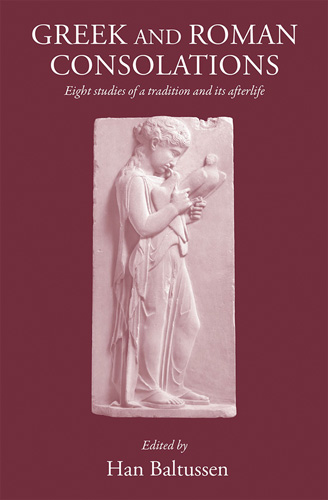
In the Ancient World death came – on average – at a far earlier age than in today’s West, and without the authoritative warnings given by modern medicine. Consolation for the trauma of loss had, accordingly, a more prominent role to play. This volume presents eight original studies on consolatory writings from ancient Greek, Roman, early Christian and Arabic societies. The authors include internationally recognised authorities in the field. They offer insight into the ancient experience of loss and the methods used to palliate it. They explore how far there was a consolatory ‘genre’, involving letters, funerary oratory, epicedia, and philosophical prose. Focusing on responses to grief in numerous ancient authors, this volume finds elements of continuity and of individual variety in modes of consolation, and reveals instructive tensions between the commonplace and the personal.
Introduction - Han Baltussen 1 Towards a Genre of Consolation - J. H. D. Scourfield 2 Mourning and Consolation in Greek Tragedy: The rejection of comfort - James H. K. O. Chong-Gossard 3 Cicero's Consolatio ad se: Character, purpose and impact of a curious treatise - Han Baltussen 4 Seneca the Consoler? A New Reading of his Consolatory Writings - Marcus Wilson 5 The Consolatio ad Apollonium: Therapy for the dead - George Boys-Stones 6 The Grieving Self: Reflections on Lucian's On Mourning and the consolatory tradition - David Konstan 7 Continuity and Transformation of Ancient Consolation in Augustine of Hippo - Josef Lossl 8 Arabic Ethics and the Limits of Philosophical Consolation - Peter Adamson
- Edited by H. Baltussen
Other Titles in this Series



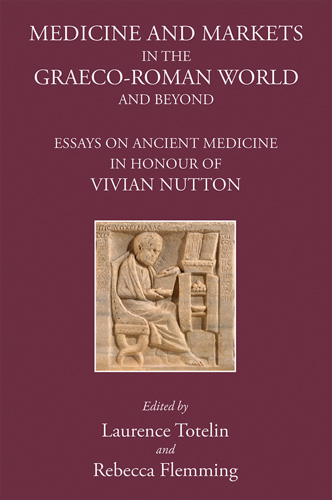 Medicine and Markets in the Graeco-Roman World and Beyond
Essays on Ancient Medicine in Honour of Vivian Nutton
Similar Books

 Drunk the Potion, No Whit Charmed
The Doctrine of Pure and Perfect Souls from Iamblichus to Damascius

 Epiphanies of the Divine in the Septuagint and the New Testament
Fifth International Symposium of the Corpus Judaeo-Hellenisticum Novi Testamenti (CJHNT), 14-17 May 2015, Nottingham


 Language and Power in the Roman Empire and Early India
Hierarchy, Ambiguity, and the Art of Reading the Signs in Cosmopolitan Cultures
 Late Antique villae in the Balkans (3rd–7th c. AD): Current Research Questions and Perspectives
HAEMUS Companion to the Late Antique Balkans 1
Volume 4
 Nurturing the Elite
Representations of Drinking, Eating, and Religious Vessels in Palmyrene Funerary Iconography
Volume 13


 The Compositional History of the Book of Kings
An Analysis of the Evaluative Frameworks in 1 Kings 14–2 Kings 25


 Contesting Labeled Identities
The Sociology of Gentilics in Biblical and Northwest Semitic Literature


 After Life in Roman Paganism. L’Égypte des astrologues. Les Mages hellénisés
Introductions historiographiques
Volume 7


 Diodor über den ersten Sklavenaufstand auf Sizilien
Ein philologischer und historischer Kommentar
Volume 67


 Frauen im römischen Erbrecht
Historische Entwicklungen, familiäre Rollenbilder und die erbrechtliche Reskriptenpraxis
Volume 241

 Frieden schaffen durch ein gemeinsames Bekenntnis?
Eine Predigtreihe zur Vergegenwärtigung des Nizänischen Glaubensbekenntnises von 325
Volume 7
 I Germani e l’Impero Romano. Storia e diritti
Saggi delle edizioni degli incontri 2024-2025
Volume 14


 Nach der Zerstörung
Die gewaltsame Einnahme von Städten von der Antike bis zum 20. Jahrhundert zwischen Disruption und Kontinuität

 Religiöse Erfahrung in Korinth
Paulus und die frühchristliche Bewegung im Kontext ihrer griechisch-römischen Erfahrungswelt


 But the Wise Shall Understand
Reuse of Prophecies, Chronotope, and Merging of Eschatological Horizons in Daniel 10-12
