
Aristocracy in Antiquity
Redefining Greek and Roman Elites
edited by Nick Fisher and Hans van Wees
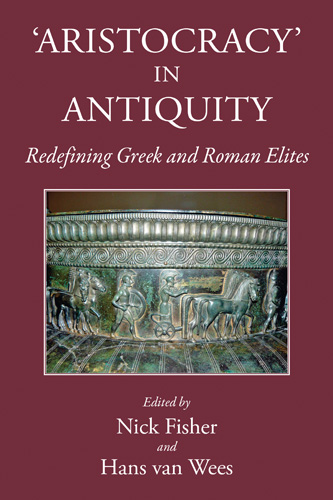
Hardback (Published)
(October 2015)
ISBN: 9781910589014
6.1 x 9.17 inches
Price: $95.00
In stock
The words ‘aristocrats’, ‘aristocracy’ and ‘aristocratic values’ appear in many a study of ancient history and culture. Sometimes these terms are used with a precise meaning. More often they are casual shorthand for ‘upper class’, ‘ruling elite’ and ‘high standards’. This book brings together 12 new studies by an impressive international cast of specialists. It demonstrates not only that true aristocracies were rare in the ancient world, but also that the modern use of ‘aristocracy’ in a looser sense is misleading. The word comes with connotations derived from medieval and modern history. Antiquity, it is here argued, was different. An introductory chapter by the editors argues that ‘aristocracy’ is rarely a helpful concept for the analysis of political struggles, of historical developments or of ideology. The editors call instead for close study of the varied nature of social inequalities and relationships in particular times and places. The following eleven chapters explore and in most cases challenge the common assumption that hereditary ‘aristocrats’ who derive much of their status, privilege and power from their ancestors are identifiable at most times and places in the ancient world. They question, too, the related notion that deep ideological divisions existed between ‘aristocratic values’, such as hospitality, generosity and a disdain for commerce or trade, and the norms and ideals of lower or ‘middling’ classes. They do so by detailed analysis of archaeological and literary evidence for the rise and nature of elites and leisure classes, diverse elite strategies, and political conflicts in a variety of states across the Mediterranean. Chapters deal with archaic and classical Athens, Samos, Aigina and Crete; the Greek ‘colonial’ settlements such as Sicily; archaic Rome and central Italy; and the Roman empire under the Principate.
Acknowledgements INTRODUCTION 1. The trouble with 'aristocracy' Hans van Wees (University College, London) and Nick Fisher (Cardiff University) PART I: ELITES IN THE ANCIENT MEDITERRANEAN: APPROACHES AND MODELS 2. Genealogical and dynastic behaviour in archaic and classical Greece: two gentilician strategies Alain Duplouy (Universite Paris 1 Pantheon-Sorbonne) 3. Investigating aristocracy in archaic Rome and central Italy: social mobility, ideology and cultural influences Guy Bradley (Cardiff University) 4. Roman elite mobility under the Principate Laurens E. Tacoma (University of Leiden) PART II: HEREDITY AND SOCIAL MOBILITY AT ATHENS 5. Who were the Eupatrids in archaic Athens? Antoine Pierrot (Universite de Montpellier 3) 6. Aristocracy and the Attic genos: a mythological perspective Stephen Lambert (Cardiff University) 7. 'Aristocracy' in Athenian diplomacy Noboru Sato (University of Kobe) PART III: COMPETITION AND STRATIFICATION IN THE AEGEAN 8. 'Aristocratic' values and practices in ancient Greece: Aegina, athletes and coaches in Pindar Nick Fisher (Cardiff University) 9. Honour and genealogy: Megas, his ancestors and strategies of social differentiation in Samos Olivier Mariaud (Universite Pierre Mendes-France, Grenoble) 10. Agonistic aristocrats? The curious case of archaic Crete James Whitley (Cardiff University) PART IV: GREEK ELITES OVERSEAS 11. Modes of colonization and elite integration in archaic Greece Thomas J. Figueira (Rutgers University, New Jersey) 12. The emergence of elites in archaic Sicily Gillian Shepherd (La Trobe University, Melbourne) Index and Glossary
- Edited by Nick Fisher
- Edited by Hans van Wees
Other Titles in this Series



 Medicine and Markets in the Graeco-Roman World and Beyond
Essays on Ancient Medicine in Honour of Vivian Nutton
Similar Books


 Contesting Labeled Identities
The Sociology of Gentilics in Biblical and Northwest Semitic Literature

 Drunk the Potion, No Whit Charmed
The Doctrine of Pure and Perfect Souls from Iamblichus to Damascius

 Epigraphic “Shades” from Hellenistic Thrace
Contextualizing Inscriptions in Greek from Thracian Tombs

 Epiphanies of the Divine in the Septuagint and the New Testament
Fifth International Symposium of the Corpus Judaeo-Hellenisticum Novi Testamenti (CJHNT), 14-17 May 2015, Nottingham


 Gold, Silver and Glass: Power Networks, Cultural Identities, Technology Transfers and Agency across the Old World (7th Century BC – 1st Century AD)
Proceedings of a Conference Held at the British Museum, 16–18 June 2023
 Language and Power in the Roman Empire and Early India
Hierarchy, Ambiguity, and the Art of Reading the Signs in Cosmopolitan Cultures
 Late Antique villae in the Balkans (3rd–7th c. AD): Current Research Questions and Perspectives
HAEMUS Companion to the Late Antique Balkans 1
Volume 4


 Nurturing the Elite
Representations of Drinking, Eating, and Religious Vessels in Palmyrene Funerary Iconography
Volume 13





 Roman Copies, Collecting, and Culture in the Bay of Naples and Beyond
Papers in Honor of Eugene J. Dwyer





 The Compositional History of the Book of Kings
An Analysis of the Evaluative Frameworks in 1 Kings 14–2 Kings 25




 Zooarchaeology of Ancient Greek Sanctuaries in Southwestern Sicily
Faunal Analysis from Selinus and Akragas as Evidence of Differences in the Treatment of Animals for Ritual Purposes