
Eusèbe d’Émèse. Commentaire de la Genèse
Texte arménien de l'édition de Venise (1980), fragments grecs et syriaques, avec traductions
By (author) F. Petit By (author) L. Van Rompay By (author) J.J.S. Weitenberg

Du Commentaire original d’Eusebe d’Emese sur la Genese, redige en grec vers le milieu du IVe siecle, seuls des fragments sont connus, incorpores dans la Chaine exegetique grecque et dans l’Epitome de Procope de Gaza. Il existe toutefois une ancienne traduction armenienne complete (ed. V. Hovhannessian, 1980). A cette documentation s’ajoutent des fragments syriaques conserves dans le Commentaire d’Iso’dad de Merv (IXe siecle). Le present volume regroupe les quatre rameaux de la tradition. Du Commentaire armenien, dont le texte est reproduit en entier, on trouve ici la premiere traduction dans une langue moderne. Les fragments grecs (dont ceux de Procope edites ici pour la premiere fois) et syriaques sont egalement accompagnes de traductions francaises annotees. Le volume permet, des lors, pour la premiere fois une vue d’ensemble de ce commentaire dont l’importance consiste en son originalite et en sa position intermediaire entre l’ancienne exegese syriaque et l’exegese grecque antiochienne de la fin du IVe et du Ve siecle. Eusebius of Emesa’s Commentary on Genesis, which was written in Greek around the middle of the fourth century, is extant only in fragments preserved in the Greek exegetical Catena and in Procopius of Gaza’s Epitome. An early translation of the entire Commentary, however, exists in Armenian (ed. V. Hovhannessian, 1980). In addition, Syriac fragments are preserved in the ninth-century Commentary by Iso’dad of Merv. The present volume brings together the four branches of the tradition. The Armenian Commentary is presented both in Armenian and in a French translation, the first translation in a modern language. The Greek fragments (those of Procopius edited here for the first time) as well as the Syriac fragments are also accompanied with annotated French translations. The present volume, therefore, enables for the first time a comprehensive view of this Commentary, the significance of which lies in the originality of its approach as well as in its intermediary position between ancient Syriac exegesis and Greek Antiochene exegesis of the late fourth and fifth centuries.
- By (author) F. Petit
- By (author) L. Van Rompay
- By (author) J.J.S. Weitenberg
Other Titles in this Series
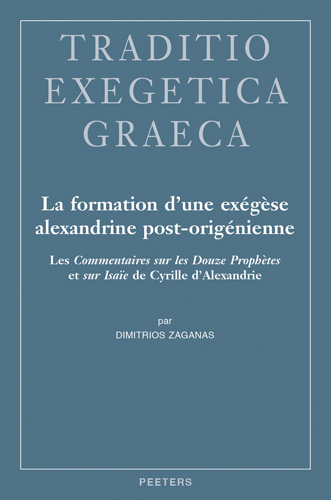 La formation d’une exégèse alexandrine post-origénienne
Les Commentaires sur les Douze Prophètes et sur Isaïe de Cyrille d'Alexandrie
Volume 17
 Der Kommentar Cyrills von Alexandrien zum 1. Korintherbrief
Einleitung, kritischer Text, Übersetzung, Einzelanalyse
Volume 16
 Sévère d’Antioche
Fragments grecs tirés des chaînes sur les derniers livres de l'Octateuque et sur les Règnes
Volume 14
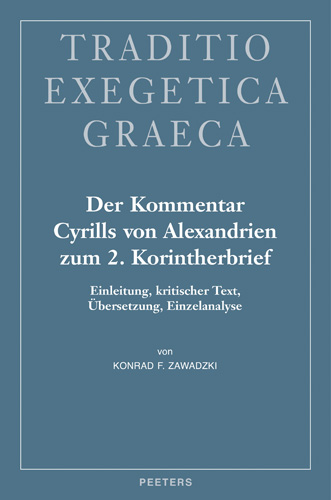 Der Kommentar Cyrills von Alexandrien zum 2. Korintherbrief
Einleitung, kritischer Text, Übersetzung, Einzelanalyse
Volume 18
Similar Books


 Apocrypha, Magic, Liturgy
The Multiple Identities of Coptic Prayers in Late Antique and Early Islamic Egypt
 Athanasius of Alexandria, Epistula ad episcopos Aegypti et Libyae
Old Slavonic Version and English Translation
Volume 261



 Contesting Labeled Identities
The Sociology of Gentilics in Biblical and Northwest Semitic Literature

 Cyril of Alexandria’s Christological Exegesis
Explorations of Partitive Exegesis in the Dialogues on the Trinity
Volume 70


 Epiphanies of the Divine in the Septuagint and the New Testament
Fifth International Symposium of the Corpus Judaeo-Hellenisticum Novi Testamenti (CJHNT), 14-17 May 2015, Nottingham


 Extracanonical Traditions and the Holy Land
Texts, Rituals, and Material Culture in Late Antique Palestine
 From Joseph to Jesus
The Joseph Narrative as a Compositional Template from Old Greek Esther to the Gospel of Luke
Volume 125





 Nicholas of Lyra’s Commentaries on the Gospels of Matthew and Luke
Franciscan Exegesis in a Time of Crisis
 Paradise Lost in Transmission
The Return to Eden in the Apocalypse of Peter within Its Ethiopic and Early Christian Contexts




 Punning in Odd or Elegant Constructions in Jeremiah
The Convergence of Linguistics, Rhetoric, and Textuality in the Hebrew Text of Jeremiah
