
Christ Identity
A Social-Scientific Reading of Philippians 2.5-11
By (author) Sergio Rosell Nebreda
Hardback (Published)
(March 2011)
ISBN: 9783525532546
6.34 x 9.33 inches
Price: $213.00
In stock
How did the Philippian Christ-followers receive Paul’s letter?
Sergio Rosell Nebreda focuses on how the Philippian Christ-followers received Paul’s letter. The social, historical, literary, rhetorical, anthropological and theological elements are dealt with in order to understand the effect Paul wanted to achieve. The main thesis of the book is that the apostle Paul, who greatly suffered at Philippi, and writing from a prison, desires to affect the Philippian believers to acquire a Christ-orientation based on the values expressed in the Christ-hymn. Phlp 2, 5-11 forms the core of Paul’s theological narrative that aims at constructing a sense of imitatio and conformatio in the Christ-following community. Paul uses a ‘friendly’ style in his letters in order to produce rapport and trust in the community, presenting himself as examplum ad imitando, after that of Christ. It is because Paul so fully identifies with Christ’s orientation in life that the apostle presents himself as a slave of Jesus Christ. In the midst of a society ill with the desire for honour and power, the Christ narrative stands as a radical call for an alternative lifestyle, based on the exercise of humility which seeks the interest of others rather than focusing on one’s own needs and desires. Paul insists on the basis of the Christ-hymn that such a lifestyle reveals God’s character and it is therefore a life rewarded. Through the use of Social Identity Theory this book evaluates how ancient people constructed their group identity in daily life and how through a seemingly inferior model (that of Christ’s kenosis in 2, 5-11) the community receives a re-definition of values which are according to God’s values, and who has the last word in history. Paul thus presents an alternative and viable way of life in the midst of a society he knows well.
Sergio Rosell Nebreda, PhD, is Professor for New Testament at the United Evangelical Theological Seminary in Madrid, Spain.
- By (author) Sergio Rosell Nebreda
Other Titles in this Series


 Der eine Gott Israels und die Mächte der Welt
Der Weg Gottes im Alten Testament vom Herrn seines Volkes zum Herrn der ganzen Welt



 Paulus und die antike Welt
Beiträge zur zeit- und religionsgeschichtlichen Erforschung des paulinischen Christentums
 How Prophecy Works
A Study of the Semantic Field of נביא and a Close Reading of Jeremiah 1:4–19, 23:9–40 and 27:1–28:17


 Jakob, der ambivalente Ahnherr Israels
Die Jakoberzählung auf dem Weg von der Volks- zur Völkergeschichte


 Die „Ich-Sphäre“ des Beters
Eine anthropologische Untersuchung zur Selbstreflexion des Beters am Beispiel von Ps 42/43

 Die Geschichte des Motivkomplexes Theophanie
Seine Elemente, Einbindung in Geschehensabläufe und Verwendungsweisen in altisraelitischer, frühjüdischer und frühchristlicher Literatur
 Christologie und Ethik im Philipperbrief
Studien zur Handlungsorientierung einer frühchristlichen Gemeinde in paganer Umwelt
 Macht und Weisheit
Untersuchungen zur politischen Anthropologie in den Erzählungen vom Absalomaufstand
 From Qumran to Aleppo
A Discussion with Emanuel Tov about the Textual History of Jewish Scriptures in Honor of his 65th Birthday

 Anthropologische Aufbrüche
Alttestamentliche und interdisziplinäre Zugänge zur historischen Anthropologie
 Heiliges Land und Nähe Gottes
Wandlungen alttestamentlicher Landvorstellungen in frühjüdischen und neutestamentlichen Schriften
Similar Books


 Apocrypha, Magic, Liturgy
The Multiple Identities of Coptic Prayers in Late Antique and Early Islamic Egypt
 Athanasius of Alexandria, Epistula ad episcopos Aegypti et Libyae
Old Slavonic Version and English Translation
Volume 261



 Contesting Labeled Identities
The Sociology of Gentilics in Biblical and Northwest Semitic Literature
 Cyril of Alexandria’s Christological Exegesis
Explorations of Partitive Exegesis in the Dialogues on the Trinity
Volume 70

 Epiphanies of the Divine in the Septuagint and the New Testament
Fifth International Symposium of the Corpus Judaeo-Hellenisticum Novi Testamenti (CJHNT), 14-17 May 2015, Nottingham


 Extracanonical Traditions and the Holy Land
Texts, Rituals, and Material Culture in Late Antique Palestine
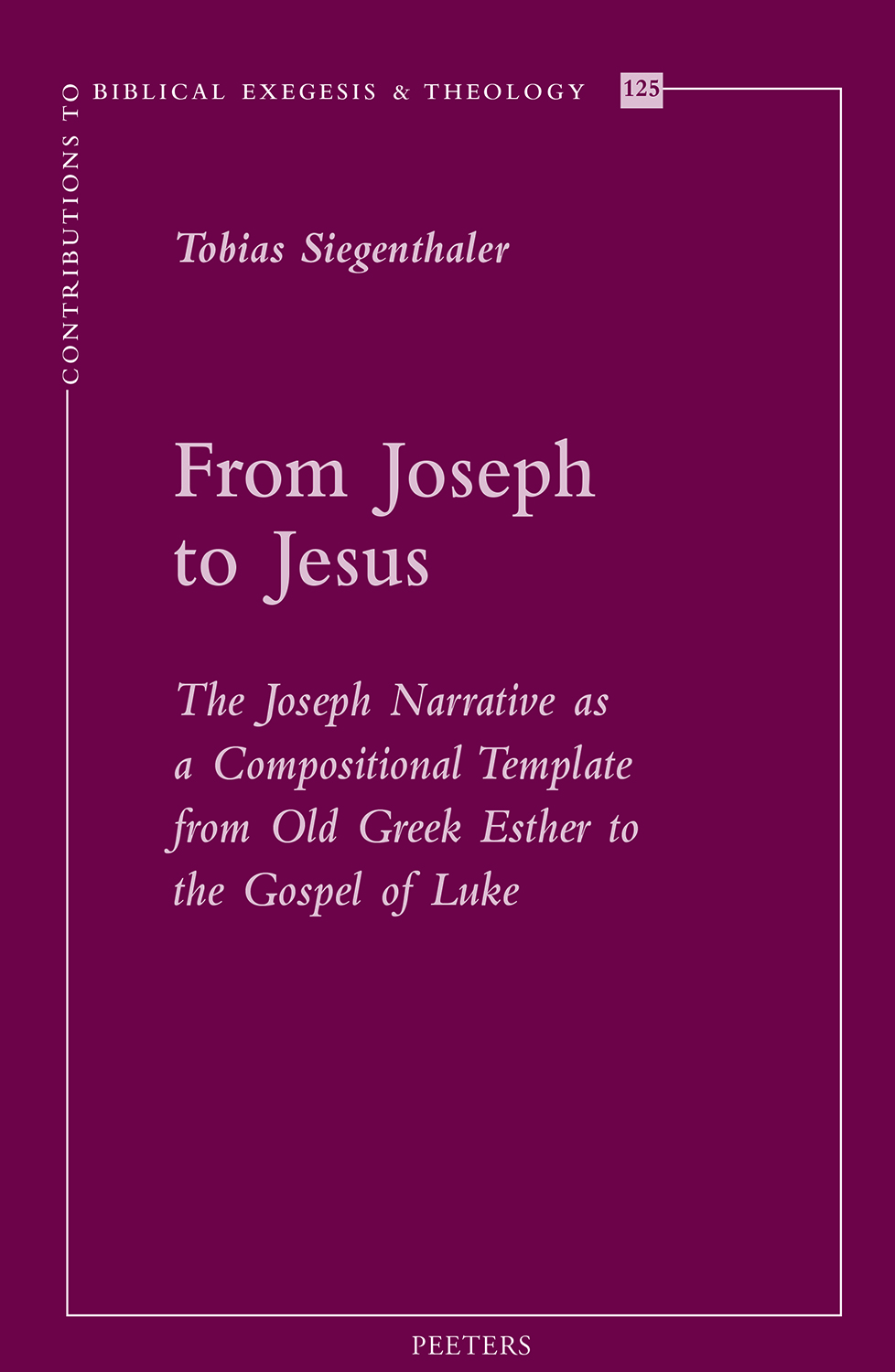 From Joseph to Jesus
The Joseph Narrative as a Compositional Template from Old Greek Esther to the Gospel of Luke
Volume 125





 Nicholas of Lyra’s Commentaries on the Gospels of Matthew and Luke
Franciscan Exegesis in a Time of Crisis
 Paradise Lost in Transmission
The Return to Eden in the Apocalypse of Peter within Its Ethiopic and Early Christian Contexts



 Punning in Odd or Elegant Constructions in Jeremiah
The Convergence of Linguistics, Rhetoric, and Textuality in the Hebrew Text of Jeremiah

 Reformed Covenantal Eudaimonism
Wilhelmus à Brakel (1635–1711) on Highest Good, Virtue, and Law
Volume 87