
“Behold King Solomon on the Day of his Wedding”
A Symbolic-Diachronic Reading of Song 3,6-11 and 4,12-5,1
By (author) N.S. Heereman

The Song of Songs is a theological work in its literal sense. For centuries this was recognized by the overwhelming majority of its readers. Yet, in the argument of this study the Song is neither an allegory of divine-human love, nor a mere human love song. Rather, by adopting a symbolic language, the Song is able to express the realities of divine love in and through human love, thereby giving full expression to both dimensions. In order to substantiate and advance this view, this study introduces a new hermeneutical refinement into the discussion, giving careful consideration to different orders of textual meaning in order to better understand what precisely we mean in speaking of the sensus literalis.
The Song of Songs is a theological work in its literal sense. For centuries this was recognized by the overwhelming majority of its readers. Yet, in the argument of this study the Song is neither an allegory of divine-human love, nor a mere human love song. Rather, by adopting a symbolic language, the Song is able to express the realities of divine love in and through human love, thereby giving full expression to both dimensions. In order to substantiate and advance this view, this study introduces a new hermeneutical refinement into the discussion, giving careful consideration to different orders of textual meaning (i.e. “metaphor”, “allegory”, and “symbol”) in order to better understand what precisely we mean in speaking of the sensus literalis. The success of this symbolic approach owes much to its diachronic method. In particular, it is able to assimilate a redactional analysis of the Song’s composition in which the personage of Solomon plays a remarkable and increasingly significant role (i.e. “Solomonic Redaction”). This prominence of Israel’s legendary king is plotted within an identifiable ancient Near Eastern royal ideology marked by an unmistakably religious orientation. This ideology in turn opens the door to a phenomenology of the kingship symbol by which certain aporias are resolved and the poetics of the text recover their full force.
- By (author) N.S. Heereman
Other Titles in this Series

 Florilegium Lovaniense
Studies in Septuagint and Textual Criticism in Honour of FlorentinoGarcía Martínez
Volume 224
 Analyse narrative et Bible
Deuxième colloque international du RRENAB, Louvain-la-Neuve, avril2004
Volume 191


 Texts in Context
Essays on Dating and Contextualising Christian Writings from the Second and Early Third Centuries
Volume 319


 Writing, Rewriting, and Overwriting in the Books of Deuteronomy and the Former Prophets
Essays in Honor of Cynthia Edenburg
Volume 304

 The Belgian Contribution to the Second Vatican Council
International Research Conference at Mechelen, Leuven andLouvain-la-Neuve (September 12-16, 2005)
Volume 216


 Half-Truths
The Irish College, Rome, and a Select History of the Catholic Church, 1771-1826
Volume 322

 Virtuelle Vergangenheit
Die Textrekonstruktion einer verlorenen mittelniederländischenEvangelienharmonie. Die Handschrift Utrecht Universitätsbibliothek 1009
Volume 210
 The Holy Spirit, The Church, and Christian Unity
Proceedings of the Consultation Held at the Monastery of Bose, Italy(14-20 October 2002)
Volume 181
 Des communautés nouvelles dans le catholicisme contemporain
Innovations, réinventions, ruptures et régulations
Volume 345
 The Anthropological Turn, Christian Humanism, and Vatican II
Louvain Theologians Preparing the Path for 'Gaudium et spes'(1942-1965)
Volume 303
Similar Books


 Athanasius of Alexandria, Epistula ad episcopos Aegypti et Libyae
Old Slavonic Version and English Translation
Volume 261


 Cyril of Alexandria’s Christological Exegesis
Explorations of Partitive Exegesis in the Dialogues on the Trinity
Volume 70


 Epiphanies of the Divine in the Septuagint and the New Testament
Fifth International Symposium of the Corpus Judaeo-Hellenisticum Novi Testamenti (CJHNT), 14-17 May 2015, Nottingham

 Extracanonical Traditions and the Holy Land
Texts, Rituals, and Material Culture in Late Antique Palestine
 From Joseph to Jesus
The Joseph Narrative as a Compositional Template from Old Greek Esther to the Gospel of Luke
Volume 125


 Paradise Lost in Transmission
The Return to Eden in the Apocalypse of Peter within Its Ethiopic and Early Christian Contexts



 Punning in Odd or Elegant Constructions in Jeremiah
The Convergence of Linguistics, Rhetoric, and Textuality in the Hebrew Text of Jeremiah

 Shame in the Worlds of the Hebrew Bible and Akkadian Texts
A Linguistic Study and Its Implications
Volume 33

 Tabernacle, Table, Ark, and Text
Richard of Saint Victor on the Interpretation of Scripture
Volume 67
 The Anglo-Norman Bible’s Books of Kings, a Critical Edition
(BL Royal 1 C III, fols 234r-274v)
Volume 37
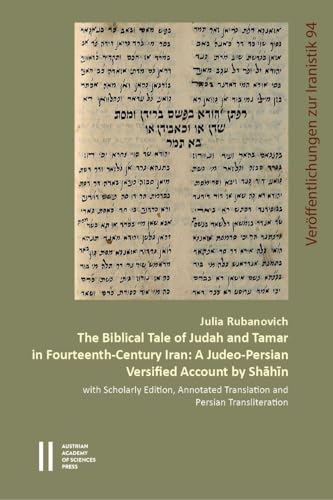 The Biblical Tale of Judah and Tamar in Fourteenth-Century Iran
A Judeo-Persian Versified Account by Shāhīn with Scholarly Edition, Annotated Translation and Persian Transliteration
Volume 94, 951
 The Body
Lived, Cultured, Adorned: Essays on Dress and the Body in the Bible and Ancient Near East in Honor of Nili S. Fox

 The Compositional History of the Book of Kings
An Analysis of the Evaluative Frameworks in 1 Kings 14–2 Kings 25
 The Discourse of Rites
Shaping and Reshaping the (Counter-)Priestly Rituals Conducted Outside the Tabernacle


