
Vom punischen zum römischen Karthago
Konfliktreflexionen und die Konstruktion römischer Identität
By (author) Sebastian Modrow
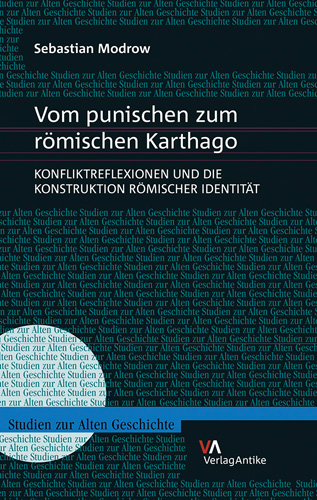
English summary: In his “Aeneid,” Vergil established the historic antagonism between Rome and Carthage in the episode of Aeneas and Dido, but how old was this idea in reality? As opposed to the traditional narratives of older scholarship, which date this antagonism quite early, this study shows that the idea of a special rivalry between Rome and Carthage can only be dated to the second century BCE. The essential case studies suggest that the internal political struggles among the Roman elite shaped the image of Carthage retroactively. The final destruction of the city of Carthage had contingent causes and cannot not be seen as the direct and necessary consequence of the earlier war with Hannibal and explained as part of a transgenerational “Punic trauma.” Rather, the destruction of the city makes the most sense in terms of Rome’s foreign policy in its own time. The most complex and idiosyncratic source of the Roman image of Carthage was developed by Gaius Gracchus and the debate over building a new, Roman, Carthage. This study emphasizes the historical and contextualized (re-)interpretation of the changing understanding of the Punic metropolis as part of a comprehensive process of self-identification for the Romans, a process that was only complete in the early days of the Roman Empire. German description: Mit der Idee einer Erzfeindschaft zwischen Rom und Karthago seit urvordenklicher Zeit hat sich Vergil in der Aeneas-Dido-Episode seiner “Aeneis” wortgewaltig auseinandergesetzt. Aber wie alt ist diese Idee tatsachlich? Gegen die Neigung der alteren Forschung, sie fruh zu datieren, wird in der hier vorgelegten Studie gezeigt, dass die Vorstellung einer besonderen Rivalitat tatsachlich erst ab dem spaten 2. Jahrhundert v.Chr. wirksam wurde. Grundliche Einzeluntersuchungen konturieren die innernobilitaren Positionskampfe entlang des Karthagobildes. Die schliealiche Vernichtung der Stadt hatte kontingente Ursachen und kann nicht als direkte Nachwirkung eines im Hannibalkrieg erwor benen, generationenubergreifend tradierten Puniertraumas erklart werden, sondern ist im Kontext der romischen Auaenpolitik jener Zeit zu sehen. Die hochst komplexe Genese und Eigenart des romischen Karthagerbildes pragte seit Gaius Gracchus auch die Debatte um ein neues, romisches Karthago. Insgesamt waren die in dieser Studie historisierten und kontextualisierten (Um-)Deutungen des wechselvollen Verhaltnisses zur punischen Metropole Teil eines allumfassenden romischen Selbstdefinitionsprozesses, der erst in der fruhen Kaiserzeit abgeschlossen war.
English summary: In his “Aeneid,” Vergil established the historic antagonism between Rome and Carthage in the episode of Aeneas and Dido, but how old was this idea in reality? As opposed to the traditional narratives of older scholarship, which date this antagonism quite early, this study shows that the idea of a special rivalry between Rome and Carthage can only be dated to the second century BCE. The essential case studies suggest that the internal political struggles among the Roman elite shaped the image of Carthage retroactively. The final destruction of the city of Carthage had contingent causes and cannot not be seen as the direct and necessary consequence of the earlier war with Hannibal and explained as part of a transgenerational “Punic trauma.” Rather, the destruction of the city makes the most sense in terms of Rome’s foreign policy in its own time. The most complex and idiosyncratic source of the Roman image of Carthage was developed by Gaius Gracchus and the debate over building a new, Roman, Carthage. This study emphasizes the historical and contextualized (re-)interpretation of the changing understanding of the Punic metropolis as part of a comprehensive process of self-identification for the Romans, a process that was only complete in the early days of the Roman Empire. German description: Mit der Idee einer Erzfeindschaft zwischen Rom und Karthago seit urvordenklicher Zeit hat sich Vergil in der Aeneas-Dido-Episode seiner “Aeneis” wortgewaltig auseinandergesetzt. Aber wie alt ist diese Idee tatsachlich? Gegen die Neigung der alteren Forschung, sie fruh zu datieren, wird in der hier vorgelegten Studie gezeigt, dass die Vorstellung einer besonderen Rivalitat tatsachlich erst ab dem spaten 2. Jahrhundert v.Chr. wirksam wurde. Grundliche Einzeluntersuchungen konturieren die innernobilitaren Positionskampfe entlang des Karthagobildes. Die schliealiche Vernichtung der Stadt hatte kontingente Ursachen und kann nicht als direkte Nachwirkung eines im Hannibalkrieg erwor benen, generationenubergreifend tradierten Puniertraumas erklart werden, sondern ist im Kontext der romischen Auaenpolitik jener Zeit zu sehen. Die hochst komplexe Genese und Eigenart des romischen Karthagerbildes pragte seit Gaius Gracchus auch die Debatte um ein neues, romisches Karthago. Insgesamt waren die in dieser Studie historisierten und kontextualisierten (Um-)Deutungen des wechselvollen Verhaltnisses zur punischen Metropole Teil eines allumfassenden romischen Selbstdefinitionsprozesses, der erst in der fruhen Kaiserzeit abgeschlossen war.
- By (author) Sebastian Modrow
Other Titles in this Series

 Christliche Identitat und Assimilation in der Spatantike
Probleme des Christseins in der Reflexion der Zeitgenossen
Volume 3
 Potentialität durch Ambiguität
Die Dynamik politischer Handlungsspielräume als Strukturprinzip der Römischen Republik
Similar Books

 Drunk the Potion, No Whit Charmed
The Doctrine of Pure and Perfect Souls from Iamblichus to Damascius

 Epiphanies of the Divine in the Septuagint and the New Testament
Fifth International Symposium of the Corpus Judaeo-Hellenisticum Novi Testamenti (CJHNT), 14-17 May 2015, Nottingham


 Language and Power in the Roman Empire and Early India
Hierarchy, Ambiguity, and the Art of Reading the Signs in Cosmopolitan Cultures
 Late Antique villae in the Balkans (3rd–7th c. AD): Current Research Questions and Perspectives
HAEMUS Companion to the Late Antique Balkans 1
Volume 4
 Nurturing the Elite
Representations of Drinking, Eating, and Religious Vessels in Palmyrene Funerary Iconography
Volume 13


 The Compositional History of the Book of Kings
An Analysis of the Evaluative Frameworks in 1 Kings 14–2 Kings 25

 Contesting Labeled Identities
The Sociology of Gentilics in Biblical and Northwest Semitic Literature


 After Life in Roman Paganism. L’Égypte des astrologues. Les Mages hellénisés
Introductions historiographiques
Volume 7


 Diodor über den ersten Sklavenaufstand auf Sizilien
Ein philologischer und historischer Kommentar
Volume 67


 Frauen im römischen Erbrecht
Historische Entwicklungen, familiäre Rollenbilder und die erbrechtliche Reskriptenpraxis
Volume 241

 Frieden schaffen durch ein gemeinsames Bekenntnis?
Eine Predigtreihe zur Vergegenwärtigung des Nizänischen Glaubensbekenntnises von 325
Volume 7
 I Germani e l’Impero Romano. Storia e diritti
Saggi delle edizioni degli incontri 2024-2025
Volume 14


 Nach der Zerstörung
Die gewaltsame Einnahme von Städten von der Antike bis zum 20. Jahrhundert zwischen Disruption und Kontinuität

 Religiöse Erfahrung in Korinth
Paulus und die frühchristliche Bewegung im Kontext ihrer griechisch-römischen Erfahrungswelt


 But the Wise Shall Understand
Reuse of Prophecies, Chronotope, and Merging of Eschatological Horizons in Daniel 10-12

