
Occasio in der Frühen Neuzeit
Situationen – Praktiken – Medien
Contributions by Thomas A. Schmitz Contributions by Michael Rohrschneider Contributions by Christian Moser Contributions by Christian Meierhofer Contributions by Birgit Ulrike Münch Contributions by Christiane Frey Contributions by Hania Siebenpfeiffer Contributions by Hui Luan Tran Contributions by Christian Kaiser Contributions by Mariacarla Gadebusch Bondio Contributions by Karin Peters Contributions by Marc Laureys Contributions by Irina Tautschnig Edited by Karin Peters Edited by Marc Laureys Edited by Irina Tautschnig
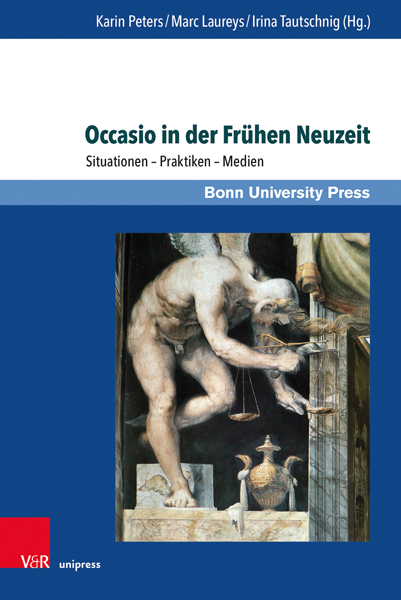
Hardback (Published)
(June 2026)
ISBN: 9783847119920
6.34 x 9.33 inches
Price: $57.00
In stock
Momente, die zählen – kulturelle Produktion im richtigen Augenblick
Die Beiträge des Bandes untersuchen die Occasio als wesentliches, bislang aber kaum interdisziplinär erforschtes Prinzip frühneuzeitlicher Kultur. Anlass und Gelegenheit fungieren dabei sowohl als realweltliche Impulse wie auch als textinterne Motoren kreativen Sprechens, Schreibens und Handelns. Ein praxeologisches Konzept der Occasio, das diese Aspekte bündelt, ermöglicht neue Perspektiven auf Situiertheit, formale Innovation und frühneuzeitliche Zeiterfahrung. Denn im Zusammenspiel von Situationen, Praktiken und Medien zeigt sich ein tiefgreifender Wandel: Die günstige Gelegenheit wird seit dem 16. Jahrhundert zunehmend als einmaliger, irreversibler Moment verstanden und ermöglicht damit in Europa ein Denken der Zeitlichkeit von Gegenwart, das fortan okkasionelle Kommunikationsformen prägt.
The contributions in this volume examine Occasio as an essential principle of early modern culture that has thus far received little interdisciplinary attention. Occasion and opportunity function both as real-world impulses and as internal drivers of creative speech, writing, and action. A praxeological concept of Occasio that combines these aspects opens up new perspectives on situatedness, formal innovation, and early modern experience of time. For the interplay of situations, practices, and media reveals a profound change: since the 16th century, favourable opportunity has increasingly been understood as a unique, irreversible moment, thus enabling a European conception of the temporality of the present that has shaped occasional forms of communication ever since.
- Contributions by Thomas A. Schmitz
- Contributions by Michael Rohrschneider
- Contributions by Christian Moser
- Contributions by Christian Meierhofer
- Contributions by Birgit Ulrike Münch
- Contributions by Christiane Frey
- Contributions by Hania Siebenpfeiffer
- Contributions by Hui Luan Tran
- Contributions by Christian Kaiser
- Contributions by Mariacarla Gadebusch Bondio
- Contributions by Karin Peters
- Contributions by Marc Laureys
- Contributions by Irina Tautschnig
- Edited by Karin Peters
- Edited by Marc Laureys
- Edited by Irina Tautschnig
Other Titles in this Series
 Die Kunst des Streitens
Inszenierung, Formen und Funktionen öffentlichen Streits in historischer Perspektive
 Theodosius Schoepffers ›Gerontologia seu Tractatus de jure senum‹
Kulturwissenschaftliche Studien zu einem vergessenen Traktat über das Altenrecht
 Cum verbis ut Italici solent ornatissimis
Funktionen der Beredsamkeit im kommunalen Italien / Funzioni dell’eloquenza nell’Italia comunale



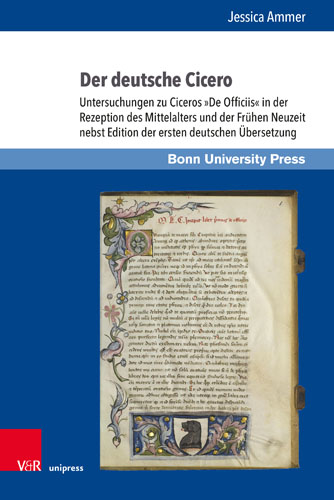 Der deutsche Cicero
Untersuchungen zu Ciceros »De Officiis« in der Rezeption des Mittelalters und der Frühen Neuzeit nebst Edition der ersten deutschen Übersetzung
 Ästhetik des Charakteristischen
Quellentexte zu Kunstkritik und Streitkultur in Klassizismus und Romantik


 Lexicologica byzantina
Beiträge zum Kolloquium zur byzantinischen Lexikographie (Bonn, 13.–15. Juli 2007)

 Poetry, Politics and Promises of Empire
Prophetic Rhetoric in the English and Neo-Latin Epithalamia on the occasion of the Palatine Marriage in 1613
 I Cantici di Fidenzio di Camillo Scroffa e la pluralità dei mondi
Il canone classico, l'eredità del Petrarca e la tradizione giocosa
 De emendatione vitae. Eine kritische Ausgabe des lateinischen Textes von Richard Rolle
Mit einer Übersetzung ins Deutsche und Untersuchungen zu den lateinischen und englischen Handschriften
 Autobiographie
Eine interdisziplinäre Gattung zwischen klassischer Tradition und (post-)moderner Variation
Similar Books


 Balthasar Caymox of Nuremberg
Early Modern German Print Publishers: Popular Prints of the Seventeenth Century


 Beyond Sovereign Courts
Agents and Practices in Early Modern Spanish and Habsburg Diplomacy
Volume 3

 Circulation, Use, Impact
The Consumption of Architectural Books in the Early Modern Eastern Adriatic
Volume 1

 Councils, Conflicts, Correspondence
Urban Diplomacy in Reval (Tallinn) and Lübeck (c. 1470–1570)
Volume 67


 Homo-Politicus in the Balkans
Early Modern Southeast European History in Imperial and Regional Context

 Innovationes Lovanienses: Arts, Law and Theology at the University of Louvain (1425–1797)
Studium Lovaniense: Learning across Borders, 2
Volume 18
 Legal Visuality
Exegesis, Ambiguity, and Dissimulation of the Donation of Constantine in the Early Modern Period

 Naples as Laboratory / Laboratorium Neapel
Style Options, Artistic Rivalry and Self Fashioning in Neapolitan Baroque Painting / Plurale Stilbildung, Kunstlerkonkurrenz und Self Fashioning in der neapolitanischen Barockmalerei

 Power and Women in Southeast and Central Europe in Late Medieval and Early Modern Period (1300-1600)
Volume 10



 Staging the Spectacle of Majesty
Ceremonial, Courtly Space, and Collecting under the Spanish Habsburgs
Volume 9
 Students, Scholars and Their Books at the University of Louvain (1425-1797)
Studium Lovaniense: Learning across Borders, 1
Volume 17


 The Embodied Court in the Premodern World
Understanding the Physicality, Performativity and Lifecycle of Bodies at Court in Europe and Beyond, 1400-1800
Volume 4
 The Sacred and the Secular in Renaissance Florence
Vallombrosan Exorcisms and the Rise of Observant Mendicancy
Volume 31
 Tradition, Interpretation, and Change
Developments in the Liturgy of Medieval and Early Modern Ashkenaz

 wunder in Serie
 À la recherche des normes de traduction
Textes spécialisés dans le monde hispanophone et francophone (1450–1850)