
Messiah and the Throne
Jewish Merkabah Mysticism and Early Christian Exaltation Discourse
by Timo Eskola

Paperback (Out of print)
(July 2001)
ISBN: 9783161476419
Price: $88.00
On back order
Did Jewish throne mysticism, the so-called ‘merkabah mysticism’, influence the emergence and formation of the earliest exaltation Christology? The author presents resurrection Christology as a part of Jewish Christian merkabah tradition. Christ’s exaltation was described as a heavenly journey that culminated in his enthronement on the divine throne of glory. Christian writers did exploit the symbolic world, the images and metaphors of Second Temple Judaism. The exaltation discourse that they present, however, is completely new. A simple typological explanation is unable to explain the nature of early Christology. Christ was not depicted as a heavenly angelic figure or an exalted patriarch. He was described as the enthroned Son of God whose reign is eternal. By exploiting linguistic and literary methods Eskola reconstructs the narrative structure of christological statements. Several different narratives were discerned, each one of which expresses one form of a so-called Christian merkabah tradition. In the New Testament, Christ’s resurrection has been interpreted in terms of exaltation discourse, cultic discourse, and judicial discourse. Each one of these produced a different narrative about the exalted Christ. Further, the new approach sheds light for instance on the idea of the so-called adoptionist Christology. There was no concept of adoption in early Jewish Christian exaltation Christology. Exalted Christ on the throne of Glory was not considered merely as a pious Jew making a heavenly journey, but as the divine Savior of the world. The intertextual transformation of Jewish concepts underlined the Lordship of Christ as a heavenly king. The confessing of Christ as Lord realized simultaneously the core of traditional Jewish devotion – faith in and faithfulness to God as a heavenly King.
- By (author) Timo Eskola
Other Titles in this Series


 Teaching through Song in Antiquity
Didactic Hymnody among Greeks, Romans, Jews, and Christians
Volume 302


 The Baptismal Episode as Trinitarian Narrative
Proto-Trinitarian Structures in Mark's Conception of God
Volume 535

 Veranderte Endzeitvorstellungen
Die Rezeption der Offenbarung des Johannes beim ersten christlich-lateinischen Dichter Commodian
Volume 504
 The Use of Scripture in the Apocryphon of John
A Diachronic Analysis of the Variant Versions
Volume 441


 Jesus Tradition in the Apostolic Fathers
Their Explicit Appeals to the Words of Jesus in Light of Orality Studies
Volume 311


 Scribal Habits and Theological Influences in the Apocalypse
The Singular Readings of Sinaiticus, Alexandrinus, and Ephraemi
Volume 218

 Paul and Sacrifice in Corinth
Rethinking Paul's Views on Gentile Cults in 1 Corinthians 8 and 10
Volume 623

 The Formative Stratum of the Sayings Gospel Q
Reconsidering Its Extent, Message, and Unity
Volume 545


Similar Books


 Athanasius of Alexandria, Epistula ad episcopos Aegypti et Libyae
Old Slavonic Version and English Translation
Volume 261


 Cyril of Alexandria’s Christological Exegesis
Explorations of Partitive Exegesis in the Dialogues on the Trinity
Volume 70


 Epiphanies of the Divine in the Septuagint and the New Testament
Fifth International Symposium of the Corpus Judaeo-Hellenisticum Novi Testamenti (CJHNT), 14-17 May 2015, Nottingham

 Extracanonical Traditions and the Holy Land
Texts, Rituals, and Material Culture in Late Antique Palestine
 From Joseph to Jesus
The Joseph Narrative as a Compositional Template from Old Greek Esther to the Gospel of Luke
Volume 125


 Paradise Lost in Transmission
The Return to Eden in the Apocalypse of Peter within Its Ethiopic and Early Christian Contexts



 Punning in Odd or Elegant Constructions in Jeremiah
The Convergence of Linguistics, Rhetoric, and Textuality in the Hebrew Text of Jeremiah

 Shame in the Worlds of the Hebrew Bible and Akkadian Texts
A Linguistic Study and Its Implications
Volume 33
 Tabernacle, Table, Ark, and Text
Richard of Saint Victor on the Interpretation of Scripture
Volume 67
 The Anglo-Norman Bible’s Books of Kings, a Critical Edition
(BL Royal 1 C III, fols 234r-274v)
Volume 37
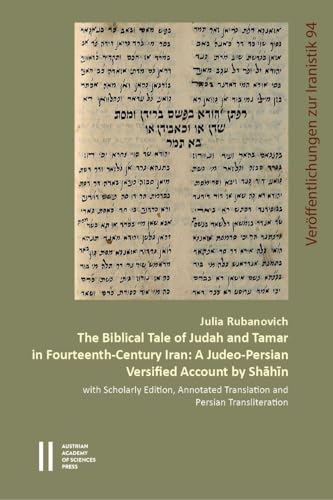 The Biblical Tale of Judah and Tamar in Fourteenth-Century Iran
A Judeo-Persian Versified Account by Shāhīn with Scholarly Edition, Annotated Translation and Persian Transliteration
Volume 94, 951
 The Body
Lived, Cultured, Adorned: Essays on Dress and the Body in the Bible and Ancient Near East in Honor of Nili S. Fox

 The Compositional History of the Book of Kings
An Analysis of the Evaluative Frameworks in 1 Kings 14–2 Kings 25
 The Discourse of Rites
Shaping and Reshaping the (Counter-)Priestly Rituals Conducted Outside the Tabernacle


