
Judges
By (author) K. Spronk
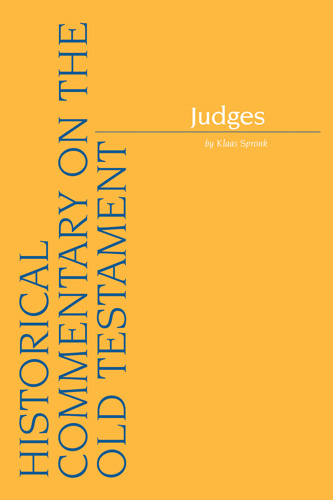
This commentary presents a new approach to the old problems of the dating of the book of Judges and the reconstruction of the way different sources were used. It wants to show that the book of Judges can be read as the work of one literary talented author living in the early Hellenistic period. With materials from different sources he wrote his book as introduction to the history of the kings of Israel as can be found in the books of Samuel and Kings with a clear view on leadership and on the relation between the leader and YHWH. Next to the reconstruction of the historical background of the book and its author, much attention is paid to the history of interpretation, from the earliest retellings to the newest interpretations.
This commentary presents a new approach to the old problems of the dating of the book of Judges and the reconstruction of the way different sources were used. It wants to show that the book of Judges can be read as the work of one literary talented author living in the early Hellenistic period. With materials from different sources he wrote his book as introduction to the history of the kings of Israel as can be found in the books of Samuel and Kings with a clear view on leadership and on the relation between the leader and YHWH. Next to the reconstruction of the historical background of the book and its author, much attention is paid to the history of interpretation, from the earliest retellings to the newest interpretations.
- By (author) K. Spronk
Other Titles in this Series













Similar Books


 Athanasius of Alexandria, Epistula ad episcopos Aegypti et Libyae
Old Slavonic Version and English Translation
Volume 261



 Contesting Labeled Identities
The Sociology of Gentilics in Biblical and Northwest Semitic Literature
 Cyril of Alexandria’s Christological Exegesis
Explorations of Partitive Exegesis in the Dialogues on the Trinity
Volume 70


 Epiphanies of the Divine in the Septuagint and the New Testament
Fifth International Symposium of the Corpus Judaeo-Hellenisticum Novi Testamenti (CJHNT), 14-17 May 2015, Nottingham


 Extracanonical Traditions and the Holy Land
Texts, Rituals, and Material Culture in Late Antique Palestine
 From Joseph to Jesus
The Joseph Narrative as a Compositional Template from Old Greek Esther to the Gospel of Luke
Volume 125





 Nicholas of Lyra’s Commentaries on the Gospels of Matthew and Luke
Franciscan Exegesis in a Time of Crisis
 Paradise Lost in Transmission
The Return to Eden in the Apocalypse of Peter within Its Ethiopic and Early Christian Contexts


 Punning in Odd or Elegant Constructions in Jeremiah
The Convergence of Linguistics, Rhetoric, and Textuality in the Hebrew Text of Jeremiah


 Reformed Covenantal Eudaimonism
Wilhelmus à Brakel (1635–1711) on Highest Good, Virtue, and Law
Volume 87
