
The Song of Songs
By (author) W.G.E. Watson
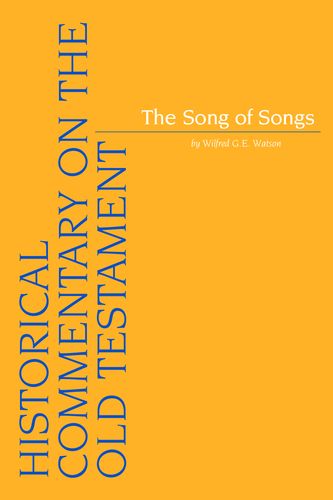
The Song of Songs contains a very high number of rare Hebrew words and expressions, some of which are unique twists on well-established forms, and these need to be understood before any attempt is made at deciphering the meaning of the book. In many cases there is no clear-cut solution, so the reader is presented with a series of choices. The other focus is on similar compositions from Egypt – its well-known and extensive love poetry – as well as from Anatolia, Mesopotamia, Syria and elsewhere, which supply an invaluable cultural background. Particular attention is paid to poetic aspects, including comparison with ancient Near Eastern verse patterns. In line with the rest of the series, account is also taken of the many approaches adopted by previous interpreters.
The Song of Songs remains one of the most enigmatic and difficult books to understand. In addition, the text has been fluid, as shown by the Qumran scrolls, although it has reached us in a fairly stable form. There are two main focal points in this commentary. One is language, using comparative Semitics as well as reference to more remote cognates in other languages. The Song of Songs contains a very high number of rare Hebrew words and expressions, some of which are unique twists on well-established forms, and these need to be understood before any attempt is made at deciphering the meaning of the book. In many cases there is no clear-cut solution, so the reader is presented with a series of choices. The other focus is on similar compositions from Egypt – its well-known and extensive love poetry – as well as from Anatolia, Mesopotamia, Syria and elsewhere, which supply an invaluable cultural background. Particular attention is paid to poetic aspects, including comparison with ancient Near Eastern verse patterns. In line with the rest of the series, account is also taken of the many approaches adopted by previous interpreters. The illustrations, black and white versions of original watercolours, help to give this commentary a contemporary appeal.
- By (author) W.G.E. Watson
Other Titles in this Series












Similar Books





 Athanasius of Alexandria, Epistula ad episcopos Aegypti et Libyae
Old Slavonic Version and English Translation
Volume 261



 Connecting the Dots: Counting, Writing, and the Beginnings of Civilization
The Secret Lives of Clay Tokens: A Memoir
 Contesting Labeled Identities
The Sociology of Gentilics in Biblical and Northwest Semitic Literature

 Curating the Prehistoric Past
Studies on West Asian Archaeology and Beyond in Honour of Yoshihiro Nishiaki
 Cyril of Alexandria’s Christological Exegesis
Explorations of Partitive Exegesis in the Dialogues on the Trinity
Volume 70


 Epiphanies of the Divine in the Septuagint and the New Testament
Fifth International Symposium of the Corpus Judaeo-Hellenisticum Novi Testamenti (CJHNT), 14-17 May 2015, Nottingham


 Exploring Gender Dynamics across the Ancient Near East
Collected Essays of Gender and Methodology in the Ancient Near East (GeMANE) 4 and 5
Volume 7
 Extracanonical Traditions and the Holy Land
Texts, Rituals, and Material Culture in Late Antique Palestine

 From Joseph to Jesus
The Joseph Narrative as a Compositional Template from Old Greek Esther to the Gospel of Luke
Volume 125


 Ḫattušaš utnē išḫameški
Hittite and Other Ancient Near Eastern Studies Presented to Piotr Taracha on the Occasion of His 65th Birthday





