
Studies on the History of the Reformation in Hungary and Transylvania
By (author) Katalin Péter Edited by Gabriella Erdélyi Series edited by Herman J. Selderhuis Associate editor Günter Frank Associate editor Barbara Mahlmann-Bauer Associate editor Johannes Schilling Associate editor Günther Wassilowsky Associate editor Siegrid Westphal Associate editor Tarald Rasmussen Associate editor Mathijs Lamberigts Associate editor Bruce Gordon Associate editor David M. Whitford Associate editor Zsombor Tóth
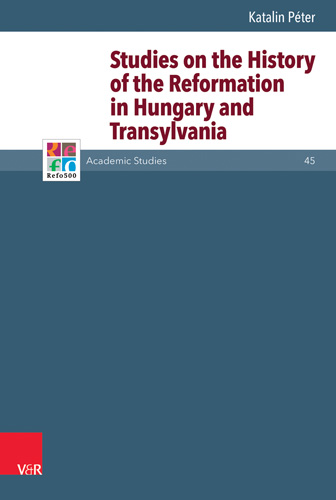
Hardback (Published)
(October 2018)
ISBN: 9783525552711
6.34 x 9.33 inches
Price: $125.00
In stock
A bottom-up examination of religious change in Hungarian Reformation
Katalin Peter offers is a vigorous and stimulating reassessment of the history of the Protestant Reformation in Hungary. The Reformation has traditionally been explained in terms of theology, the corruption of the church, and the roles of princes. Katalin Peter shifts the context of study of the Reformation in Hungary to a bottom-up examination of the social dynamics of religious change, producing a lively narrative of the experiences and reactions of contemporary actors — including rural town and village communities, local priests and landlords — to evangelical ideas. Through a close reading of church visitation records, common men and women emerge on the pages of the book both as the agents of religious change and as the defenders of the old faith, while local priests, as Peter, had to adapt to lay demands. A comparative analysis of the position and actions of landlords as church patrons in all three parts of contemporary Hungary — the kingdom under Habsburg rule, the Ottoman-vassal Principality of Transylvania, and Ottoman Hungary — leads to the conclusion that patrons did not interfere in local religious change, since this change did not interfere with the distribution of power. In addition to this radically new narrative of the social dynamics of the early Reformation in Hungary, Peter engages in the long-standing debates concerning the roles of the Protestant Reformation in intellectual culture, and she illuminates the scopes and limits of the confessional cultures that emerged in its wake. The book brings together a coherent body of work that began to be published in the 1990s and until now has only been available in Hungarian.
- By (author) Katalin Péter
- Edited by Gabriella Erdélyi
- Series edited by Herman J. Selderhuis
- Associate editor Günter Frank
- Associate editor Barbara Mahlmann-Bauer
- Associate editor Johannes Schilling
- Associate editor Günther Wassilowsky
- Associate editor Siegrid Westphal
- Associate editor Tarald Rasmussen
- Associate editor Mathijs Lamberigts
- Associate editor Bruce Gordon
- Associate editor David M. Whitford
- Associate editor Zsombor Tóth
Other Titles in this Series


 ‘Church’ at the Time of the Reformation
Invisible Community, Visible Parish, Confession, Building …?




 On Becoming a Theologian of the Cross
Revisiting Luther’s theologus crucis from the Heidelberg Disputation to the Genesis Lectures
 Constantino de la Fuente (San Clemente, 1502–Seville, 1560)
From acclaimed cathedral preacher to condemned "Lutheran" heretic
 Arts, Portraits and Representation in the Reformation Era
Proceedings of the Fourth Reformation Research Consortium Conference


 Reformation und Konfessionsbildung in Speyer
Von konfessioneller Unentschiedenheit zum nonkonkordistischen Luthertum im Spannungsfeld von Reichspolitik und bürgerlichem Handeln. Mit Edition der archivalischen Quellen
 Lutheran Theology and the shaping of society: The Danish Monarchy as Example
The Danish Monarchy as Example

 Beyond Devotion
Religious and Literary Communities in the 16th and 17th Century Polish-Lithuanian Commonwealth. Texts and Contexts


 Anton Engelbrecht 1487–1556
Eine Biografie und eine vollständige Edition der Acten des sunderlichen sinodums die oberkeit belangend (1533)




Similar Books

 A Companion to Christianity and Sport in Europe and North America (19th-21st centuries)
Volume 1: Western and Eastern Europe
 A Connecting Polemic in the Medieval Mediterranean
The Correspondence of Leo III and ʿUmar II
Volume 6





 Ars Prophetica
Theology in the Poetry of Twentieth-Century Hebrew Poets Avraham Halfi, Shin Shalom, Amir Gilboa, and T. Carmi
 As Messianism Turns to Heresy
The Regenstein Chair Lectures On Lurianic Kabbalah and Shabbatai Tzevi at Hebrew Union College - Cincinnati
 Balthasar Caymox of Nuremberg
Early Modern German Print Publishers: Popular Prints of the Seventeenth Century


 Beyond Sovereign Courts
Agents and Practices in Early Modern Spanish and Habsburg Diplomacy
Volume 3


 Circulation, Use, Impact
The Consumption of Architectural Books in the Early Modern Eastern Adriatic
Volume 1



 Councils, Conflicts, Correspondence
Urban Diplomacy in Reval (Tallinn) and Lübeck (c. 1470–1570)
Volume 67
 Creating the Woman in Antiquity
Proceedings of the 16th Melammu Workshop, Innsbruck, 2–3 June 2022
Volume 13
 Cultic Kisses
Fruitful Encounters Between Deities and Humans. Festschrift for Angelika Berlejung on the Occasion of Her 65th Birthday
 De/colonizing Theologies
Glocal Histories, Contemporary Challenges, Theoretical Reflections
Volume 4

 Drunk the Potion, No Whit Charmed
The Doctrine of Pure and Perfect Souls from Iamblichus to Damascius

